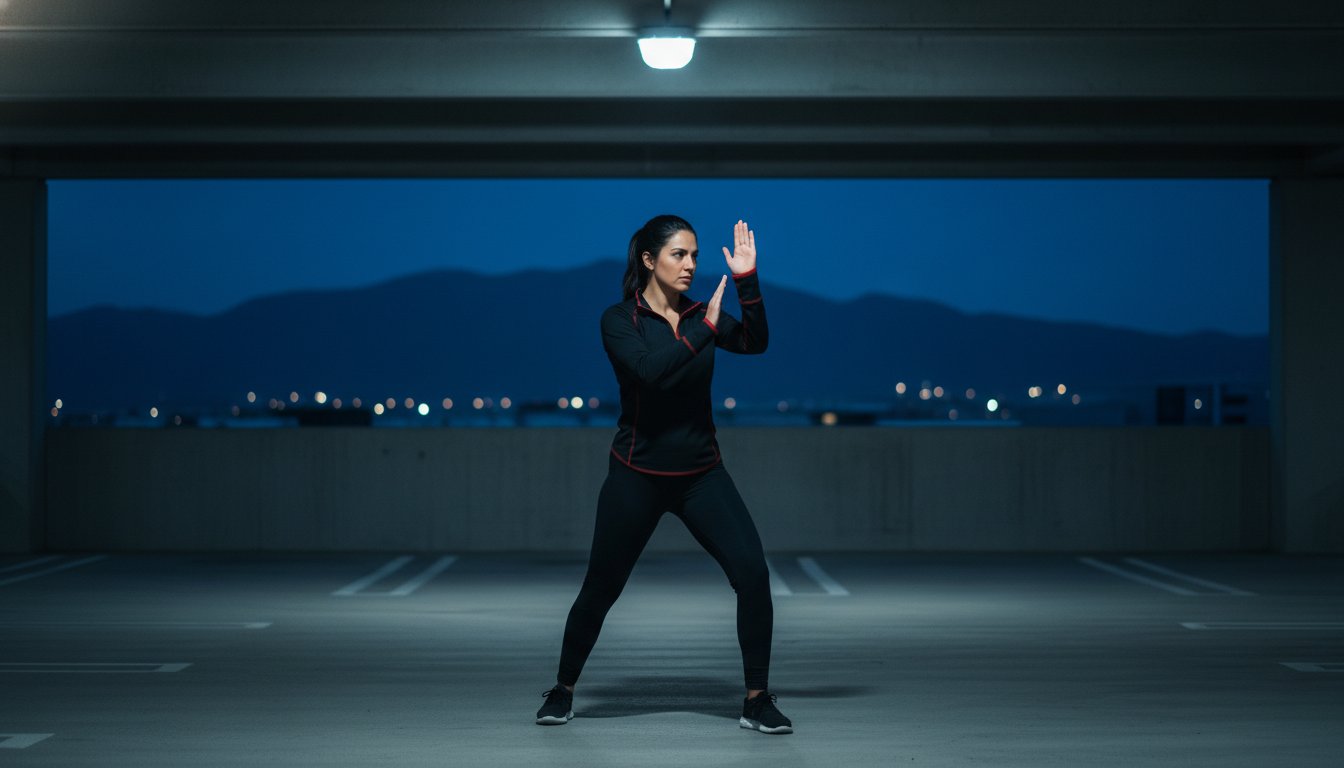
What if the most effective way to protect your family has nothing to do with a black belt? Many people believe they need years of elite training to stay safe. That’s a myth. Real safety starts with a simple shift in how you see the world. If you’re searching for self defense for beginners, you’ve likely felt that knot of vulnerability while walking to your car at night. You might feel intimidated by aggressive gym cultures or confused by the mountain of conflicting advice online. We understand that frustration. You want to be prepared, not a professional fighter.
You deserve to walk with your head up and your eyes open. This guide is your roadmap to total confidence in 2026. We’ll help you master the essential mindset and physical techniques to keep you and your loved ones secure. We are diving into the 90 percent of prevention that stops trouble before it starts. Then, we’ll cover the 10 percent of physical action that finishes it. We’re breaking down simple, high-percentage moves that actually work regardless of your fitness level. It’s time to trade fear for a functional plan.
Key Takeaways
- Shift your focus from fighting to prevention. Learn why situational awareness is your most powerful weapon in any environment.
- Master high-impact responses that work under stress. This guide simplifies self defense for beginners by targeting the body’s most vulnerable points.
- Choose a system built for the street, not the trophy case. Discover why Krav Maga handles real-world chaos better than traditional sports.
- Move beyond YouTube tutorials. Real safety requires hands-on training and pressure testing to ensure your moves work when it matters most.
- Break through the intimidation barrier. Find out exactly how to prepare for your first session and what to bring to the mat.
The Beginner Mindset: Why Self-Defense Starts Before the Fight
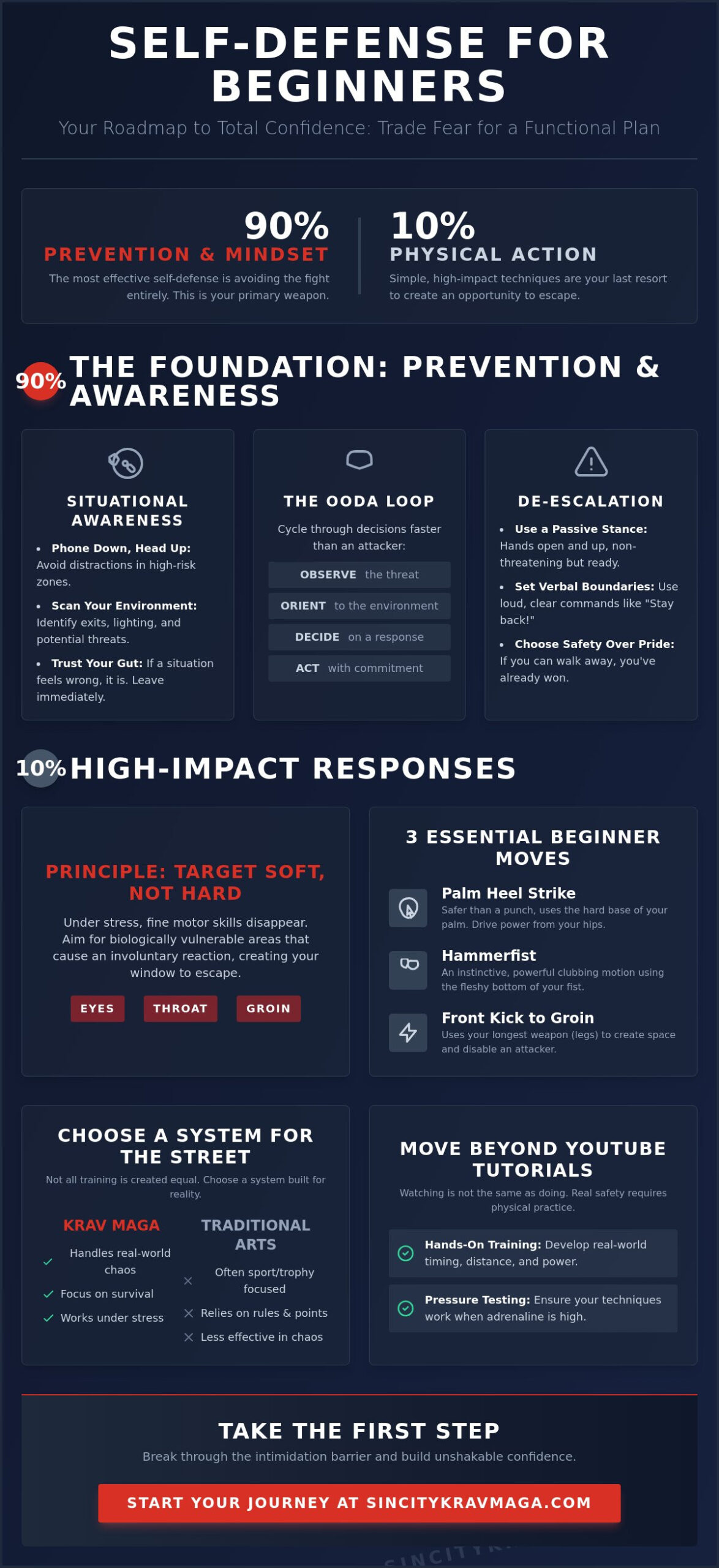
The best self-defense is never having to fight. It’s a simple truth. If you avoid the conflict, you’ve already won. Real-world safety isn’t about flashy kicks or cinematic choreography. It’s about awareness. Most predators aren’t looking for a challenge. They are looking for an easy target. They want someone distracted, isolated, or unaware. By changing your mindset, you stop being a target before a single word is spoken. This is the foundation of self defense for beginners.
Understanding your legal right of self-defense starts with the concept of the OODA Loop. Developed by military strategist John Boyd, it stands for Observe, Orient, Decide, and Act. In a crisis, your brain must process information fast. You observe a threat. You orient yourself to the environment. You decide on a response. Then you act. Training helps you cycle through this loop faster than your attacker. It gives you the edge. But this edge requires humility. At our gym, we teach “No Ego” training. It takes more strength to de-escalate a situation than to escalate it. Humility is your first line of protection.
To better understand this concept, watch this helpful video:
Situational Awareness in Las Vegas
Living in a busy city like Las Vegas means constant stimulation. Whether you’re at a crowded venue in Northwest Las Vegas or a local park, you must scan your environment. Don’t just look; see. Identify the exits. Know where the light is. We follow the “Phone Down, Head Up” rule. Parking lots and public transit are high-risk zones for those buried in their screens. Most importantly, trust your gut. If a situation feels wrong, it is wrong. Your subconscious picks up on micro-signals of danger before your conscious mind can name them. Listen to that voice.
De-Escalation: The Art of Talking Your Way Out
If conflict finds you, your voice is your first weapon. Use a passive stance. Keep your hands up and open near your chest. This looks non-threatening to bystanders but keeps your hands ready to protect your face. Set clear verbal boundaries. Use loud, short commands like “Stay back” or “I don’t want to fight.” This draws attention and creates space. You must know when to walk away. If you can leave, leave. Standing your ground is a last resort, not a first choice. Effective self defense for beginners means having the discipline to choose safety over pride every single time.
5 Essential Self-Defense Moves Every Beginner Should Master
While mindset is your first shield, physical tools are your final insurance policy. When adrenaline hits, your fine motor skills vanish. You won’t remember a twelve-step wrist lock or complex choreography. You need high-percentage moves that work when your heart is pounding. This is the reality of self defense for beginners. We focus on simple, violent, and effective responses. Your goal isn’t to win a trophy; it’s to get home safe. That requires tools that function under extreme stress.
Speed and target selection matter most. Don’t waste energy on “hard” targets like the chest or shoulders. Aim for the “soft” targets: the eyes, throat, and groin. These areas are biologically vulnerable. No amount of muscle can tough out a strike to the windpipe or a thumb to the eye. Impacting these zones causes an involuntary flinch response. That is your window to escape. Always remember the principle of recoil. Hit and move. Never stay engaged longer than necessary.
The Palm Heel Strike and Hammerfist
Closed fists often lead to broken hands. The small bones in your knuckles are fragile compared to a human skull. Use the palm heel strike instead. Keep your fingers curled and strike with the hard base of your palm. Drive the power from your hips, not just your shoulder. The hammerfist is another essential tool. It uses the fleshy bottom of your fist in a natural, clubbing motion. It’s instinctive. It’s powerful. It’s hard to stop. Practice these until the movement feels like second nature.
The Front Kick to the Groin
Your legs are your longest weapons. Use them to keep an attacker at bay. The front kick to the groin is a classic for a reason. It is fast and difficult to see coming. Strike with the top of your foot or your shin. Don’t aim high. Keep your center of gravity low and strike through the target. Immediately recoil your leg. If you leave your foot out there, you can be grabbed. Hit, reset, and look for your exit.
Escaping Common Grabs: Wrists and Bearhugs
If someone grabs your wrist, don’t play tug-of-war. You will lose against a larger opponent. Instead, find the “weak link.” Every grip is weakest where the thumb and fingers meet. Rotate your arm toward that gap and pull. Use your whole body weight to break the seal. In a bearhug from behind, drop your weight immediately. Become heavy. Use your elbows to hammer the ribs or your head to strike back. Create enough pain to force a release.
These moves must be practiced until they are reflexive. Reading about them is the first step, but training with a partner at Sin City Krav Maga & Fitness ensures you can execute them under pressure. Don’t just learn the move. Own the move.
Krav Maga vs. Traditional Martial Arts: Choosing Your Path
Not all training is created equal. Traditional martial arts like Karate, Taekwondo, or Kung Fu often prioritize aesthetics, history, and “form.” They are excellent for building discipline and physical fitness. However, they aren’t always designed for a dark parking lot at 2 AM. Krav Maga is different. It was born in real conflict. It doesn’t care about “form” or looking pretty. It cares about efficiency. This is a critical distinction for anyone starting self defense for beginners. You need a system that assumes the other person is bigger, faster, and willing to cheat. Krav Maga provides that tactical edge.
While Krav Maga handles the initial explosion of violence, Brazilian Jiu-Jitsu (BJJ) solves the problem of the ground. Statistics often suggest that many physical altercations end up on the pavement. BJJ teaches you how to survive when you are pinned or grabbed. It’s about leverage and technique over raw strength. A flexible training program combines these disciplines. It gives you a complete toolkit for any situation. You don’t just learn to strike. You learn to survive. This balanced approach ensures you aren’t helpless if the fight moves from your feet to the floor.
Real-World Scenarios vs. Point Sparring
In a sport-based martial art, there is a referee. There are weight classes. There are “start” and “stop” commands. The street has none of these luxuries. “Beautiful” moves with complex footwork often fail when adrenaline dumps into your system. You need tactical roots. You need to train for the chaos of multiple attackers and uneven terrain. Sport rules can create bad habits, like stopping after landing a single strike. In reality, you must continue until the threat is neutralized. To understand how this works in a local context, explore our guide on Krav Maga Las Vegas. It breaks down the transition from theory to practice.
The Importance of an Ego-Free Environment
Many people avoid martial arts because they fear a “tough guy” culture. They imagine a room full of intimidating experts looking for a punching bag. That environment kills progress. A beginner needs a supportive community. You need to feel safe enough to fail while you learn. Skill development happens faster when you aren’t worried about being bullied on the mat. We explicitly reject exclusionary attitudes. A warm, community-centric heart is what keeps students coming back. Finding the right culture is just as important as the style itself. Use our choosing a martial arts school checklist to vet your local options and find a place that treats you like a partner in the journey.
How to Train Effectively: Beyond YouTube Tutorials
Watching isn’t doing. A screen won’t grab your shirt. It won’t push you against a wall or scream in your face. Don’t fall for the “YouTube University” trap. Watching a video gives you information, but it doesn’t give you skill. Skill lives in the muscles. It lives in the nervous system. Real self defense for beginners happens on the mat, not on the couch. You need to feel the weight of a resisting partner to understand how leverage and timing actually function in a crisis. Without that physical feedback, your techniques are just theories.
Pressure testing is the only way to know if your training works. In a safe, controlled gym environment, we simulate the stress of a real encounter. We increase the intensity slowly. This helps you manage the adrenaline dump that happens when conflict starts. If you’ve never had someone try to stop your palm strike during practice, you won’t be ready when a real attacker does it. We bridge that gap. We turn theory into reality. This process builds the confidence that only comes from knowing you’ve done it before under pressure.
Build a habit that lasts. Don’t try to master everything in one week. That leads to burnout. Aim for consistency over intensity. Training twice a week keeps the moves fresh without taking over your entire life. It’s about life-changing transformations, not temporary fixes. Stay focused on the goal: keeping your family safe. When you train with a supportive community, the hard work feels like a shared mission rather than a chore. This support system is what keeps you showing up when motivation dips.
The Role of Private Instruction
Group classes are high-energy and inclusive. But sometimes you want a deeper dive. Private coaching provides personalized feedback that corrects dangerous technical errors before they become permanent habits. It’s the fastest way to build a solid foundation. You get one-on-one tactical coaching tailored to your specific body type and fitness level. Explore the benefits of private self defense lessons in Las Vegas to accelerate your progress and sharpen your skills.
Training on Your Own Terms
Training should be a partner in your journey, not a burden on your bank account. Avoid long-term binding contracts. Your needs might change. Your schedule might shift. We advocate for no contract martial arts in Las Vegas to give you the freedom to train on your terms. This transparency builds trust. It ensures you are here because you want to be, not because a legal document forced you. You can even integrate simple drills into your regular fitness routine to keep your reflexes sharp between classes.
Ready to move beyond the screen? Start your beginner journey at Sin City Krav Maga & Fitness today and see what real, practical training feels like.
Taking the First Step: Your Beginner Journey at Sin City Krav Maga & Fitness
Everyone is nervous during their first class. It’s a natural reaction to the unknown. But at Sin City Krav Maga & Fitness, the intimidation stops at the door. Starting self defense for beginners isn’t about being the toughest person in the room. It’s about being better than you were yesterday. Our community is built on mutual respect and shared growth. You aren’t just another member; you’re a partner in training. We’ve built a space where the standards are high but the support system is even higher.
Brock and Camilla lead our team with a pragmatic approach. They combine high-intensity tactical expertise with a genuine, personal touch. They know our students by name. This isn’t a corporate gym chain where you’re just a number on a spreadsheet. It’s a localized, family-oriented environment. We focus on life-changing transformations that go far beyond physical fitness. You get the confidence of seasoned experts with the sincerity of a mentor who is personally invested in your success. It feels like a firm handshake and a direct conversation with a coach every time you walk in.
Preparation is simple. You don’t need fancy gear or a background in athletics to start. Wear comfortable gym clothes that allow you to move freely. Bring a water bottle and a positive attitude. We handle the rest. We’ve eliminated the traditional barriers to entry. No long-term binding contracts. No exclusionary attitudes. Just practical training for real people who want to stay safe. This directness eliminates ambiguity. You’ll know exactly what to expect from the moment you arrive.
What to Expect in a Beginner Class
Every session follows a logical, energetic flow. We start with a functional warm-up to prepare your body for movement. Then, we move into specific technique instruction. You’ll practice moves in a controlled, supportive environment with partners who want you to succeed. Finally, we introduce light stress drills to help you apply what you’ve learned. You’ll meet our instructors and experience our culture firsthand. For a deeper look at our curriculum, read our full self defense classes Las Vegas guide.
Joining the Community
Training here is about more than just fighting. It’s about building discipline, resilience, and local friendships. Our Northwest Las Vegas location is a trusted fixture of the neighborhood. We take pride in serving our local community and helping our neighbors feel secure in public spaces. Whether you’re interested in Krav Maga, Brazilian Jiu-Jitsu, or Women’s Self Defense, you’ll find a place here. Ready to see the difference for yourself? Book your Krav Maga trial class in Las Vegas today. Take the first step toward a safer, more confident future.
Start Your Journey Toward Total Confidence
Safety is a choice you make every day. You now have the roadmap to protect yourself and your family. Real safety isn’t about complex choreography or years of elite training. It’s about a simple, proactive mindset and a handful of moves that actually work when the pressure is on. By understanding the psychology of an attacker and mastering high-percentage strikes, you’ve already taken the most important steps in self defense for beginners. You’ve learned that prevention is your primary weapon, while simple, violent action is your insurance policy.
Don’t leave your protection to chance or a YouTube video. You need a supportive community that prioritizes your growth over ego. We’ve been a trusted part of the Northwest Las Vegas community since 2010. Brock and Camilla are personally invested in your success. They provide the expert guidance you need to turn these concepts into instinctive reflexes. We keep it simple. No long-term contracts required. You have the freedom to train on your own terms. It’s time to trade vulnerability for a functional plan that provides genuine peace of mind.
Join our no-ego community and start your journey with a trial class today!
Walk with your head up. Stay alert. We are ready when you are.
Frequently Asked Questions
Is self-defense hard to learn for someone with no experience?
No, self-defense is designed specifically for people with zero background. Systems like Krav Maga build on your natural flinch response rather than complex, artistic forms. You learn simple, direct moves that work regardless of your starting point. Our instructors break every movement down into manageable steps. You’ll feel more capable and aware after your very first class.
Do I need to be in good shape to start self-defense classes?
You don’t need to be an athlete to begin your journey. You get in shape through the training itself. We welcome all fitness levels and ages because real-world safety doesn’t discriminate. The moves we teach rely on leverage and target selection rather than raw athletic power. If you can move, you can learn to protect yourself and your family.
What is the best martial art for a beginner to learn for safety?
Krav Maga is widely considered the most practical choice for real-world safety. It isn’t a sport with rules or referees; it’s a tactical system designed to end a threat quickly so you can escape. Brazilian Jiu-Jitsu is also vital for understanding how to survive if a fight reaches the ground. This holistic approach is the gold standard for self defense for beginners.
How long does it take to become proficient in basic self-defense?
You can learn the most critical, high-percentage moves in just a few months of consistent training. While mastery takes time, basic proficiency happens faster than you might think. Training twice a week keeps your reflexes sharp and your muscle memory fresh. Most students report a significant shift in their confidence and situational awareness within their first ninety days.
Are self-defense classes safe for women and smaller individuals?
Yes, these classes are specifically designed to help smaller individuals overcome larger, stronger attackers. We teach you how to use an attacker’s size against them through leverage and striking biologically vulnerable points. Our ego-free environment ensures everyone trains safely and respectfully. Women often find that our supportive community provides a unique sense of empowerment and security.
Can I learn effective self-defense at home using online videos?
You can learn basic concepts at home, but you can’t build reflexes without a resisting partner. Real safety requires pressure testing and immediate feedback from a qualified instructor. A screen can’t grab your wrist or correct your stance. Training in person ensures you are doing the moves safely and effectively. It’s the difference between knowing a theory and having a skill.
What should I look for in a local Las Vegas self-defense gym?
Look for a gym that prioritizes a supportive culture and transparent business practices. Avoid facilities that demand long-term binding contracts. In Las Vegas, you want a place that feels like a neighborhood fixture and values your personal growth. Check the instructors’ backgrounds to ensure they offer a welcoming environment. A good gym should feel like a partnership in your safety journey.
How much do beginner self-defense classes typically cost?
Costs vary depending on the specific program and how often you choose to train. Most reputable gyms offer introductory packages or trial classes so you can experience the training before making a decision. In the self-defense industry, monthly rates are generally comparable to high-quality fitness memberships. Look for a facility that offers a clear trial period to ensure the culture is a good fit for you.
Leave a Reply