Most martial arts schools are selling you a membership, not a skill set. It’s a harsh reality in an industry now worth over $21 billion. When you’re choosing a martial arts school, you want real-world confidence. You don’t want a long-term contract or a gym full of egos looking for their next target. You deserve a training environment that builds you up without breaking your spirit. It’s natural to feel anxious about getting injured or confused about whether a style will actually work when it matters most.
This guide will show you how to cut through the marketing noise. You’ll learn to find a school that delivers practical skills in a supportive, ego-free environment. We will walk through the essential 2026 evaluation checklist. We’ll cover everything from spotting “McDojos” to ensuring your training offers the transparent membership and community focus you need to reach your goals. It’s time to find a training partner who is genuinely invested in your personal growth.
Key Takeaways
- Identify your “why” before you step on the mat. Matching the school’s focus to your personal goals for safety or fitness is the first step to success.
- Learn the specific red flags to watch for when choosing a martial arts school. Avoid predatory long-term contracts and schools where belts are bought rather than earned.
- Verify real-world efficacy through stress testing. Look for programs that practice techniques against resisting partners to ensure your skills actually work.
- Apply the “Firm Handshake” rule. This simple test helps you find an ego-free community that prioritizes your safety and inclusion from day one.
- Master the trial class evaluation. Use our checklist to assess instructor pedagogy and student diversity before you make any commitment.
Defining Your Goals: Why the School Matters More Than the Style
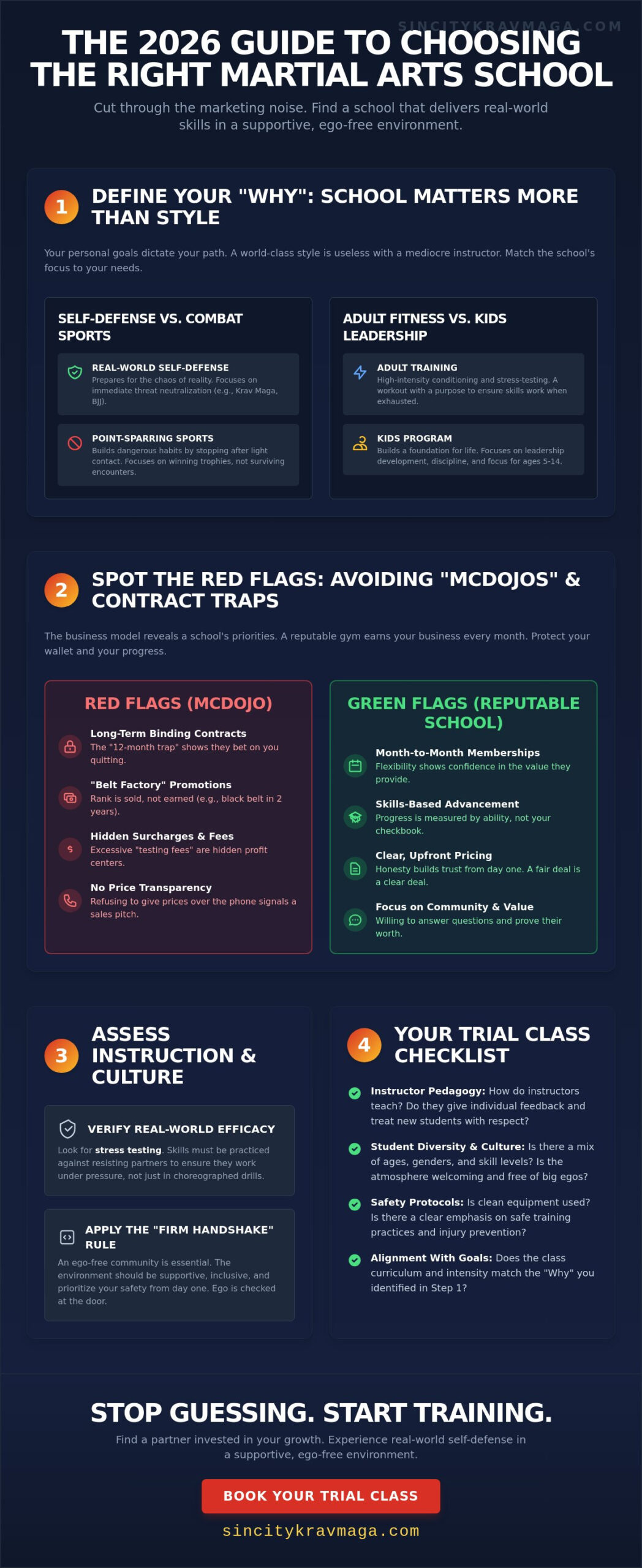
Stop searching for the “perfect” style. Start searching for the right environment. Your goals dictate your path. Are you looking for elite fitness, real-world safety, or a competitive outlet? When you’re choosing a martial arts school, start with brutal honesty about your “Why.” If you want to protect your family, a school focused on winning trophies won’t help you. You need substance over flashy marketing. You need a coach who understands your specific needs.
A world-class style taught by a mediocre instructor is a waste of time. A great mentor transforms any curriculum into a life-changing experience. Understanding what to expect from a martial arts school involves looking past the logos on the wall. It’s about the pedagogy. It’s about how the instructors treat the newest person on the mat. Look for a place where ego is checked at the door and safety is the highest priority.
To better understand how to evaluate your training options, watch this helpful video:
Self-Defense vs. Combat Sports
Winning a plastic trophy is one thing. Getting home safe is another. Traditional point-sparring can build dangerous habits. It teaches you to stop after a light touch or wait for a referee to reset the action. In the real world, the threat doesn’t stop. Krav Maga focuses on immediate, aggressive responses to neutralize threats. Brazilian Jiu-Jitsu (BJJ) gives you the tools to survive if a fight goes to the ground. Both systems prioritize practical safety over sportsmanship. Choose a curriculum that prepares you for the chaos of reality.
Adult Fitness vs. Kids Leadership
Training shouldn’t just be for the young. Adult classes must focus on high-intensity conditioning and stress-testing. You need to know your skills work when you’re exhausted. For children ages 5-14, the focus shifts. We look for leadership development, focus, and discipline. A family-friendly environment ensures everyone grows at their own pace. Adult training should feel like a workout with a purpose. Kids training should feel like a foundation for life. Both require age-appropriate instruction that respects the student’s stage of development.
Choosing a martial arts school in Las Vegas also requires a reality check on traffic. If your gym is a forty-minute crawl across town, you won’t show up. Consistency is the engine of progress. Find a location that integrates into your daily routine. Your training should be a highlight of your day, not a logistical nightmare. Look for a school that offers flexible schedules to match your lifestyle. Consistency beats intensity every single time.
The ‘Red Flag’ Checklist: Avoiding McDojos and Contract Traps
Protect your wallet and your progress. Many schools prioritize their bottom line over your growth. When you’re choosing a martial arts school, the business model tells you everything you need to know. Avoid the 12-month trap. Schools that force long-term binding contracts are betting on you quitting. They want your money, not your success. A reputable gym earns your business every single month. If they don’t offer flexibility, walk away.
Watch out for “belt factories.” This is a classic form of martial arts fraud where rank is sold, not earned. If every student has a black belt after only two years, the standards are likely low. Ask about testing fees before you sign up. Some schools charge significant surcharges just to change the color of your belt. These fees are hidden profit centers. Your progress should be measured by your ability to defend yourself, not by the size of your checkbook.
The Business of Martial Arts
Transparency is non-negotiable. If a school won’t give you pricing over the phone, they’re preparing for a high-pressure sales pitch. Month-to-month memberships for no contract martial arts in Las Vegas protect the student. They keep the instructors motivated to provide value every class. You can find more details in our guide on no contract martial arts in Las Vegas. A fair deal is always a clear deal. Don’t let marketing noise drown out your intuition.
Safety and Hygiene Standards
Look at the mats. Are they cleaned daily or do they smell of old sweat? Hygiene reflects the school’s respect for its students. Staph infections and ringworm are real risks in poorly maintained facilities. Beyond cleanliness, look at the injury rates. A gym that focuses on “toughing it out” instead of training for longevity will leave you broken. Instructors should be first aid certified and have clear safety protocols for every drill. At Sin City Krav Maga & Fitness, we believe safety is the foundation of all effective training.
Finally, perform a quick ego check. Is the lead instructor a mentor or a dictator? A mentor answers questions and remains accessible to everyone. A dictator demands blind obedience and creates an exclusionary atmosphere. You’re paying for expert instruction, not to join a cult. A healthy community is built on mutual respect and shared goals. If the vibe feels off or intimidating during your first visit, it probably is. Trust your gut and keep looking for a place that feels like a partnership.
Instruction Quality: Assessing Real-World Efficacy
Don’t get blinded by trophies. A world champion isn’t always a world-class teacher. When you’re choosing a martial arts school, prioritize pedagogy over pedigree. You need an instructor who can break down complex movements for a beginner. Lineage is a great marketing tool. It doesn’t guarantee you’ll learn effectively. Look for teachers who focus on your progress, not their own highlight reel. They should be able to explain the logic behind every move. If they can’t explain the “why,” they haven’t mastered the craft of teaching.
Efficacy requires resistance. Real-world skills aren’t built in a vacuum. Ask the school if they practice techniques against resisting partners. This is called stress testing. Without it, you’re just learning a choreographed dance. You need to know how a technique feels when someone is actively trying to stop you. A logical class structure is also vital. It should move from a functional warmup to technical drills and finally to controlled application. This progression builds muscle memory and confidence safely.
Real-World Krav Maga and BJJ
Self-defense is about more than just physical strikes. Effective Krav Maga in Las Vegas must include situational awareness. You need to spot trouble before it starts. In Brazilian Jiu-Jitsu (BJJ), the focus should be on survival and submissions. Many sport-centric gyms teach students to “stall” for points. That habit will get you hurt in a real fight. If you want to accelerate your growth, consider private self defense lessons in Las Vegas. One-on-one sessions allow for immediate correction and a customized technical path that fits your specific body type and goals.
Instructor Accessibility
Check who is actually on the mats. At a boutique school, you should see the lead instructors like Brock and Camilla teaching daily. They shouldn’t be hidden in a back office doing paperwork. Accessibility matters. Watch how they handle a student who is struggling. A great mentor adjusts their teaching style to fit the individual. They don’t just yell louder. They find a new way to explain the concept until it clicks. This personal investment is what separates a factory from a community.
Observe the community vibe. Senior students should be assets, not obstacles. In a healthy environment, the higher belts help the beginners. They don’t “hunt” them for easy wins. This culture of mutual growth is a hallmark of a high-quality facility. When choosing a martial arts school, look for a room where everyone is invested in each other’s success. This is how you build real-world skills that last a lifetime. It’s about the people standing next to you on the mat.
The Culture Test: Finding an Ego-Free Community in Las Vegas
The first ten seconds inside a gym tell you more than any brochure. Pay attention to how you are greeted. We call this the “Firm Handshake” rule. A welcoming, professional greeting at the door signals a culture of respect. If you are ignored or treated like a number, the training will likely follow suit. When choosing a martial arts school, you are looking for a community, not just a place to sweat. The atmosphere should feel like a partnership from the moment you step inside.
Diversity on the mat is a vital health metric for any gym. Look around the room. A healthy school has students of all ages, genders, and fitness levels. If the class only consists of twenty-something “tough guys,” the culture probably prioritizes dominance over development. A supportive community thrives when everyone helps the person next to them. This support often extends beyond the mat. Students who grab coffee together or support each other’s local businesses create a resilient network. This is the “third place” you need for mental health and stress relief.
Local ownership creates accountability. In Northwest Las Vegas, having owners who live in the neighborhood changes the dynamic. They aren’t just running a business; they are building a local institution. They care about their reputation because they see you at the grocery store. This localized pride ensures the standards remain high and the environment stays professional. It’s a level of personal investment you won’t find in a corporate franchise.
Inclusive Training Environments
Safety starts with the environment. For many, starting women’s self defense in Las Vegas requires a space that feels safe and non-intimidating. A “No Ego” policy is essential here. This means senior students don’t use beginners as punching bags. It means the focus is on technical growth, not physical dominance. Community events like seminars or social mixers help foster this sense of belonging. When you feel included, you train harder and stay longer.
Supportive Fitness and Conditioning
Conditioning should be a tool for leadership, not a form of punishment. Check if the fitness portion of the class is encouraging. High-intensity training is necessary, but it should build you up. This is how combat fitness in Las Vegas develops character alongside muscle. You learn to push through limits while your teammates cheer you on. It transforms a simple workout into a leadership exercise. Choosing a martial arts school means finding a place where you leave feeling empowered rather than defeated.
Ready to experience a supportive, ego-free environment for yourself? Join our community at Sin City Krav Maga & Fitness and start your journey today.
Taking the Leap: Your First Trial Class Checklist
You’ve narrowed down your list. Now it’s time to see the reality on the mats. This is the final, most critical step in choosing a martial arts school. Walk in with your eyes open. Don’t just listen to the sales pitch. Watch a class in action before you ever put on a uniform. Observe how students interact during the toughest parts of the workout. Is there mutual respect? Or is it a room full of individuals trying to prove something? The truth is in the training, not the marketing.
A professional facility treats your first visit with care. Use this checklist to evaluate the school during your trial:
- The Intro Program: Ask if they have a dedicated path for beginners. You shouldn’t be thrown into a “shark tank” on day one. A structured start ensures you learn the basics safely.
- Gear Quality: Inspect the equipment. Are the kick pads and heavy bags well-maintained? Duct-taped gear is a sign of a school that cuts corners on your safety.
- Instructor Philosophy: Interview the teacher. Ask how they handle injuries and what their specific approach to real-world safety is. A mentor will have a clear, logical answer.
- The Greeting: Revisit the “Firm Handshake” rule. If the staff is too busy to acknowledge you, they’ll be too busy to coach you effectively.
What to Watch for During Training
Focus on the vibe of the room. Are students smiling while they sweat? This is the hallmark of a healthy community. It shows they enjoy the process of growth. Watch how the instructor handles a student who fails a technical drill. A great coach uses it as a teaching moment. They don’t use shame or ego to motivate. If you are looking at kids martial arts, safety protocols must be visible. Every drill should have a clear purpose and a safe exit. You want a school that builds confidence, not fear.
The Final Decision
Trust your gut. If the atmosphere feels off, it probably is. Don’t let a “limited time” discount pressure you into a long-term commitment. Compare the total value of the experience. This includes the quality of the coaching, the cleanliness of the mats, and the strength of the community. A low price is no bargain if the instruction is poor or the environment is toxic. Choosing a martial arts school is an investment in your safety and your future. Book your trial class. See if the school lives up to its “No Ego” promise. It’s time to stop thinking and start training.
Take Command of Your Personal Safety
You’ve done the research. You know how to spot the difference between a sport-centric gym and a real-world safety facility. You understand that the right environment matters more than the style alone. Choosing a martial arts school is a decision that impacts your confidence, your fitness, and your ability to protect what matters most. Don’t settle for a school that views you as a signed contract. Find a place where the standards for training are high but the encouragement and support system are even higher.
At Sin City Krav Maga & Fitness, we’ve built a community in Northwest Las Vegas that prioritizes your growth over our bottom line. You’ll find expert instruction from Brock and Camilla on the mats every single day. We don’t use long-term binding contracts because we believe in earning your trust through tangible results and a welcoming culture. It’s time to stop second-guessing and start training in a space designed for your personal success. Join our ego-free community with a trial class at Sin City Krav Maga & Fitness! We look forward to seeing you on the mat.
Frequently Asked Questions
What is the best age to start martial arts for kids?
Most children are ready to begin kids martial arts around age five. At this stage, the focus is on developing coordination, discipline, and listening skills. It’s about building a foundation for life, not just learning how to kick. Every child develops differently, so look for a program that offers age-appropriate instruction for the 5-14 age range.
How much do martial arts classes usually cost in Las Vegas?
Costs for training in Las Vegas depend on the school’s facility and the expertise of the instructors. When you are choosing a martial arts school, prioritize transparency over the lowest price. Ask about registration fees, testing surcharges, and mandatory gear costs upfront. A reputable gym will provide clear details without a high-pressure sales pitch.
Do I need to be in shape before I start self-defense classes?
You don’t need to be in shape to start. The training itself is what builds your conditioning and strength. Every expert on the mat started as a beginner who was just looking to improve. Our programs are designed to meet you where you are today. You’ll find that the community supports your progress at every fitness level.
What is the difference between Krav Maga and Brazilian Jiu-Jitsu?
Krav Maga is a tactical system focused on neutralizing threats quickly using striking and situational awareness. Brazilian Jiu-Jitsu (BJJ) is a grappling art that teaches you how to control and submit an opponent on the ground. Both are essential for real-world safety. Many students choose to train in both styles to become well-rounded.
How many times a week should a beginner train?
Beginners should aim to train two to three times per week. This frequency allows your body to recover while still building the necessary muscle memory. Consistency is the most important factor in your long-term success. As you get more comfortable on the mat, you can adjust your schedule to include more sessions or private self defense lessons in Las Vegas to accelerate your tactical development.
Are martial arts schools safe for women and beginners?
A high-quality school is safe for everyone. Look for an ego-free environment that specifically offers women’s self defense and intro programs for newcomers. Safety protocols should be the top priority in every drill. If the senior students are helping you learn rather than trying to dominate you, you’ve found the right place.
Should I choose a school with a long-term contract or month-to-month?
Always choose a no contract martial arts program in Las Vegas over a long-term binding contract. A gym should earn your business every month through high-quality instruction and a supportive community. Avoid schools that try to lock you into 12-month or 24-month commitments. Flexibility protects the student and keeps the instructors accountable to your goals.
What equipment do I need for my first martial arts class?
For your first class, all you need is comfortable athletic wear and a water bottle. Most schools will provide any specialized equipment you need for your trial. As you progress, you might need specific gear like a gi for BJJ or gloves for Krav Maga. Check with the instructors during your first visit to see what is required for their specific curriculum.
Leave a Reply