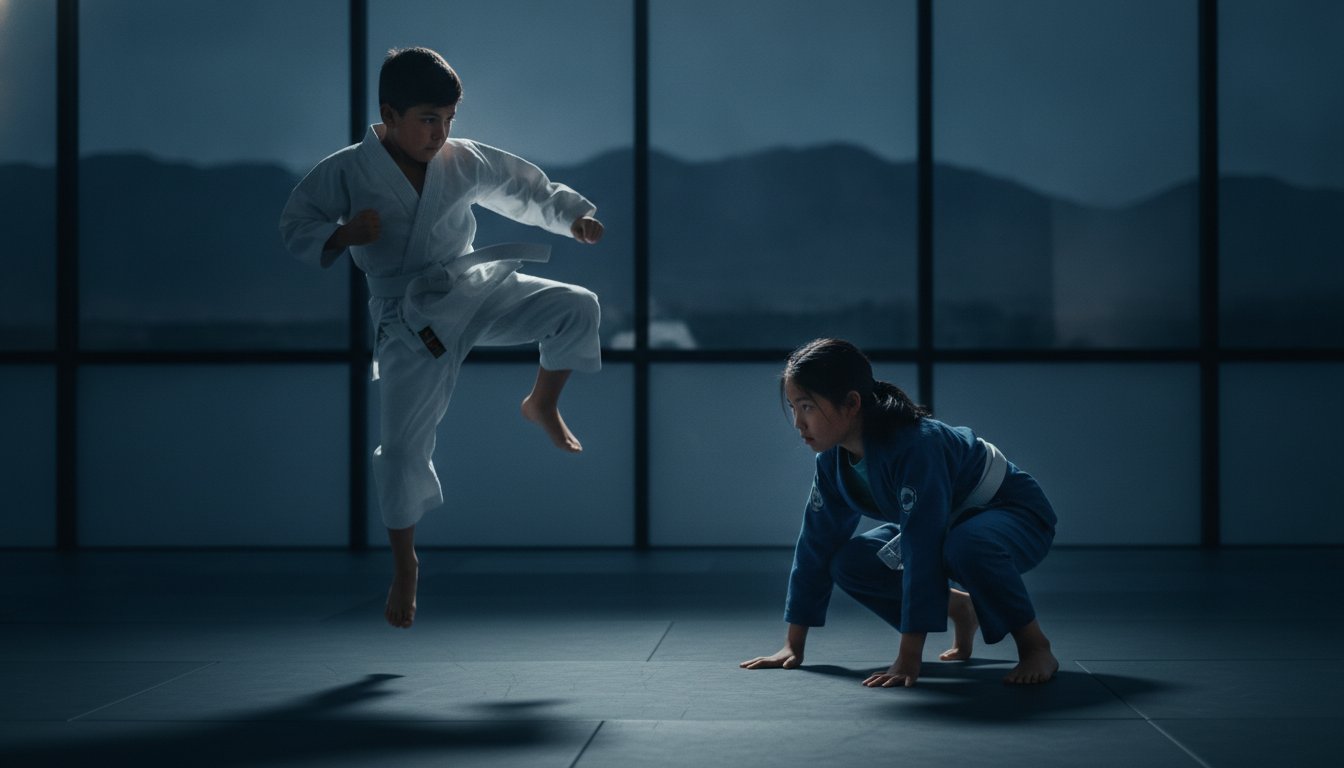
Tag: McDojo

  • Karate or BJJ for My Child? A Practical Comparison for 2026

    Karate or BJJ for My Child? A Practical Comparison for 2026

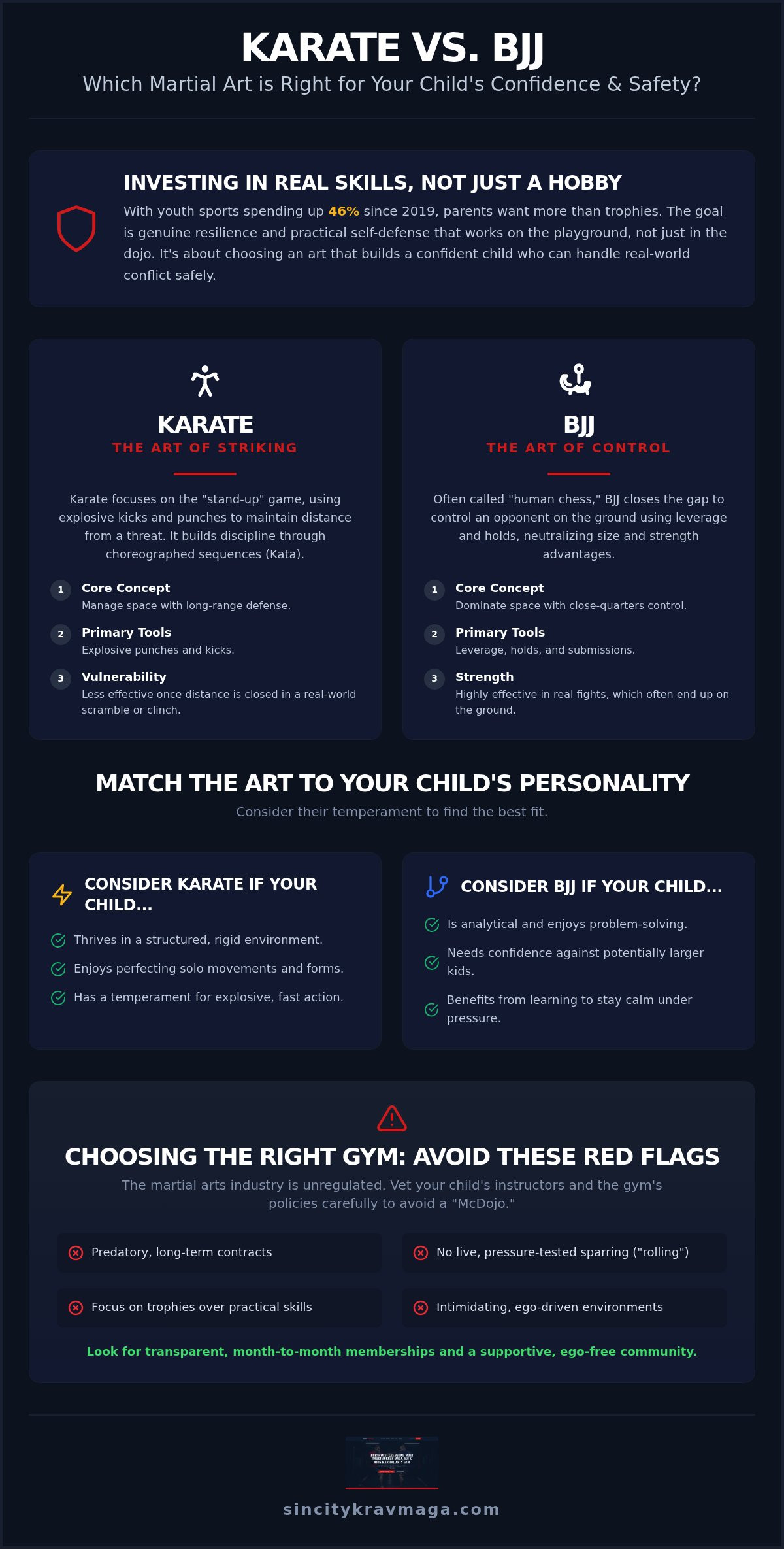
    What if the flashy high kicks you see in movies are the last thing your child needs to stop a playground bully? It’s a question we hear often from parents trying to decide between karate or bjj for my child. You want your kid to be safe. You want them to walk with their head held high. But with youth sports spending up 46 percent since 2019, you can’t afford to waste money on a “McDojo” that prioritizes long contracts over real progress.

    Choosing the right path shouldn’t feel like a gamble. We understand the confusion. You’re looking for a supportive community, not an intimidating ego-trip. This comparison will help you discover the key differences between Karate and BJJ to find the perfect martial arts fit for your child’s confidence and safety. We’ll break down the tactical “human chess” of grappling versus the traditional focus of striking. You’ll learn how to spot a gym that builds a confident child who can stand up for themselves while avoiding common traps in the unregulated martial arts industry.

    Key Takeaways

    • Understand the tactical shift from standing strikes to ground-based control, where the majority of real-world bullying scenarios actually take place.
    • Decide between karate or bjj for my child by matching their unique temperament to either explosive movement or the analytical “human chess” of grappling.
    • Learn how to spot “McDojos” and avoid predatory long-term contracts by prioritizing transparent, month-to-month membership models.
    • Discover why practical, pressure-tested self-defense skills build more genuine confidence than traditional point-sparring or choreographed forms.
    • Get a clear framework for vetting instructors in an unregulated industry to ensure your child trains in a safe, supportive, and ego-free environment.

    Karate or BJJ for My Child? The Parent’s Dilemma

    Choosing a martial art feels like a high-stakes decision. You aren’t just picking a weekend hobby; you’re choosing a safety net for your child’s future. The dilemma of karate or bjj for my child often starts with the color of the uniform, but it ends with their ability to handle a real conflict. Parents in 2026 are looking past the plastic trophies. They want functional skills that translate to the playground and beyond. They want a child who can stand their ground without becoming the aggressor. With average youth sports spending hitting over $1,000 per child, you need to know your investment builds genuine resilience.

    The fundamental split between these arts is simple: striking versus grappling. Karate focuses on the “stand-up” game. Brazilian Jiu-Jitsu takes the fight to the floor. Most schoolyard altercations don’t stay standing for long; they become messy scrambles. This reality is why modern training has shifted toward practical, pressure-tested techniques. Parents today prioritize “functional fitness” over “theoretical forms.” They want programs that offer a supportive community while teaching kids how to control a situation safely.

    The Appeal of Traditional Karate

    Traditional Karate offers a clear, visual path to discipline. Most parents grew up with the “Karate Kid” ideal, visualizing sharp punches and high kicks. It emphasizes individual precision through “Kata,” which are choreographed sequences of movements. This structured hierarchy builds respect for authority and personal focus. It’s a solid choice for kids who thrive in a rigid environment where they can perfect their posture and striking technique in a solo setting. The focus is on the “point” or the “strike,” emphasizing speed and standing defense.

    The Rise of Brazilian Jiu-Jitsu (BJJ)

    Many parents now choose Brazilian Jiu-Jitsu because it solves the problem of physical size. It’s often called “human chess” for kids. Instead of trading blows, students learn to use leverage and weight. Your child learns how to use an opponent’s momentum against them. The focus is entirely on ground-based defense. It moves away from “point scoring” and toward “controlling the situation.” Instructors like Brock and Camilla emphasize that BJJ is about safety through holds rather than impact. For those deciding on karate or bjj for my child, the appeal of BJJ lies in this analytical approach. It builds a quiet confidence that doesn’t require a single punch to be thrown.

    Understanding the Core Differences: Striking vs. Grappling

    Distance is the deciding factor in any physical conflict. In Karate, you stay away. You use long-range weapons like kicks and punches to keep a barrier between your child and a threat. In Brazilian Jiu-Jitsu, you close the gap. You move toward the conflict to neutralize it. This mechanical split changes how your child perceives a threat. One art teaches them to manage space; the other teaches them to dominate the space. Muscle memory is the body’s autopilot. When deciding on karate or bjj for my child, you must consider which autopilot you want them to develop.

    • Karate: Focuses on the “stand-up” game. It’s about explosive speed and maintaining a perimeter.
    • BJJ: Focuses on the “ground” game. It’s about connection, leverage, and finishing the fight safely.

    Karate: The Power of the Strike

    Karate emphasizes speed. It relies on explosive power from a distance. Students spend hours perfecting the “snap” of a punch or the reach of a kick. Sparring in traditional schools often stops the moment a strike connects. This builds great timing and reflexes. However, it creates a gap in muscle memory. If a bully grabs your child’s shirt or tackles them to the pavement, Karate’s primary tools are often neutralized. Most striking arts struggle once the distance is closed and the fight becomes a scramble. It’s a discipline of precision, but it can leave a child vulnerable in a clinch.

    BJJ: The Art of Control

    Brazilian Jiu-Jitsu works where most fights end up: the ground. It’s the “gentle art” because it lacks the concussive force of striking. No punches to the face. No broken noses in class. Instead, kids learn to handle larger, stronger opponents through leverage. They learn to breathe under pressure. This happens during “rolling,” which is live, controlled practice. Rolling builds a type of confidence that choreographed forms simply can’t match. It’s real. It’s practical. It’s the ultimate problem-solving tool for a smaller child.

    If you are still torn on karate or bjj for my child, consider the “human chess” aspect. BJJ requires deep thinking. It isn’t just about who is faster; it’s about who understands body mechanics better. Our Kids Martial Arts program in Northwest Las Vegas focuses on these ground-based realities for ages 5 to 14. Under the guidance of Brock and Camilla, students learn to react with calm precision. They don’t just learn a move; they learn how to apply it when someone is actually resisting. This builds a child who doesn’t panic when things get physical.
    Karate or BJJ for My Child? A Practical Comparison for 2026

    Practical Comparison: Which Martial Art Wins for Kids?

    A plastic trophy won’t help your child in a real conflict. When you weigh up karate or bjj for my child, you have to look at the physical reality of the playground. Most schoolyard fights don’t look like an Olympic sparring match. They’re messy. They’re frantic. Usually, they end up in a scramble on the ground. This is where the practical application of your child’s training is truly tested. You want a program that builds a kid who’s capable, not just someone who can perform a choreographed routine.

    Self-Defense and Bullying

    Real self-defense is about ending a conflict as quickly and safely as possible. Brazilian Jiu-Jitsu gives kids the tools to neutralize a threat without necessarily hurting the other person. They learn to use holds and leverage to pin an aggressor until help arrives. This is a massive psychological advantage. It allows for de-escalation rather than escalation. While Karate is effective for maintaining boundaries and “standing your ground,” it often relies on impact. When looking for kids martial arts las vegas, prioritize schools that teach your child how to handle the clinch and the ground. BJJ removes the fear of the unknown that comes when a fight gets close.

    Discipline and Focus

    Discipline looks different in every gym. In a traditional Karate school, it often manifests as silence, bowing, and rigid rituals. This is great for teaching respect for authority and order. However, BJJ offers a different kind of discipline: problem-solving under physical stress. It’s human chess. Your child has to think while someone is trying to control them. This is incredibly beneficial for kids with high energy or ADHD. It forces them to slow down, breathe, and find a logical way out of a difficult position. It isn’t just about following orders; it’s about developing an analytical mind that stays calm under pressure.

    Safety is also a major factor. Karate involves high-impact kicks and strikes, which carry a specific risk profile for growing joints. BJJ is a controlled, grappling-based art. There’s no head impact in training. The ego factor is also lower in gyms like ours in Northwest Las Vegas. Brock and Camilla focus on individual growth rather than collecting medals. A good program should feel like a supportive community. It shouldn’t be a factory for “McDojo” black belts. It should be a place where your child feels safe to fail, learn, and eventually, succeed.

    Decision Framework: Matching the Art to Your Child’s Personality

    Every kid is built differently. Some children are naturally methodical and quiet. Others are a ball of kinetic energy that never seems to stop. When you ask if you should choose karate or bjj for my child, you’re really asking which environment will help them grow into a confident adult. You need to look past the martial art and look at the person. A child’s temperament determines their long-term success. If the art doesn’t match their personality, they’ll burn out before they ever reach a blue belt.

    Sustainability matters. You want a path that leads to real resilience, not just a collection of participation trophies. Avoid corporate “belt factories” that hand out promotions just to keep the monthly checks clearing. Look for a community. Look for instructors like Brock and Camilla who see your child as an individual. The right school environment acts as a stable foundation for growth. Ask yourself these questions before signing a contract:

    • Does my child prefer to keep their distance or are they okay with wrestling?
    • Do they enjoy memorizing patterns or solving physical puzzles?
    • Is the school focused on real skills or just moving kids through a belt system?

    The ‘Chess Player’ Child

    Analytical kids often find their home on the mats. In BJJ, every movement is a puzzle. There is no “faking it.” You either have the technique or you don’t. This technical depth appeals to children who like to understand the “why” behind the “how.” They build confidence through small, incremental wins. They learn that a smaller person can win through superior logic and mechanics. The social bond in jiu jitsu classes las vegas is unique. It’s built on mutual trust and problem-solving, creating friendships that go deeper than just being teammates.

    The ‘High Energy’ Child

    Some kids need to move fast. They have explosive energy that needs a constructive outlet. Striking arts like Karate or the practical applications of Krav Maga provide that release. The immediate feedback of hitting a pad or executing a sharp form keeps them engaged. It teaches them to channel that power into focus. This is where combat fitness las vegas shines. It turns physical exertion into a leadership exercise. It isn’t just about burning calories. It’s about learning to control the “on” switch.

    If you’re still weighing up karate or bjj for my child, the best way to decide is to see them in action. A trial class removes the guesswork. You can watch how they react to the physical contact and the instruction style. Book a trial class at Sin City Krav Maga & Fitness today to see which path fits your child’s personality best.

    Why Our Northwest Las Vegas Program Offers a Better Way

    Most martial arts schools force you to pick a side. They want you to commit to one philosophy and stay there. When you’re caught between choosing karate or bjj for my child, you shouldn’t have to sacrifice standing defense for ground control. At Sin City Krav Maga & Fitness, we’ve stripped away the fluff. We don’t do traditional point-sparring. We don’t spend hours on choreographed forms that won’t work in a real conflict. Instead, we offer a hybrid approach for kids ages 5 to 14. We combine the tactical “human chess” of Brazilian Jiu-Jitsu with the practical, fast-paced reality of Krav Maga.

    The debate over karate or bjj for my child often misses the most important factor: the business model. Many “McDojos” in Las Vegas survive on predatory, long-term contracts. They care more about your signature than your child’s progress. We do things differently. Our program is built on month-to-month memberships. No long-term binding contracts. We believe our value should keep you here, not a legal document. Instructors Brock and Camilla lead with a personal, family-oriented dialogue. We’re a local fixture of the Northwest neighborhood, and we treat every student like a partner in their own growth.

    An Ego-Free Community in Northwest Las Vegas

    We explicitly reject the “tough guy” stereotypes that plague many combat sports gyms. Our mats are a safe space for learning. We focus on building “Local Leaders” through discipline and mutual respect. This isn’t about creating the next professional fighter; it’s about creating a confident child who can navigate life’s challenges. We encourage parents to stay and watch the journey. You’ll see a supportive community where the standards for training are high, but the encouragement is even higher. We focus on tangible reality and genuine results, moving beyond theoretical concepts to prepare your child for the world.

    Start Your Journey Today

    The best way to understand our culture is to experience it. We invite you to see the difference a practical, no-nonsense environment makes. During your child’s first month, they won’t just learn “moves.” They will learn how to breathe under pressure, how to solve physical puzzles, and how to carry themselves with quiet authority. It starts with a simple step. Take advantage of a krav maga trial class las vegas to meet Brock and Camilla and see our ego-free community first-hand. Join a community that values your child’s safety and confidence above all else. Let’s start building their future today.

    Empower Your Child’s Future with Real-World Skills

    Choosing between karate or bjj for my child isn’t just about a belt color. It’s about giving them the tools to handle physical stress with calm logic. You’ve seen the difference between traditional striking and the tactical “human chess” of grappling. Now, it’s time to see how those skills translate to your child’s confidence. Real skills. No ego. In an unregulated industry, your best defense is a supportive community that prioritizes safety above all else.

    At Sin City Krav Maga & Fitness, we believe in transparency and results. Expert instructors Brock and Camilla are here to guide your family through a life-changing journey. We don’t hide behind long-term contracts; we let our training speak for itself. You deserve a partner in your child’s growth who values their safety as much as you do. Don’t wait for a conflict to happen before you prepare them.

    Book a Trial Class for Your Child Today and join our ego-free community in Northwest Las Vegas. We can’t wait to see your child walk taller and lead with strength.

    Frequently Asked Questions

    Is BJJ safer than Karate for a 5-year-old?

    BJJ is often considered safer for young children because it eliminates striking to the head and face. At age five, motor skills are still developing. Grappling focuses on controlled ground movement and leverage rather than high-impact kicks. This reduces the risk of concussive injuries. Expert instructors like Brock and Camilla prioritize supervised safety, ensuring kids learn to move without the risks associated with traditional point-sparring impact.

    How many times a week should my child attend martial arts classes?

    Two to three sessions per week is the ideal frequency for most children. This schedule allows for consistent skill retention without causing physical or mental burnout. It balances well with school and other family commitments. Consistency is the secret to progress. Regular attendance helps your child build a strong bond with our supportive community while keeping their technical “human chess” skills sharp and ready.

    Will my child become more aggressive if they learn BJJ or Karate?

    Martial arts training actually reduces aggression by providing a disciplined outlet for energy. Kids learn that real strength is rooted in self-control, not intimidation. When a child knows they can defend themselves, the urge to “prove” something through bullying disappears. They develop a quiet confidence. Our ego-free environment emphasizes that these skills are for protection and leadership, never for starting a conflict.

    Do I have to sign a long-term contract for kids martial arts in Las Vegas?

    You shouldn’t have to sign your life away for your child to learn self-defense. While many corporate gyms rely on binding agreements, we offer month-to-month memberships. This provides busy Las Vegas families with the flexibility they need. We believe the value of our training should be the only reason you stay. Our “no contract” promise ensures we earn your trust every single month on the mats.

    What is the best age to start my child in BJJ?

    Five years old is the perfect age to begin the journey. By this stage, most children have the coordination to handle basic grappling and the focus to follow safety protocols. Starting early helps them internalize body mechanics as a natural reflex. It builds a foundation of physical literacy that serves them through adulthood. Our program specifically tailors the “human chess” aspect to be engaging for the 5 to 14 age range.

    Can my child do both Karate and BJJ?

    Cross-training is possible, but mastering the fundamentals of one style first is usually more effective. If you are debating karate or bjj for my child, consider a hybrid approach. We focus on practical skills that combine the best of grappling and functional defense. This prevents the confusion of switching between different rule sets. It ensures your child develops a cohesive set of skills that work in the real world.

    What equipment does my child need for their first martial arts class?

    For a trial class, your child only needs comfortable athletic wear like a t-shirt and shorts. We keep the entry barrier low so they can focus on the experience. If they decide to continue, they will eventually need a Gi for BJJ or specific safety gear. We don’t believe in forcing expensive equipment packages on day one. We want the focus to remain on the training and the community.

    How does BJJ help with bullying more than Karate?

    BJJ is uniquely effective because it addresses the reality that most fights end up on the ground. It teaches kids how to neutralize an aggressor without needing to throw a punch. This is a vital distinction when choosing karate or bjj for my child. Your child learns to pin an opponent and wait for help. It allows them to end a conflict safely without escalating the violence through striking.
  • Choosing a Martial Arts School: The Ultimate 2026 Evaluation Checklist

    Choosing a Martial Arts School: The Ultimate 2026 Evaluation Checklist

    Most martial arts schools are selling you a membership, not a skill set. It’s a harsh reality in an industry now worth over $21 billion. When you’re choosing a martial arts school, you want real-world confidence. You don’t want a long-term contract or a gym full of egos looking for their next target. You deserve a training environment that builds you up without breaking your spirit. It’s natural to feel anxious about getting injured or confused about whether a style will actually work when it matters most.

    This guide will show you how to cut through the marketing noise. You’ll learn to find a school that delivers practical skills in a supportive, ego-free environment. We will walk through the essential 2026 evaluation checklist. We’ll cover everything from spotting “McDojos” to ensuring your training offers the transparent membership and community focus you need to reach your goals. It’s time to find a training partner who is genuinely invested in your personal growth.

    Key Takeaways

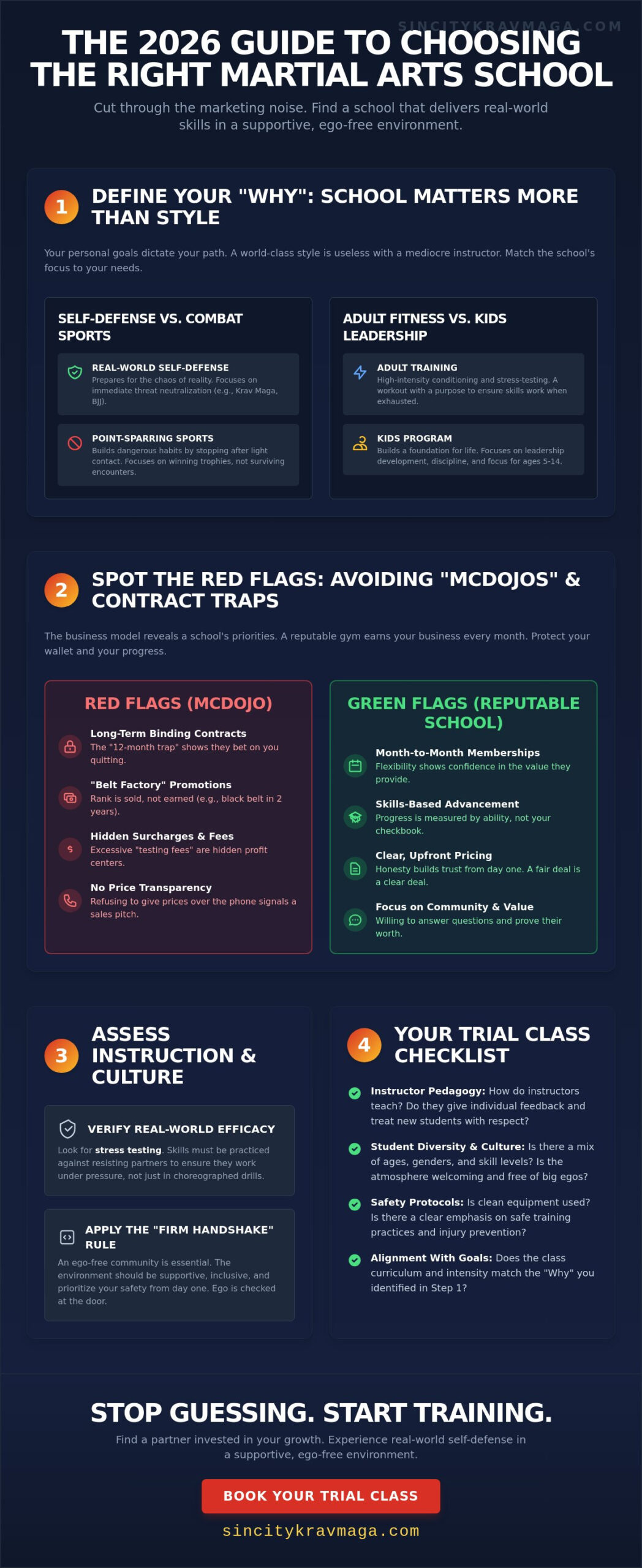
    • Identify your “why” before you step on the mat. Matching the school’s focus to your personal goals for safety or fitness is the first step to success.
    • Learn the specific red flags to watch for when choosing a martial arts school. Avoid predatory long-term contracts and schools where belts are bought rather than earned.
    • Verify real-world efficacy through stress testing. Look for programs that practice techniques against resisting partners to ensure your skills actually work.
    • Apply the “Firm Handshake” rule. This simple test helps you find an ego-free community that prioritizes your safety and inclusion from day one.
    • Master the trial class evaluation. Use our checklist to assess instructor pedagogy and student diversity before you make any commitment.

    Defining Your Goals: Why the School Matters More Than the Style

    Stop searching for the “perfect” style. Start searching for the right environment. Your goals dictate your path. Are you looking for elite fitness, real-world safety, or a competitive outlet? When you’re choosing a martial arts school, start with brutal honesty about your “Why.” If you want to protect your family, a school focused on winning trophies won’t help you. You need substance over flashy marketing. You need a coach who understands your specific needs.

    A world-class style taught by a mediocre instructor is a waste of time. A great mentor transforms any curriculum into a life-changing experience. Understanding what to expect from a martial arts school involves looking past the logos on the wall. It’s about the pedagogy. It’s about how the instructors treat the newest person on the mat. Look for a place where ego is checked at the door and safety is the highest priority.

    To better understand how to evaluate your training options, watch this helpful video:

    Self-Defense vs. Combat Sports

    Winning a plastic trophy is one thing. Getting home safe is another. Traditional point-sparring can build dangerous habits. It teaches you to stop after a light touch or wait for a referee to reset the action. In the real world, the threat doesn’t stop. Krav Maga focuses on immediate, aggressive responses to neutralize threats. Brazilian Jiu-Jitsu (BJJ) gives you the tools to survive if a fight goes to the ground. Both systems prioritize practical safety over sportsmanship. Choose a curriculum that prepares you for the chaos of reality.

    Adult Fitness vs. Kids Leadership

    Training shouldn’t just be for the young. Adult classes must focus on high-intensity conditioning and stress-testing. You need to know your skills work when you’re exhausted. For children ages 5-14, the focus shifts. We look for leadership development, focus, and discipline. A family-friendly environment ensures everyone grows at their own pace. Adult training should feel like a workout with a purpose. Kids training should feel like a foundation for life. Both require age-appropriate instruction that respects the student’s stage of development.

    Choosing a martial arts school in Las Vegas also requires a reality check on traffic. If your gym is a forty-minute crawl across town, you won’t show up. Consistency is the engine of progress. Find a location that integrates into your daily routine. Your training should be a highlight of your day, not a logistical nightmare. Look for a school that offers flexible schedules to match your lifestyle. Consistency beats intensity every single time.

    The ‘Red Flag’ Checklist: Avoiding McDojos and Contract Traps

    Protect your wallet and your progress. Many schools prioritize their bottom line over your growth. When you’re choosing a martial arts school, the business model tells you everything you need to know. Avoid the 12-month trap. Schools that force long-term binding contracts are betting on you quitting. They want your money, not your success. A reputable gym earns your business every single month. If they don’t offer flexibility, walk away.

    Watch out for “belt factories.” This is a classic form of martial arts fraud where rank is sold, not earned. If every student has a black belt after only two years, the standards are likely low. Ask about testing fees before you sign up. Some schools charge significant surcharges just to change the color of your belt. These fees are hidden profit centers. Your progress should be measured by your ability to defend yourself, not by the size of your checkbook.

    The Business of Martial Arts

    Transparency is non-negotiable. If a school won’t give you pricing over the phone, they’re preparing for a high-pressure sales pitch. Month-to-month memberships for no contract martial arts in Las Vegas protect the student. They keep the instructors motivated to provide value every class. You can find more details in our guide on no contract martial arts in Las Vegas. A fair deal is always a clear deal. Don’t let marketing noise drown out your intuition.

    Safety and Hygiene Standards

    Look at the mats. Are they cleaned daily or do they smell of old sweat? Hygiene reflects the school’s respect for its students. Staph infections and ringworm are real risks in poorly maintained facilities. Beyond cleanliness, look at the injury rates. A gym that focuses on “toughing it out” instead of training for longevity will leave you broken. Instructors should be first aid certified and have clear safety protocols for every drill. At Sin City Krav Maga & Fitness, we believe safety is the foundation of all effective training.

    Finally, perform a quick ego check. Is the lead instructor a mentor or a dictator? A mentor answers questions and remains accessible to everyone. A dictator demands blind obedience and creates an exclusionary atmosphere. You’re paying for expert instruction, not to join a cult. A healthy community is built on mutual respect and shared goals. If the vibe feels off or intimidating during your first visit, it probably is. Trust your gut and keep looking for a place that feels like a partnership.

    Choosing a Martial Arts School: The Ultimate 2026 Evaluation Checklist

    Instruction Quality: Assessing Real-World Efficacy

    Don’t get blinded by trophies. A world champion isn’t always a world-class teacher. When you’re choosing a martial arts school, prioritize pedagogy over pedigree. You need an instructor who can break down complex movements for a beginner. Lineage is a great marketing tool. It doesn’t guarantee you’ll learn effectively. Look for teachers who focus on your progress, not their own highlight reel. They should be able to explain the logic behind every move. If they can’t explain the “why,” they haven’t mastered the craft of teaching.

    Efficacy requires resistance. Real-world skills aren’t built in a vacuum. Ask the school if they practice techniques against resisting partners. This is called stress testing. Without it, you’re just learning a choreographed dance. You need to know how a technique feels when someone is actively trying to stop you. A logical class structure is also vital. It should move from a functional warmup to technical drills and finally to controlled application. This progression builds muscle memory and confidence safely.

    Real-World Krav Maga and BJJ

    Self-defense is about more than just physical strikes. Effective Krav Maga in Las Vegas must include situational awareness. You need to spot trouble before it starts. In Brazilian Jiu-Jitsu (BJJ), the focus should be on survival and submissions. Many sport-centric gyms teach students to “stall” for points. That habit will get you hurt in a real fight. If you want to accelerate your growth, consider private self defense lessons in Las Vegas. One-on-one sessions allow for immediate correction and a customized technical path that fits your specific body type and goals.

    Instructor Accessibility

    Check who is actually on the mats. At a boutique school, you should see the lead instructors like Brock and Camilla teaching daily. They shouldn’t be hidden in a back office doing paperwork. Accessibility matters. Watch how they handle a student who is struggling. A great mentor adjusts their teaching style to fit the individual. They don’t just yell louder. They find a new way to explain the concept until it clicks. This personal investment is what separates a factory from a community.

    Observe the community vibe. Senior students should be assets, not obstacles. In a healthy environment, the higher belts help the beginners. They don’t “hunt” them for easy wins. This culture of mutual growth is a hallmark of a high-quality facility. When choosing a martial arts school, look for a room where everyone is invested in each other’s success. This is how you build real-world skills that last a lifetime. It’s about the people standing next to you on the mat.

    The Culture Test: Finding an Ego-Free Community in Las Vegas

    The first ten seconds inside a gym tell you more than any brochure. Pay attention to how you are greeted. We call this the “Firm Handshake” rule. A welcoming, professional greeting at the door signals a culture of respect. If you are ignored or treated like a number, the training will likely follow suit. When choosing a martial arts school, you are looking for a community, not just a place to sweat. The atmosphere should feel like a partnership from the moment you step inside.

    Diversity on the mat is a vital health metric for any gym. Look around the room. A healthy school has students of all ages, genders, and fitness levels. If the class only consists of twenty-something “tough guys,” the culture probably prioritizes dominance over development. A supportive community thrives when everyone helps the person next to them. This support often extends beyond the mat. Students who grab coffee together or support each other’s local businesses create a resilient network. This is the “third place” you need for mental health and stress relief.

    Local ownership creates accountability. In Northwest Las Vegas, having owners who live in the neighborhood changes the dynamic. They aren’t just running a business; they are building a local institution. They care about their reputation because they see you at the grocery store. This localized pride ensures the standards remain high and the environment stays professional. It’s a level of personal investment you won’t find in a corporate franchise.

    Inclusive Training Environments

    Safety starts with the environment. For many, starting women’s self defense in Las Vegas requires a space that feels safe and non-intimidating. A “No Ego” policy is essential here. This means senior students don’t use beginners as punching bags. It means the focus is on technical growth, not physical dominance. Community events like seminars or social mixers help foster this sense of belonging. When you feel included, you train harder and stay longer.

    Supportive Fitness and Conditioning

    Conditioning should be a tool for leadership, not a form of punishment. Check if the fitness portion of the class is encouraging. High-intensity training is necessary, but it should build you up. This is how combat fitness in Las Vegas develops character alongside muscle. You learn to push through limits while your teammates cheer you on. It transforms a simple workout into a leadership exercise. Choosing a martial arts school means finding a place where you leave feeling empowered rather than defeated.

    Ready to experience a supportive, ego-free environment for yourself? Join our community at Sin City Krav Maga & Fitness and start your journey today.

    Taking the Leap: Your First Trial Class Checklist

    You’ve narrowed down your list. Now it’s time to see the reality on the mats. This is the final, most critical step in choosing a martial arts school. Walk in with your eyes open. Don’t just listen to the sales pitch. Watch a class in action before you ever put on a uniform. Observe how students interact during the toughest parts of the workout. Is there mutual respect? Or is it a room full of individuals trying to prove something? The truth is in the training, not the marketing.

    A professional facility treats your first visit with care. Use this checklist to evaluate the school during your trial:

    • The Intro Program: Ask if they have a dedicated path for beginners. You shouldn’t be thrown into a “shark tank” on day one. A structured start ensures you learn the basics safely.
    • Gear Quality: Inspect the equipment. Are the kick pads and heavy bags well-maintained? Duct-taped gear is a sign of a school that cuts corners on your safety.
    • Instructor Philosophy: Interview the teacher. Ask how they handle injuries and what their specific approach to real-world safety is. A mentor will have a clear, logical answer.
    • The Greeting: Revisit the “Firm Handshake” rule. If the staff is too busy to acknowledge you, they’ll be too busy to coach you effectively.

    What to Watch for During Training

    Focus on the vibe of the room. Are students smiling while they sweat? This is the hallmark of a healthy community. It shows they enjoy the process of growth. Watch how the instructor handles a student who fails a technical drill. A great coach uses it as a teaching moment. They don’t use shame or ego to motivate. If you are looking at kids martial arts, safety protocols must be visible. Every drill should have a clear purpose and a safe exit. You want a school that builds confidence, not fear.

    The Final Decision

    Trust your gut. If the atmosphere feels off, it probably is. Don’t let a “limited time” discount pressure you into a long-term commitment. Compare the total value of the experience. This includes the quality of the coaching, the cleanliness of the mats, and the strength of the community. A low price is no bargain if the instruction is poor or the environment is toxic. Choosing a martial arts school is an investment in your safety and your future. Book your trial class. See if the school lives up to its “No Ego” promise. It’s time to stop thinking and start training.

    Take Command of Your Personal Safety

    You’ve done the research. You know how to spot the difference between a sport-centric gym and a real-world safety facility. You understand that the right environment matters more than the style alone. Choosing a martial arts school is a decision that impacts your confidence, your fitness, and your ability to protect what matters most. Don’t settle for a school that views you as a signed contract. Find a place where the standards for training are high but the encouragement and support system are even higher.

    At Sin City Krav Maga & Fitness, we’ve built a community in Northwest Las Vegas that prioritizes your growth over our bottom line. You’ll find expert instruction from Brock and Camilla on the mats every single day. We don’t use long-term binding contracts because we believe in earning your trust through tangible results and a welcoming culture. It’s time to stop second-guessing and start training in a space designed for your personal success. Join our ego-free community with a trial class at Sin City Krav Maga & Fitness! We look forward to seeing you on the mat.

    Frequently Asked Questions

    What is the best age to start martial arts for kids?

    Most children are ready to begin kids martial arts around age five. At this stage, the focus is on developing coordination, discipline, and listening skills. It’s about building a foundation for life, not just learning how to kick. Every child develops differently, so look for a program that offers age-appropriate instruction for the 5-14 age range.

    How much do martial arts classes usually cost in Las Vegas?

    Costs for training in Las Vegas depend on the school’s facility and the expertise of the instructors. When you are choosing a martial arts school, prioritize transparency over the lowest price. Ask about registration fees, testing surcharges, and mandatory gear costs upfront. A reputable gym will provide clear details without a high-pressure sales pitch.

    Do I need to be in shape before I start self-defense classes?

    You don’t need to be in shape to start. The training itself is what builds your conditioning and strength. Every expert on the mat started as a beginner who was just looking to improve. Our programs are designed to meet you where you are today. You’ll find that the community supports your progress at every fitness level.

    What is the difference between Krav Maga and Brazilian Jiu-Jitsu?

    Krav Maga is a tactical system focused on neutralizing threats quickly using striking and situational awareness. Brazilian Jiu-Jitsu (BJJ) is a grappling art that teaches you how to control and submit an opponent on the ground. Both are essential for real-world safety. Many students choose to train in both styles to become well-rounded.

    How many times a week should a beginner train?

    Beginners should aim to train two to three times per week. This frequency allows your body to recover while still building the necessary muscle memory. Consistency is the most important factor in your long-term success. As you get more comfortable on the mat, you can adjust your schedule to include more sessions or private self defense lessons in Las Vegas to accelerate your tactical development.

    Are martial arts schools safe for women and beginners?

    A high-quality school is safe for everyone. Look for an ego-free environment that specifically offers women’s self defense and intro programs for newcomers. Safety protocols should be the top priority in every drill. If the senior students are helping you learn rather than trying to dominate you, you’ve found the right place.

    Should I choose a school with a long-term contract or month-to-month?

    Always choose a no contract martial arts program in Las Vegas over a long-term binding contract. A gym should earn your business every month through high-quality instruction and a supportive community. Avoid schools that try to lock you into 12-month or 24-month commitments. Flexibility protects the student and keeps the instructors accountable to your goals.

    What equipment do I need for my first martial arts class?

    For your first class, all you need is comfortable athletic wear and a water bottle. Most schools will provide any specialized equipment you need for your trial. As you progress, you might need specific gear like a gi for BJJ or gloves for Krav Maga. Check with the instructors during your first visit to see what is required for their specific curriculum.