Confidence isn’t a personality trait your child is born with. It is a skill they build through sweat, repetition, and real-world experience. It is heartbreaking to watch your child shrink away from a challenge or struggle to set boundaries at school. You know they have incredible potential, but generic advice to “just believe in yourself” does not help when they are facing a bully or a difficult social situation. You want them to walk with their head up and have the grit to handle whatever the real world throws at them.
That is why finding the right confidence classes for kids Las Vegas parents trust is the first step toward a total transformation. We agree that the world is getting tougher; traditional advice often falls short for kids who feel stuck. This guide will show you how to replace self-doubt with resilient, real-world confidence through physical and mental mastery. You will discover how an ego-free environment helps children turn fear into focus. We will preview the exact steps to help your child set boundaries, improve social skills, and develop the mental toughness needed to thrive when things get hard.
Key Takeaways
- Stop focusing on empty praise. Learn why true confidence is built on “self-efficacy,” which is the tangible knowledge of what your child can actually achieve.
- Use the bio-feedback loop to your advantage. Discover how physical posture and active mastery can rewire a child’s mindset from the outside in.
- Equip your child for the real world. Master the ‘Conflict Escalation’ ladder to help them navigate social pressures and set firm boundaries at school.
- Find the right environment for growth. See why confidence classes for kids Las Vegas families trust offer a safe, ego-free space to fail and eventually succeed.
- Build resilience at home with micro-adversity. Use the “Rule of Three” to ensure your child develops the grit to stick with hard things until they win.
What is True Confidence in Children? (Hint: It’s Not Just Self-Esteem)
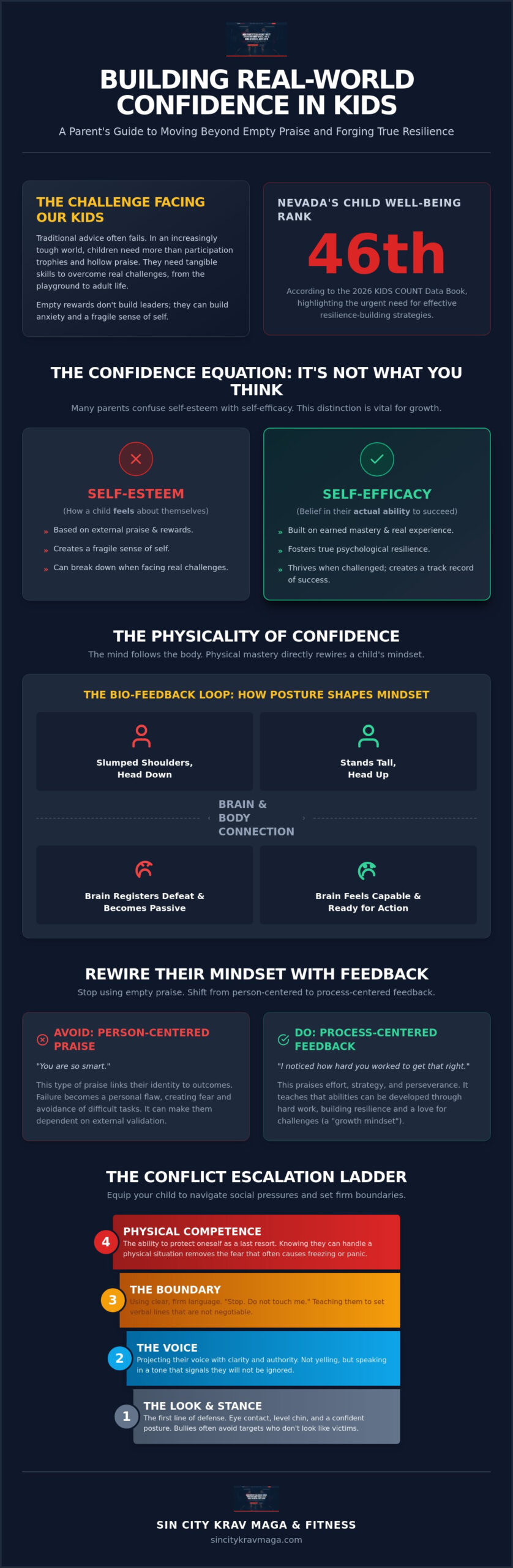
Confidence is not a feeling. It is a track record. Many parents confuse self-esteem with self-efficacy, but the difference is vital for your child’s growth. Self-esteem is simply how a child feels about themselves. Self-efficacy is their belief in their actual ability to perform a task. In 2026, we see a generation struggling because they have been given the “feeling” without the “ability.” Participation trophy culture has backfired. It creates a fragile sense of self that breaks the moment a real challenge appears. Empty rewards don’t build leaders; they build anxiety.
To better understand how we build this foundation through action, watch this helpful video about the impact of martial arts training:
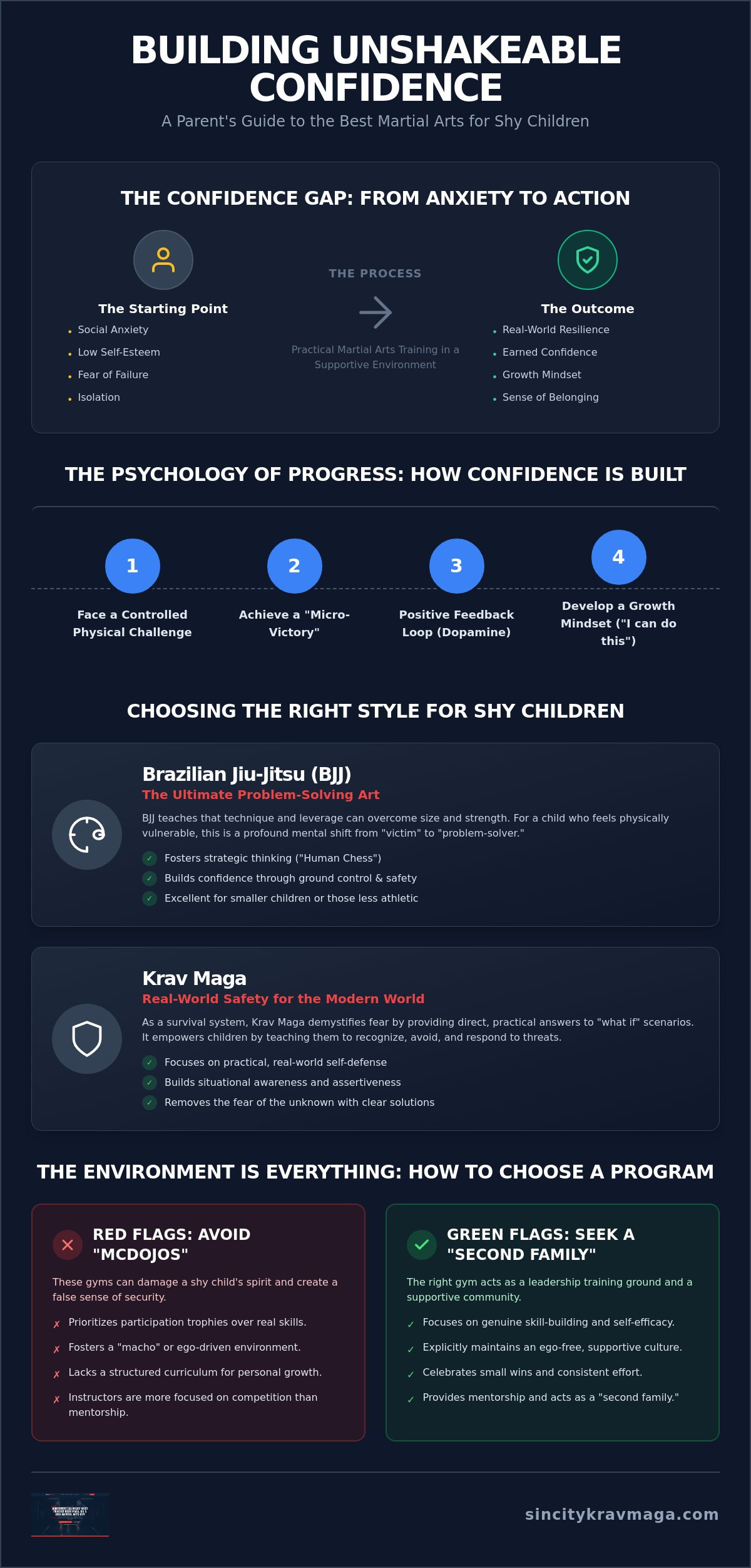
True confidence comes from earned mastery. In Nevada, where the 2026 KIDS COUNT Data Book ranked our state 46th for overall child well-being, building Psychological resilience is a priority. Kids need more than just a pat on the back. They need to know they can protect themselves, solve problems, and stand their ground. When looking for confidence classes for kids Las Vegas offers, focus on schools that challenge your child rather than just entertaining them. We act as pragmatic mentors. We don’t give confidence away. We provide the tools for kids to build it themselves through Krav Maga and BJJ.
The Difference Between Arrogance and Confidence
Arrogance is a mask. It is loud, aggressive, and usually hides a deep-seated fear of being “found out.” A child who acts like a bully is often the most insecure person in the room. Real confidence is quiet. It is the calm knowledge that “I can handle this.” You can tell your child is truly capable when they don’t feel the need to prove it to everyone. They stay humble because their ego isn’t tied to being better than others. It is tied to being better than they were yesterday. An ego-free environment is the only place where this growth happens. This is a core pillar of the best confidence classes for kids Las Vegas provides.
Why ‘Good Job’ Might Be Hurting Your Child
Stop using empty praise. When you say “good job” for every minor movement, your child becomes a “praise junkie.” They start looking for external validation instead of internal satisfaction. Move from person-centered praise like “you are so smart” to process-centered feedback like “I noticed how hard you worked to get that technique right.” This shifts the focus to effort and strategy.
Earned confidence is the result of repeated, successful effort over time.
The Physicality of Confidence: Why Movement Matters
Movement is the engine of confidence. Your child’s brain takes cues from their body. This is the bio-feedback loop. If they slouch, their brain feels defeated. If they stand tall, they feel capable. This isn’t theory. It’s biology. Even the foundations of self-confidence are laid through physical exploration and mastering the environment. When parents search for confidence classes for kids Las Vegas, they often overlook this physical connection. True grit starts in the spine.
Passive learning in a classroom is fine for math. It fails for character development. Active mastery requires movement. In our classes, kids learn physical combat skills that demand immediate action. They don’t just hear about bravery; they practice it. This physical competence directly impacts their social standing. A child who moves with purpose is rarely a target for bullies. They carry themselves with an air of capability that others notice instantly.
Body Language: The First Line of Defense
Bullies use a specific filter. They look for the head down, the slumped shoulders, and the darting eyes. We teach “The Look.” It starts with eye contact. It continues with a level chin and a clear, projected voice. You can practice this at home. Have your child walk across the kitchen like they own the space. Correct the slouch. Praise the presence. This is how confidence classes for kids Las Vegas families trust create lasting change. Physical cues are the first line of defense before a word is even spoken.
Mastery of the Body vs. Mastery of the Screen
Screens provide cheap dopamine. It is easy. It is addictive. It builds nothing of substance. Physical mastery provides hard-earned dopamine. Learning a complex BJJ transition or a Krav Maga strike takes time. It takes grit. This struggle in a safe environment is the antidote to mental fragility. It teaches them that they can handle discomfort. For more on this, read about the 5 Life-Changing Benefits of Martial Arts for Kids to see how these skills translate to real-world success. Mastering the body is the ultimate foundation for mastering life.
Navigating Social Adversity in Las Vegas Schools
Growing up in Southern Nevada comes with specific pressures. Clark County schools can be high-stress environments where social dynamics shift quickly. A 2026 report identified behavioral health as a shared challenge across our local communities. Your child needs more than just “social skills.” They need a tactical plan for when things go wrong. This is why confidence classes for kids Las Vegas parents trust focus on the ‘Conflict Escalation’ ladder. We teach children to evaluate threats in real time and respond with the appropriate level of force or verbal boundary.
Setting boundaries is a physical skill. You cannot explain your way into bravery. A child must practice the act of standing their ground in a controlled environment until it becomes muscle memory. Research on how to build resilience in kids shows that competence leads to genuine confidence. Our ego-free community acts as a shield against toxic school cliques. It is a place where kids are judged by their effort and character, not their clothes or their social media following. This supportive culture provides the mental armor they need to thrive in the real world.
The ‘Don’t Be a Victim’ Mindset
Children must know they have the right to say “No.” This applies to peers and adults alike. We teach situational awareness as a foundational habit. It means recognizing “weird” situations before they turn into dangerous ones. By understanding personal space and red flags, kids stay ahead of the curve. These Self Defense Classes in Las Vegas provide the exact framework they need to stay safe. Awareness is the best weapon. When a child knows how to spot trouble, they can avoid it entirely.
Verbal Judo for Kids
Most conflicts can be solved with words. We provide scripts for de-escalating bullies without starting a fight. The ‘Broken Record’ technique is a favorite. It involves repeating a firm, neutral boundary until the aggressor loses interest. “I don’t like that. Stop it.” No arguing. No pleading. Just a clear wall. There is a powerful paradox here. A child who knows how to fight is usually the least likely to start one. They have nothing to prove. They possess a quiet strength that de-fuses aggression before it even starts. This is the ultimate goal of confidence classes for kids Las Vegas: a child who is capable of violence but disciplined enough to choose peace.
5 Actionable Ways to Build Resilience at Home
Resilience is a muscle. You don’t wait for a life-altering crisis to train it. You start with micro-adversity. These are small, winnable challenges your child faces every day. It could be finishing a difficult puzzle or cleaning their room without being asked. When children overcome these minor obstacles, they prove to themselves that they are capable. This is the home-based version of what we do in confidence classes for kids Las Vegas parents rely on. We create a controlled environment for struggle so that success feels earned.
Modeling productive failure is your most powerful tool. If you make a mistake at work or burn dinner, don’t hide it. Admit it. Show your child that failing is just data. It is a stepping stone, not a dead end. Encourage “scary-but-safe” activities. This might be ordering their own food at a restaurant or speaking up in a group. Most importantly, help them reframe their language. Replace “I can’t” with “I can’t yet.” That one extra word changes a permanent wall into a temporary hurdle.
The Power of Household Responsibility
Chores are not just about a clean house. They are competence builders in disguise. When a child masters a task like doing laundry or washing dishes, they see a tangible result of their effort. Match the task to their age to ensure they can actually succeed. A five-year-old can set the table; a ten-year-old can help with yard work. Responsibility is the cornerstone of self-respect. It tells the child that their contribution matters to the family. It builds the “I can do” mindset that stays with them at school.
Managing the ‘Quit’ Impulse
Every child eventually wants to quit something. You must distinguish between “I don’t like this” and “This is hard.” If it is just hard, they must stay. Use the “Rule of Three.” Have them try a new activity for at least three sessions before making a decision. For sports or martial arts, use a “Finish the Season” contract. This teaches commitment through follow-through. Supporting them through a plateau without “saving” them from the work is how grit is born. If you are ready to see your child build this level of discipline, book a trial at our Las Vegas facility today.
Why Kids Martial Arts is the Ultimate Confidence Lab
Instructors like Brock and Camilla provide a “Third Space.” This is a sanctuary outside of the pressures of home and school. It is a place where kids can fail safely and grow quickly. They aren’t just learning to punch and kick. They are learning to lead. They are building a support system that values their safety and growth above all else. This community-centric heart is what transforms a simple workout into a life-changing experience.
Krav Maga vs. Traditional Karate
Traditional karate often focuses on point-sparring and kata. These are fine for tradition, but they don’t always build real-world self-trust. Krav Maga and BJJ focus on practical safety. We don’t teach kids to score points on a mat. We teach them to solve problems in the street. This tangible reality builds a deeper level of security. For a closer look at the curriculum, check out Krav Maga Las Vegas: Real-World Self Defense. When a child knows they can protect themselves, they carry themselves differently in every other part of their life.
The ‘No Contract’ Freedom for Parents
We believe in results, not binding agreements. Traditional gyms often trap families in long-term contracts. This creates financial guilt. If a child has a bad week, the parent feels the pressure of the payment. We remove that barrier. Our no-contract flexibility allows children to find their own pace. There is no pressure. Only progress. This makes our confidence classes for kids Las Vegas programs accessible and stress-free for the whole family. Ready to start? Book a Kids Martial Arts Trial Class in Las Vegas and see the transformation for yourself.
Build the Leaders of 2026 Today
Confidence is a track record. You now have the blueprint to move your child from empty praise to earned mastery. By focusing on physical presence and mental grit, you are preparing them for the real-world pressures of Southern Nevada. The strategies we’ve discussed-from micro-adversity at home to setting firm social boundaries-are the tools they need to navigate life with their head up. Mastery is the only antidote to self-doubt.
Choosing the right confidence classes for kids Las Vegas offers is a commitment to your child’s long-term resilience. At Sin City Krav Maga & Fitness, we provide a safe, ego-free space to test these skills under pressure. Our no-contract approach ensures your family can focus on transformation without feeling trapped. If you are interested in how other community-focused centers structure their pricing, you can explore Biweekly Membership Subscription Fees at Saco Sport & Fitness. We believe that when a child knows they can protect themselves, their entire perspective on the world changes for the better.
Empower your child today-Claim your Kids Martial Arts Trial Class at Sin City Krav Maga & Fitness. Brock and Camilla are ready to help your child find their quiet, resilient strength. Let’s build their future together, one class at a time.
Frequently Asked Questions
How do I know if my child lacks confidence or is just shy?
Shyness is often a social preference; a lack of confidence is a belief in inability. A shy child might enjoy a challenge but prefer to watch before joining. A child lacking confidence will actively avoid new tasks because they fear failure or judgment. Look for physical cues like a constant downward gaze or an inability to set verbal boundaries with peers. If your child seems paralyzed by the idea of making a mistake, they likely need to build self-efficacy through action.
Will teaching my child self-defense make them more aggressive?
No. It actually does the opposite. Children who know how to defend themselves don’t feel the need to prove their toughness to others. We teach that violence is a last resort. Our students develop a quiet strength that allows them to walk away from petty arguments. When a child possesses real skills, their ego settles. They become more disciplined and less likely to engage in unnecessary conflict because they have nothing to prove to bullies.
What is the best age to start a child in confidence-building classes?
Specialized programs for ages 5 to 14 are ideal for building a strong foundation. Starting around age 5 allows a child to develop coordination and social boundaries before the intense pressures of middle school begin. This early start helps them view struggle as a natural part of learning. By the time they hit their teenage years, the resilience they built in confidence classes for kids Las Vegas becomes a permanent part of their character.
Can martial arts help a child who is currently being bullied in Las Vegas schools?
Yes. Martial arts provides a tactical framework for safety that goes beyond physical fighting. We teach situational awareness and “Verbal Judo” to de-escalate threats before they turn physical. Bullying often relies on the target’s perceived fragility. By changing a child’s posture and vocal projection, we help them stop looking like a target. It gives them the mental armor needed to navigate the unique social challenges found in the Clark County school system.
How long does it take to see a change in a child’s confidence level?
Small shifts in body language and eye contact often appear within the first 4 to 6 weeks of consistent training. While total mastery takes years, the initial “head up” transformation happens quickly once a child realizes they can handle physical challenges. You will likely notice them speaking more clearly or being more willing to try new things at home. Real change is a marathon, but the first steps are visible almost immediately.
What should I do if my child wants to quit an activity when it gets hard?
Distinguish between a lack of interest and a fear of the challenge. If they want to quit because the work is difficult, you should encourage them to stay. We suggest using a “Finish the Season” contract or the “Rule of Three” mentioned earlier in this guide. Teaching them to push through a plateau is how grit is formed. Saving them from the struggle only reinforces the idea that they aren’t capable of handling hard things.
How can I model confidence if I don’t feel confident myself?
Model the process of growth rather than the finished result. You don’t have to be perfect; you just have to be honest about your efforts. Let your child see you try something new, fail, and then try again without shaming yourself. Admitting that a task is hard but doing it anyway is the highest form of confidence you can show them. This “Pragmatic Mentor” approach shows your child that confidence is about action, not just a feeling.
Are there specific martial arts that are better for building confidence?
Krav Maga and Brazilian Jiu-Jitsu (BJJ) are the most effective for building genuine self-trust. These systems focus on real-world safety and practical application rather than traditional point-sparring or kata. When children see that their techniques actually work against a resisting partner, their confidence becomes rooted in reality. This is why confidence classes for kids Las Vegas families choose often prioritize these practical styles over more traditional, performance-based arts.