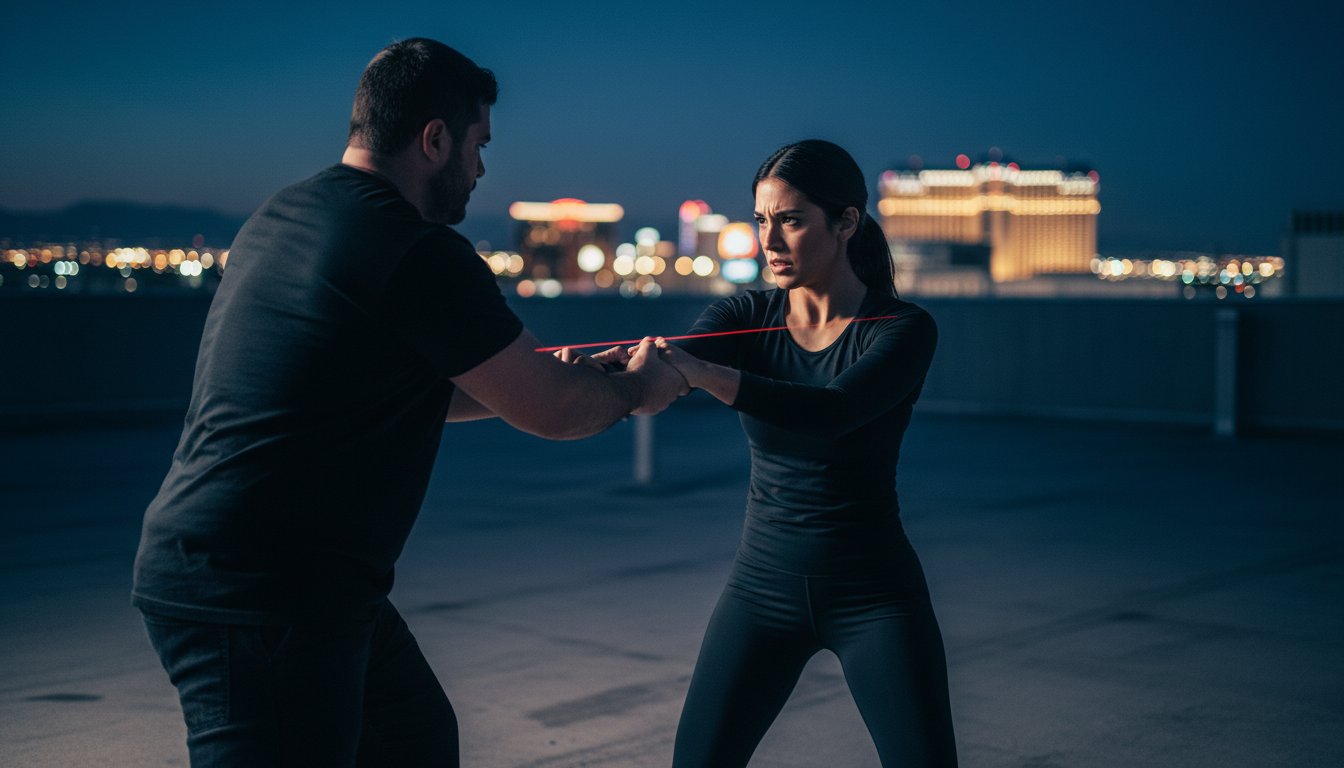
You don’t need a black belt or massive muscles to protect yourself. You just need a three-second window to escape. It is natural to feel overwhelmed by complex martial arts styles or feel like you’re too small to defend yourself. We get it. The world feels unpredictable. While 2025 saw a 9.3 percent decrease in violent crime, self-defense laws are changing fast across the country in 2026. You want to feel capable, not scared. You deserve to walk with confidence, knowing you can handle a threat without needing years of specialized training.
We are here to help you build that shield. This guide breaks down the reality-based self defense moves everyone should know to stay safe today. These aren’t flashy movie stunts or traditional point-sparring techniques. They are high-leverage mechanics designed to work under extreme stress, even if you have never stepped foot in a gym. We will cover five essential techniques to help you neutralize a threat, create an exit, and master the art of avoiding a confrontation entirely. It is time to turn fear into a proactive plan for your safety.
Key Takeaways
- Shift your mindset from “fighting” to “escaping.” Safety is the only real victory in a street encounter.
- Master the five self defense moves everyone should know that utilize high-leverage mechanics against vital, soft-tissue targets.
- Break free from common grabs and hold-downs by exploiting the “weak link” in an attacker’s grip.
- Protect yourself on the ground. Learn the essential techniques to shield your head and stand up safely under pressure.
- Transform knowledge into instinct. Discover why stress-testing your training is vital for reacting decisively when it matters most.
The Foundation: Awareness and the “Exit First” Mentality
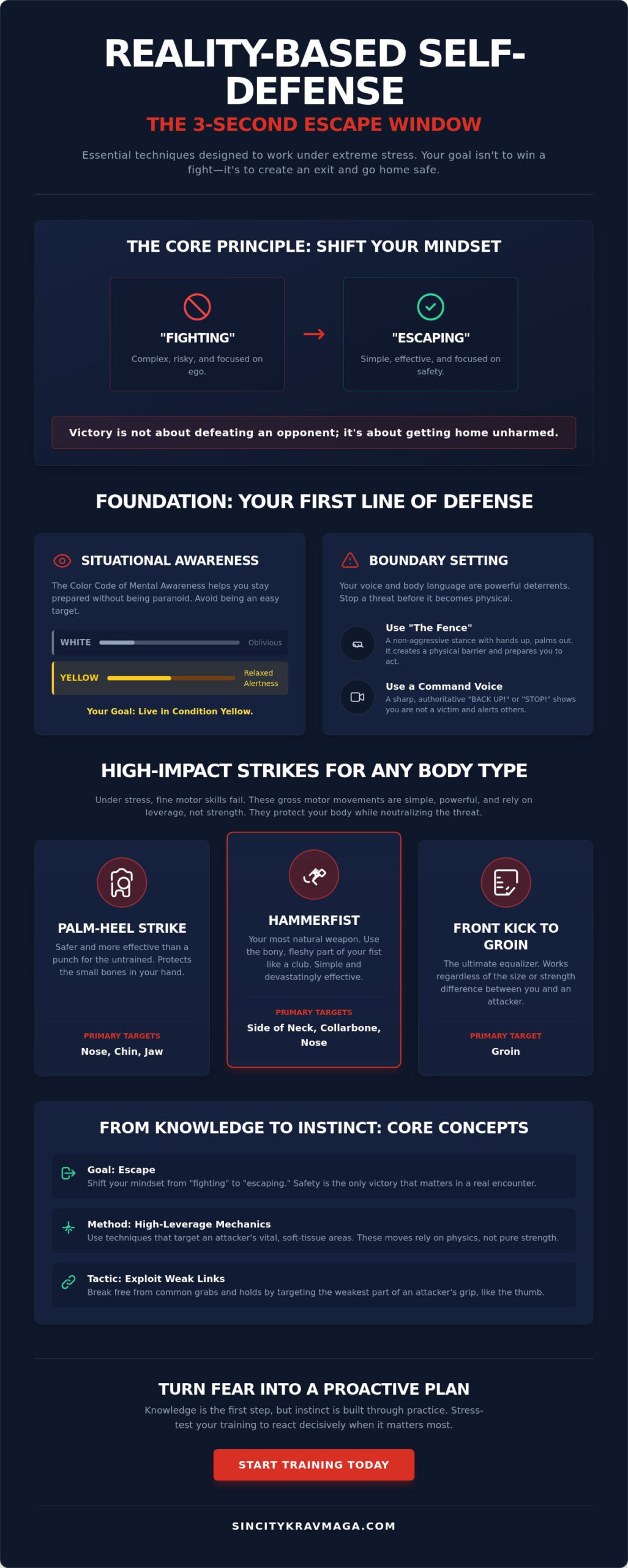
Self-defense isn’t about being the toughest person in the room. It is about being the smartest. True protection starts long before a punch is thrown. It is the ability to recognize a threat, avoid the confrontation, and escape to safety. For a comprehensive overview of self-defense, you will see it encompasses legal, physical, and mental preparedness. At our gym, we teach that safety is the only real victory. Forget the Hollywood version of “winning” a fight. If you go home unharmed, you won. That is the goal. Every time.
Many people worry they are too small or too weak to defend themselves. That is a myth. Physical confrontation is about physics, not just muscle. High-leverage mechanics allow a smaller person to neutralize a larger attacker. We focus on the self defense moves everyone should know that rely on technique rather than raw strength. This is the core of our Sin City “ego-free” approach. We don’t train for trophies or ego. We train for reality. We want you to feel capable, not intimidated. You don’t need years of training to be safe; you need the right mindset.
Situational Awareness: The 360-Degree Scan
Awareness is a spectrum. We use the “Color Code of Mental Awareness” to help students stay ready. Most people live in Condition White. They are oblivious and distracted by phones. You need to be in Condition Yellow. This is a state of relaxed alertness. When you are walking through a Las Vegas parking lot or navigating a crowded casino, keep your head up. Scan your environment constantly. Look for pre-attack indicators. Watch for “target glancing” where someone looks at your pockets or “grooming gestures” like someone adjusting their clothing before moving toward you. These small signs give you the seconds you need to change direction and avoid the problem entirely.
The Boundary Setting Voice
Your voice is your first line of defense. Use a command voice. It isn’t a scream. It is a sharp, authoritative directive. “Stop!” or “Back up!” sends a clear message to an attacker. It also alerts bystanders that something is wrong. Combine this with assertive body language. We teach a technique called “The Fence.” The Fence is a non-aggressive but protective stance where your hands are up and palms are out to create a physical barrier between you and a threat. It keeps your hands ready to move while signaling that you are not the aggressor. Use your space. Use your voice. End the threat before it starts.
High-Impact Strikes for Any Body Type
When adrenaline floods your system, your fine motor skills disappear. You can’t rely on complex finger movements or precise angles. You need gross motor skills. These are simple, powerful actions that use your body’s largest muscle groups. One of the most vital self defense moves everyone should know is the strike that targets soft tissue. We don’t aim for the forehead or the chest. We aim for the eyes, the throat, and the groin. These areas don’t require strength to damage. Also, stop thinking about one perfect punch. We teach the “continuous burst” principle. You strike, and you keep striking. Don’t stop to admire your work. Keep the pressure on until the attacker is neutralized and you have a clear path to the exit.
Safety starts with your own body. Traditional closed-fist punches are risky for the untrained. The small bones in your hand often snap against a hard skull. This is called a boxer’s fracture. If your hand breaks, your ability to defend yourself or open a door to escape is gone. We prioritize strikes that protect your tools while destroying the target’s resolve.
The Palm-Heel Strike
The palm-heel strike is your primary tool for the face. Align your wrist and lock it. Drive the strike using the large muscles in your legs and hips. The power comes from the ground, not just your shoulder. Aim for the chin or the bridge of the nose. This impact snaps the attacker’s head back and disrupts their vision. It is far more effective than a traditional punch for beginners. The palm is a blunt, durable weapon that protects your own anatomy while delivering maximum force. It creates the distance you need to turn and run.
The Hammerfist: Your Most Natural Weapon
Think of your hand like a club. The fleshy part on the bottom of your fist is the hammer. This is perhaps the most natural weapon you possess. You don’t need a special grip or years of conditioning. The mechanics are simple. Swing the fist in a downward or sideways arc. Target the side of the neck, the collarbone, or the bridge of the nose. It is a high-leverage move that works from almost any angle. If you are feeling overwhelmed by complicated styles, focusing on these Women’s Self Defense basics will simplify your response. You want moves that are hard to forget and easy to execute.
The Front Kick to the Groin
The front kick to the groin is the ultimate equalizer. It doesn’t matter how big the attacker is. This target is always vulnerable. Use your shin or the top of your foot rather than your toes. This creates a larger striking surface and reduces the chance of you missing. The “recoil” principle is critical here. Kick through the target like you are trying to put your foot through their spine. Then, immediately snap your foot back to your original stance. This keeps you balanced and ready to move. Never leave your leg hanging in the air. Hit hard, reset, and look for your exit.
Escaping Common Grabs and Hold-Downs
Being grabbed is a high-stress moment. It is personal. It is invasive. Many people make the mistake of trying to out-muscle a larger attacker. You won’t win that battle of strength. Instead, you must use the “Weak Link” principle. Every grip, no matter how strong, has a gap. That gap is where the thumb meets the fingers. This is the exit door for your limb. We also teach “Retributive Action.” This means you don’t just wait for the defense to work. You strike while you are being grabbed. You disrupt their focus. You cause pain. You create the opening you need to sever the connection. To truly master these reactions under stress, you should look into self defense classes in Las Vegas where you can practice against a resisting partner.
Your goal is never to stay and control the attacker. Competitors often teach how to pin someone down. That is a mistake in a street fight. You don’t know if they have a weapon or a friend nearby. These are the self defense moves everyone should know because they prioritize the exit strategy. Break the grip, create space, and get out of there.
Escaping a Wrist Grab
If someone grabs your wrist, don’t pull straight back. You are pulling against their entire arm. Instead, rotate your wrist toward the attacker’s thumb. This aligns the thinnest part of your arm with the weakest part of their hand. Step back and pull your elbow toward your own ribs. This uses your entire body weight against their thumb. If they don’t let go immediately, follow up with a palm-heel strike to the face. Once you are free, do not stay to talk. Run.
The Bear Hug Escape (From the Front)
A bear hug is designed to pin your arms and lift you off the ground. Your first move is to lower your center of gravity. Drop your weight. This is called “establishing your base.” It makes you much harder to lift. Next, use “space-makers.” These are immediate, brutal strikes to vital areas. Use a headbutt to the nose or a knee to the groin. If your arms are free, use an eye gouge. This pain forces the attacker to loosen their grip. Create a “frame” by placing your forearms against their chest and pushing away. This creates the three-second window you need to turn and sprint to safety.
Surviving the Ground: What to Do if You Fall
The ground is the most dangerous place to be in a street fight. It limits your mobility. It exposes you to multiple attackers. It leaves you vulnerable to kicks to the head. Your only goal is to get back to your feet as fast as possible. This is where sport martial arts and reality-based training diverge. You aren’t looking for a submission or a trophy; you are looking for an exit. Every second you spend on the pavement is a second your life is at risk.
While we teach Brazilian Jiu-Jitsu to provide the necessary leverage and body awareness, our focus remains on survival. Understanding how to use your hips and legs as a shield is one of the most critical self defense moves everyone should know. Your legs are longer and stronger than an attacker’s arms. Use them. Keep the threat at bay while you plan your escape. Leverage is your best friend when you’re on the bottom, but it’s only a tool to help you stand back up.
The Tactical Get-Up
Standing up in a fight isn’t like getting out of bed. If you just lunge forward, you’ll get hit or tackled again. You need a tactical get-up. First, prop yourself up on one hand and the opposite foot. Keep your other hand up to shield your face. This creates a frame that protects your vitals. Use your free leg to deliver a sharp “kick-away” to the attacker’s knee or shin. This impact buys you the half-second needed to stand. Crucially, you must stand up away from the attacker. Retract your bottom leg behind you. Keep your eyes on the threat. Never turn your back until you’ve created enough distance to sprint.
Ground Kicking for Distance
If you’re on your back and the attacker is standing, you’re in the danger zone. You must stay “feet-to-foe.” This means rotating your hips constantly so your feet always point toward the threat. Target the attacker’s knees, shins, or ankles with heavy, driving kicks. This prevents them from mounting you or pinning your limbs. The bicycle kick is a vital survival tool because it creates a continuous barrier of moving limbs that prevents an attacker from closing the distance or pinning you down. It is about creating chaos and pain so you can find a window to perform your tactical get-up and escape.
Turning Knowledge into Instinct: How to Train
Knowledge is just the beginning. You can’t read your way out of a headlock. When a real threat appears, your brain doesn’t have time to process a checklist. It relies on instinct. This is why drilling the self defense moves everyone should know is non-negotiable. You need muscle memory. You need your body to react before your mind even realizes there is a problem. Safety is a skill. Like any skill, it requires sweat and repetition to become permanent. If you don’t train it, you don’t own it.
Many traditional schools teach “compliant” techniques. Your partner stands still and lets you perform the move perfectly. This is a trap. It builds a false sense of security that fails the moment someone actually tries to hurt you. Real training requires stress-testing. You need a partner who resists, moves, and fights back. This same focus on tangible reality is why our kids martial arts program skips the flashy point-sparring. We teach children how to handle real-life physical threats using the same high-leverage principles we give adults. We build confidence through genuine capability, not participation trophies.
The 2-Minute Stress Drill
We don’t do repetitive katas. We do scenario-based drills. One of our most effective methods is the 2-minute stress drill. We safely simulate the “adrenaline dump” you feel during a real confrontation. You might do high-intensity calisthenics to get your heart rate up before a partner “attacks” you with a specific grab or strike. This teaches you to execute self defense moves everyone should know while you are exhausted and your fine motor skills are gone. We focus on real-world application. We don’t care about scoring points. We care about you getting home safe.
Finding the Right Gym in Las Vegas
The right environment makes all the difference. You need a place that is disciplined but welcoming. Look for a gym that rejects the “tough guy” tropes and focus on community. At Sin City Krav Maga & Fitness, Brock and Camilla have built a family-oriented space where the standards are high but the ego is non-existent. We don’t believe in long-term binding contracts. We believe in the quality of our training. You are a partner in this journey, not just a number on a spreadsheet. We are invested in your growth and your safety. Join a trial class at Sin City Krav Maga & Fitness and start your journey today.
Take Control of Your Safety Today
Safety is a choice. You’ve learned that awareness is your first line of defense. You’ve seen how high-leverage strikes like the palm-heel and hammerfist can neutralize threats regardless of your size. These self defense moves everyone should know are the foundation of a life lived without fear. But knowledge only becomes power when it’s forged into instinct through consistent, reality-based training. You deserve to walk with confidence.
Don’t wait for a dangerous situation to test your readiness. At Sin City Krav Maga & Fitness, we provide a supportive, ego-free community where you can build these skills safely. Brock and Camilla are personally invested in your success. We offer expert instruction without the burden of long-term binding contracts. You get real skills for the real world. It’s time to move from theory to action. Stop wondering if you could defend yourself and start knowing that you can.
Claim Your No-Contract Trial Class at Sin City Krav Maga & Fitness and start building your confidence today. You have the power to protect yourself. We have the roadmap to help you get there.
Frequently Asked Questions
What are the most effective self-defense moves for a smaller person?
Leverage and vital targets are the equalizers for smaller defenders. Focus on the self defense moves everyone should know that target soft tissue, like the eyes or groin. These areas don’t require muscle to damage. Use your body weight and hip rotation to drive palm-heel strikes into the attacker’s face. Snapping the head back creates the distance needed to escape safely.
Can I learn self-defense moves without joining a martial arts school?
You can start learning basic concepts through online videos, but you cannot master them alone. Self-defense requires a resisting partner to build genuine muscle memory. Without stress-testing, your brain will likely freeze under pressure. Online courses are a great introduction, but nothing replaces the physical feedback of a real training environment where you can practice timing and distance safely.
Is Krav Maga better than Jiu-Jitsu for street self-defense?
Krav Maga is designed for rapid neutralization and escape in street scenarios. Brazilian Jiu-Jitsu is the gold standard for ground survival and leverage. We teach both because they serve different purposes. Krav Maga focuses on the “continuous burst” to end a fight quickly. BJJ ensures you can get back to your feet if you are tackled. Both are vital for a complete safety plan.
What should I do first if someone grabs me from behind?
Drop your weight immediately to establish a solid base. This prevents the attacker from lifting you or moving you easily. Use your elbows to strike the ribs or head while stomping on their feet. Once the grip loosens, use the “weak link” principle to break free and sprint toward safety. Never stay and try to wrestle a stronger person from behind.
How long does it take to become proficient in basic self-defense?
You can learn the basic self defense moves everyone should know in about three to six months of consistent training. This timeframe allows you to develop the necessary muscle memory and situational awareness. You won’t be a master, but you will have a proactive plan. True proficiency is a journey, but the ability to react decisively starts much sooner than you think.
Are there specific self-defense moves for women that are different from men?
The mechanics of self-defense are the same for everyone, but the scenarios often differ. Women’s self-defense classes prioritize escaping larger attackers and handling specific threats like hair pulls or being pinned. The goal remains the same: create a window of opportunity and get out. If you want a deeper breakdown of which training systems work best, our guide on what is the best martial art for a woman covers the top options for real-world safety. We focus on high-leverage techniques that work regardless of gender or physical strength.
What are the best vital targets to hit in a self-defense situation?
Target the eyes, throat, and groin for the most immediate results. These are soft-tissue areas that cannot be strengthened through exercise. A strike to the throat or an eye gouge will stop almost any attacker regardless of their size. We prioritize these targets because they don’t require raw power to be effective. Hit hard, hit fast, and then move to your exit.
How do I handle the “freeze” response during an attack?
You handle the freeze response through scenario-based stress-testing. By safely simulating an attack in training, you desensitize your nervous system to the adrenaline dump. This allows your instinct to take over when your brain shuts down. Controlled exposure to stress is the only way to ensure you can perform under pressure. Training turns a freeze into a decisive reaction.