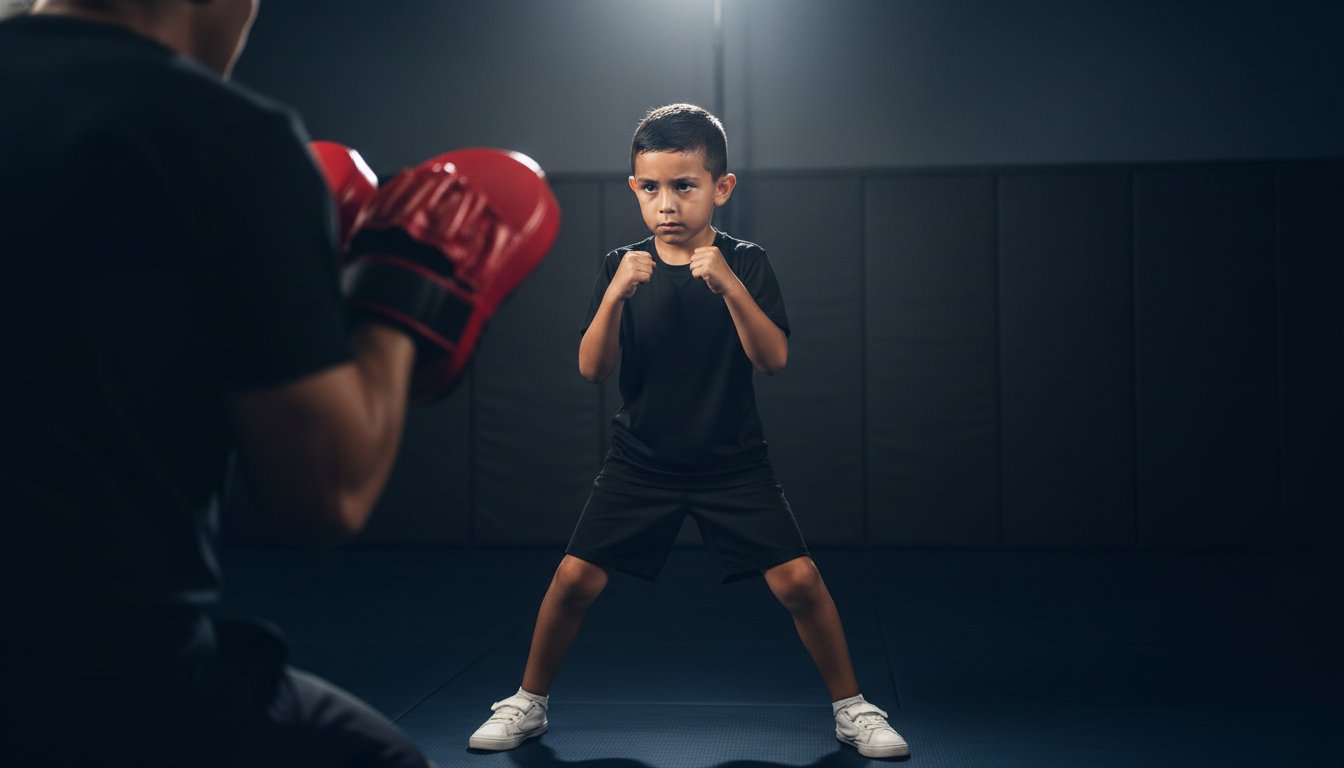
ADHD isn’t a deficit of energy that needs to be suppressed. It’s a high-octane engine. It just needs a high-performance track. If you’ve spent seasons on the sidelines of soccer games feeling judged by other parents, you know the struggle. Traditional team sports often leave children with ADHD feeling isolated or misunderstood. You need a place where their energy is an asset. Not a liability. Finding the right martial arts for kids with adhd is the turning point where your child stops struggling and starts leading.
We understand the frustration of seeing your child’s self-esteem dip because of school struggles. You want results that show up on the report card and at the dinner table. You’re looking for better emotional regulation and a community that actually accepts your kid. This article shows you how practical training provides the structure and physical outlet your child needs to thrive. We’ll break down why styles like Brazilian Jiu-Jitsu and Krav Maga build focus better than traditional sports. Discover how to give your child the tools to succeed everywhere.
Key Takeaways
- Understand how complex, practical movements trigger natural dopamine regulation to help your child find focus without the boredom of traditional sports.
- Learn why choosing the right martial arts for kids with adhd means prioritizing active engagement over rigid, repetitive forms.
- Identify the “bench-warmer syndrome” and why constant physical activity is the best way to keep high-energy children motivated and focused.
- Get a practical checklist for your first “vibe check” at a gym to ensure the environment is ego-free and truly supportive.
- Discover how a mentor-led community builds the emotional regulation skills your child needs to succeed in the classroom and at home.
Why Traditional Sports Often Fail Kids with ADHD
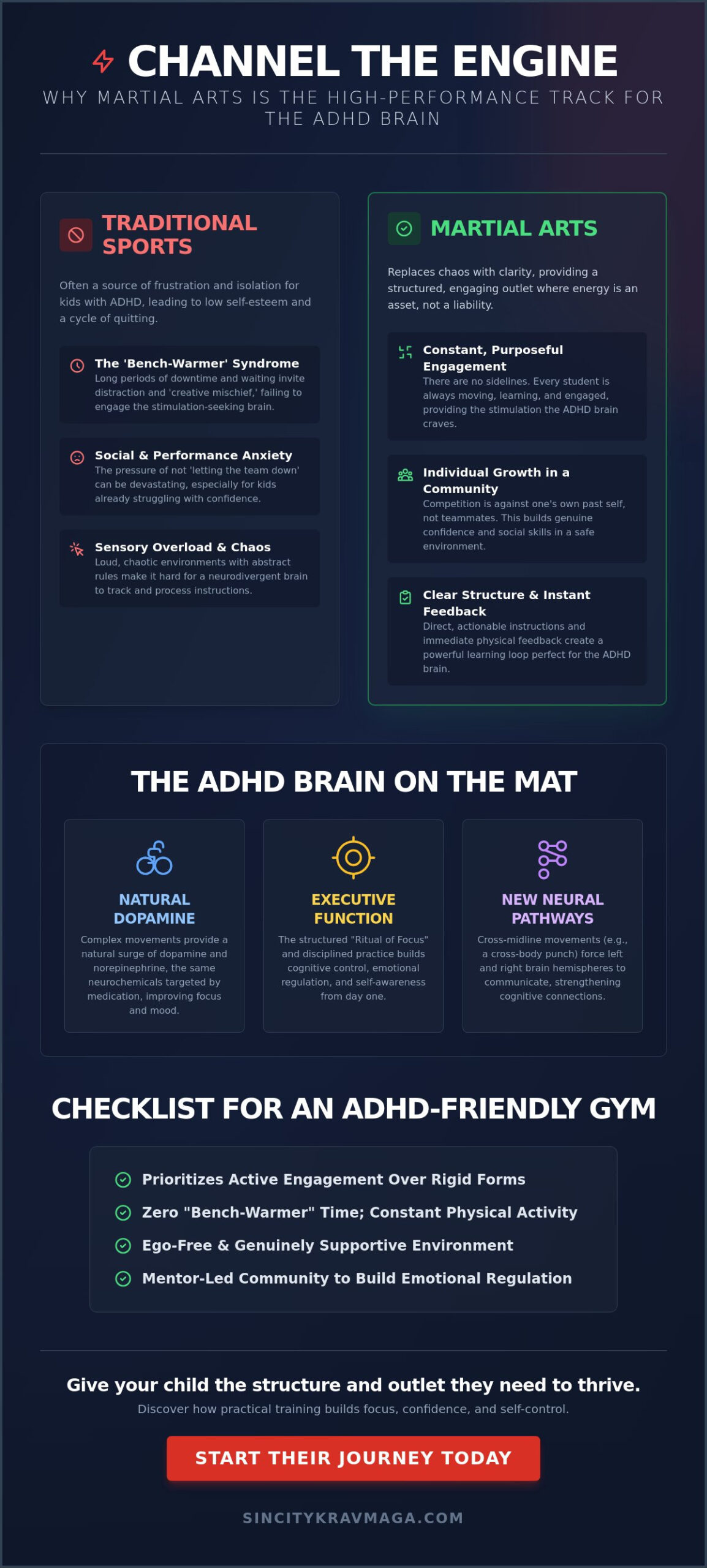
Team sports are loud. They’re often chaotic. For many parents, Saturday morning soccer is a source of stress rather than pride. You watch your child wander off during a play. You see them get distracted by a blade of grass while the ball zooms past. This happens because Attention Deficit Hyperactivity Disorder (ADHD) affects how a child processes complex instructions and sensory input. In a crowded gymnasium or a sprawling field, the noise is overwhelming. The rules are often abstract. Your child feels lost in the crowd.
Finding the right martial arts for kids with adhd solves this by replacing chaos with clarity. Team sports rely on moving parts that a neurodivergent brain might struggle to track all at once. Martial arts simplifies the equation. It’s about the student and the instructor. It’s about direct, actionable feedback. There’s no hiding in the back of the pack. Every movement has a purpose. Every second counts. We focus on the individual’s progress within a community, ensuring no one gets left behind on the bench.
To better understand this concept, watch this helpful video:
The Problem with ‘Downtime’ in Youth Sports
ADHD brains crave stimulation. They need a constant stream of engagement to stay locked in. Baseball is the ultimate test of patience; for these kids, it’s a failing grade. Standing in the outfield for twenty minutes waiting for a fly ball is an invitation for distraction. We call this ‘creative mischief.’ When there’s nothing to do, the brain finds something to do. Usually, it’s something that gets them in trouble with the coach. Martial arts for kids with adhd eliminates this ‘bench-warmer’ syndrome. There are no sidelines. You’re always moving, always learning, and always engaged. The consequences are immediate. If you drop your guard during a drill, you feel the shift in balance right away. That instant feedback loop is exactly what the ADHD brain needs to thrive.
Social Anxiety and the Team Dynamic
The pressure of a team can be paralyzing. Nobody wants to be the kid who missed the game-winning shot. For a child already struggling with self-esteem due to school, this public failure is devastating. It leads to a cycle of quitting and low confidence. Martial arts offers a different path. It’s a structured individual pursuit within a supportive community. You’re training with peers, but you’re only competing against your own previous best. This removes the fear of ‘letting the team down.’ It allows for genuine social growth in a controlled environment. Social skills are built through partner drills and mutual respect. It’s safe. It’s predictable. It’s effective.
The ADHD Brain on the Mat: How Martial Arts Builds Executive Function
The ADHD brain works differently. It’s often a dopamine-seeking machine. When a child trains, their body releases the very chemicals their brain is searching for. This isn’t just theory. A recent scientific study on martial arts and ADHD confirms that structured physical activity directly improves cognitive control. Training provides a natural surge of dopamine and norepinephrine. These are the same chemicals targeted by many medications. By using martial arts for kids with adhd, you’re giving your child a healthy, physical way to regulate their own brain chemistry.
Movement is medicine. We use complex techniques that require crossing the ‘midline’ of the body. Think about reaching across your chest to grab a lapel or throwing a cross-body punch. These movements force the left and right hemispheres of the brain to communicate. It builds new neural pathways. It’s like upgrading the wiring in a house. Every class starts with a ‘Ritual of Focus.’ We bow in. We stand tall. We leave the outside world at the door. This routine acts as a nervous system reset. It tells the brain that the chaos is over. The work starts now. Finding the right martial arts for kids with adhd is about more than just kicks and punches; it’s about brain development.
Proprioception and Self-Regulation
Proprioception is knowing where your body is in space without looking. Kids with ADHD often lack this awareness. They bump into furniture. They play too rough without meaning to. In Brazilian Jiu-Jitsu, they get the ‘heavy work’ their sensory system craves. Grappling and wrestling provide deep pressure. It’s calming. It turns physical impulsivity into controlled, purposeful movement. They learn to master their own strength.
The Science of ‘Focus Training’
Think of executive function as the brain’s ‘air traffic control system’ for kids. It manages everything from following directions to finishing homework. Martial arts acts as moving meditation. We don’t just teach a kick. We break it down into four distinct steps. Look. Chamber. Strike. Reset. By mastering these small increments, a child builds the confidence to tackle larger tasks. This discipline doesn’t stay on the mat. It follows them home. It shows up in better school grades and a cleaner bedroom. If you’re ready to see this transformation, consider checking out the classes at Sin City Krav Maga & Fitness to find the right fit for your family.
Choosing the Right Style: Practical Movement vs. Rigid Tradition
Traditional martial arts like Karate or Tae Kwon Do are the standard recommendation. You have likely heard it a thousand times. But here is the reality. Memorizing long, static sequences called katas or forms can be a disaster for a child who struggles with focus. It is repetitive. It is theoretical. For many, it is just plain boring. When an ADHD brain gets bored, it checks out. That is when the fidgeting starts. That is when they want to quit. You don’t need more “drills” that feel like schoolwork. You need engagement.
Practical styles offer a better alternative. We focus on movement that makes sense. In Krav Maga, we use natural instincts. In Brazilian Jiu-Jitsu, we solve physical puzzles. This “live” training keeps the brain engaged because the problem is changing in real-time. You can’t daydream when someone is trying to control your movement on the mats. This constant stimulation is why these styles are the premier choice for martial arts for kids with adhd. It turns training into a game of high-stakes problem solving. It keeps them locked in.
The benefits of kids in martial arts are most visible when the training is functional. We don’t care about aesthetic performance or high-kicking for a trophy. We care about results. We want your child to be safe, confident, and focused. Practical training provides a direct link between effort and outcome. There is no ambiguity. This clarity is exactly what a neurodivergent child needs to build a sense of mastery.
Why Krav Maga and BJJ Work for ADHD
Krav Maga is built on what your body already wants to do. There are no rigid, 45-degree-angle stances that feel like a chore. It is fast. It is direct. It is practical. Brazilian Jiu-Jitsu is often called “human chess.” It requires intense mental engagement. You have to plan your next move while reacting to your partner. This level of focus is exactly what builds executive function. It teaches them to stay calm under pressure. It prioritizes real-world safety over point-sparring rules that don’t apply outside the gym.
The ‘Ego-Free’ Environment Factor
The style on the sign is important, but the culture inside the gym is everything. You need to avoid “Belt Factories.” These are places that hand out ranks just for showing up and paying a fee. They prioritize profit over progress. For a child with ADHD, this lack of genuine challenge leads to disengagement. Look for these signs of a healthy gym:
- Individualized Attention: Instructors who know your child’s specific triggers and strengths.
- Realistic Goals: Progress based on skill mastery, not a calendar date.
- Positive Reinforcement: Discipline delivered with respect, not through shame or shouting.
Brock and Camilla built this gym to be a sanctuary. It’s an ego-free zone. We don’t use intimidating tropes or military-style shouting. We use encouragement and high standards. We recognize that every child learns differently. When you choose martial arts for kids with adhd, look for a place where your child is a name, not a number. A supportive community is the foundation of every life-changing transformation.
What Parents Should Look for in an ADHD-Friendly Martial Arts Gym
Choosing a gym is a major decision. It isn’t just about the location or the price. It’s about the environment. You need to perform a ‘Vibe Check.’ Walk into the facility. Don’t just look at the trophies on the wall. Look at the students on the mat. Are they engaged? Is the instructor’s voice encouraging or just loud? Martial arts for kids with adhd requires a specific balance of firm boundaries and genuine empathy. If the atmosphere feels cold or overly rigid, your child will likely shut down before the first water break.
The instructor-to-student ratio is your next priority. A child with ADHD can easily get lost in a crowd of thirty students. When they lose the thread of the lesson, they find ‘creative mischief’ to fill the void. You want a gym that keeps classes manageable or ensures multiple coaches are on the floor. This ensures your child gets the direct feedback they need to stay locked in. It prevents them from becoming a face in the back of the room who isn’t actually learning the skills.
Flexibility is the final piece of the puzzle. Life with a neurodivergent child is unpredictable. You don’t want the added stress of a 12-month binding commitment. This is why finding no contract martial arts las vegas is vital. It allows you to focus on your child’s progress rather than a monthly bill you’re forced to pay. Use a trial class strategy. It lets you gauge the fit in real-time. If the gym is confident in their product, they won’t need to trap you with a long-term contract.
Questions to Ask the Lead Instructor
Be direct with your questions. Ask how they handle a child who is having a sensory meltdown or losing focus. A seasoned instructor won’t be offended. They’ll have a clear, compassionate protocol. Inquire about age-specific groupings. If you are looking for martial arts for 5 year olds, the curriculum should focus on foundational movement and listening skills, not just high-intensity combat. Finally, ask if they offer private training. Sometimes a few one-on-one sessions can bridge the gap for a child who feels overwhelmed by a group setting.
Red Flags to Avoid
Watch out for gyms that use shame as a coaching tool. Public punishment for a lack of focus is a massive red flag. It destroys self-esteem and creates a negative association with physical activity. Be wary of high-pressure sales tactics. If the staff is more interested in your credit card than your child’s needs, keep looking. Avoid overly ‘militaristic’ environments. While discipline is key, constant shouting can trigger anxiety in neurodivergent kids. You want a mentor, not a drill sergeant. Understanding how to build self discipline in a child through action rather than lectures is the key distinction between a gym that produces real results and one that simply goes through the motions.
If you’re ready to find a community that truly understands your child, sign up for a trial at Sin City Krav Maga & Fitness today and experience our ego-free approach.
Sin City Krav Maga & Fitness: A Supportive Community for Every Child in Las Vegas
Sin City Krav Maga & Fitness isn’t just another gym. It’s a sanctuary for families in Northwest Las Vegas. We understand the specific hurdles you face at school and on the sports field. Our mats are a place where your child’s high energy is an asset, not a problem to be solved. Brock and Camilla founded this school on a strictly ego-free philosophy. We don’t care about being the toughest people in the room. We care about being the most supportive guides for your child’s transformation. This is martial arts for kids with adhd that focuses on the individual student. We act as pragmatic mentors. We provide firm discipline, but we always lead with a heart.
We believe in the power of our training. That’s why we explicitly reject long-term binding contracts. You shouldn’t feel trapped by a membership while you’re navigating your child’s needs. Life with a neurodivergent child requires flexibility. We make it easy to start. If our program isn’t the right fit, you won’t be penalized. This removes the financial stress. It lets you focus on what actually matters: your child’s progress. We want your family here because our community is making a difference. Not because of a legal document.
Real Skills for the Real World
We move beyond the theoretical “forms” found in other schools. We don’t teach point-sparring that only works in a controlled tournament. We teach actual self-defense and functional movement. This practical focus is what helps our students become local leaders. They learn that respect is earned through consistent action. They see that discipline leads to tangible growth. Our family-oriented culture at Sin City Krav Maga & Fitness ensures every child feels safe. They aren’t just another face in a class. They are part of a localized, boutique experience where instructors know their names and their stories. Beyond building focus and confidence, our kids Krav Maga Las Vegas program also equips children with the de-escalation skills and bully-proof confidence they need to stay safe at school.
- No Ego: A culture of humility where students help each other grow.
- No Contracts: Freedom to choose what’s best for your family month-to-month.
- Real Skills: Training that works in the real world, not just a gym.
- Community: Expert instruction from leaders who care about your child’s success.
Start Your Child’s Journey Today
The best way to understand our approach is to see it in person. We invite you to bring your child to the mat. Every child is welcome here. We don’t care about labels. We care about potential. When you choose martial arts for kids with adhd, the connection between the student and the coach is the most important factor. Your child deserves a place where they can be themselves while learning the skills to become their best version. We are ready to partner with you.
Ready to see the difference for yourself? Book a trial class at Sin City Krav Maga & Fitness and join our community today.
Take the Next Step Toward Your Child’s Success
Your child doesn’t need another activity where they feel misunderstood or sidelined. They need an environment that transforms their high-octane energy into a distinct advantage. Throughout this article, we’ve explored why practical movement and immediate feedback succeed where traditional team sports often fail. Finding the right martial arts for kids with adhd is the first step toward building the focus and emotional regulation they need to thrive in the classroom and at home.
At Sin City Krav Maga & Fitness, we do things differently. Brock and Camilla provide expert instruction in a setting that is strictly ego-free and community-focused. We serve Northwest Las Vegas families with a commitment to real results and genuine safety. You won’t find any long-term binding contracts here. We believe in the life-changing results of our training; we want you to feel confident in your child’s progress every single month. It’s time to stop managing energy and start mastering it.
Start your child’s journey with a trial class at Sin City Krav Maga & Fitness. Give them the tools to succeed on and off the mat. We are ready to help your child lead.
Frequently Asked Questions
Is martial arts safe for a child with ADHD who is prone to impulsivity?
Martial arts is safe because it provides a highly structured environment with clear, immediate consequences for impulsive actions. We don’t just let kids go wild. We teach them the stop and start mechanics of their own bodies. This helps them recognize the urge to act before they follow through. It builds a mental brake system that they can use in the classroom or on the playground. Safety is our non-negotiable priority.
Will martial arts make my ADHD child more aggressive?
Training does not make children more aggressive; it actually teaches them to regulate their emotions. By providing a safe, physical outlet for frustration, children learn how to process big feelings without lashing out. They realize that true strength is shown through self-control and respect for their training partners. Most parents find that their children are significantly calmer and more cooperative at home after a hard session on the mats.
How many times a week should a child with ADHD attend martial arts classes?
Attending classes two to three times per week is the ideal frequency for martial arts for kids with adhd. This schedule provides enough repetition to build muscle memory and focus without causing sensory burnout. Consistency is the foundation of success here. It creates a predictable routine that helps the child feel secure and prepared. We find that kids who attend at this rate stay motivated longer and see better results.
What is the best age for an ADHD child to start martial arts?
Most children are ready to start their journey at age five. This is the stage where they begin to grasp multi-step instructions and can participate in group social dynamics. Starting early allows us to build foundational listening skills before the pressures of school become overwhelming. If your child is younger, we recommend a trial class to see how they handle the structure and the noise of a busy training environment.
How long does it take to see focus improvements in an ADHD child?
You will often see an immediate improvement in physical energy levels after the first few classes. However, lasting improvements in school focus and emotional regulation typically take three to six months of consistent effort. We are building new neural pathways and better executive function. This isn’t a quick fix; it’s a long-term investment in your child’s ability to manage their own mind. Stay the course and the results will follow.
Can martial arts replace therapy or medication for ADHD?
Martial arts is a powerful support system, but it should not be used as a replacement for professional medical therapy or prescribed medication. It acts as a physical laboratory where kids can practice the skills they learn in therapy. It provides a natural dopamine boost that complements clinical treatments. Always discuss any major changes to your child’s ADHD management plan with your pediatrician or mental health professional to ensure a balanced approach.
What if my child wants to quit after three weeks?
It’s common for kids with ADHD to want to quit once the initial novelty wears off and the work gets challenging. This is the moment where the most growth happens. We encourage parents to commit to a specific period to get past that first hurdle. Our no-contract policy gives you peace of mind, but we find that children who push through the novelty dip end up gaining the most confidence and resilience.
What is the difference between Krav Maga and Karate for a child with ADHD?
The main difference is the level of mental engagement required by each style. Karate often relies on memorizing static forms which can lead to boredom and disengagement for a neurodivergent brain. martial arts for kids with adhd like Krav Maga or Brazilian Jiu-Jitsu focus on instinctive, practical movements. These styles require live problem-solving and constant adaptation. This keeps the brain stimulated and prevents the child from checking out during the lesson. If you are concerned about bullying as well as focus, our anti-bullying classes for kids in Las Vegas teach children how to use their words before their hands while building the real-world confidence to stand tall in any situation.