Tag: Emotional Regulation

  • Anger Management for Kids in Las Vegas: Why Martial Arts is the Physical Solution

    Anger Management for Kids in Las Vegas: Why Martial Arts is the Physical Solution

    What if the answer to your child’s outbursts isn’t more talking, but more movement? You’re likely exhausted from the constant phone calls from school. You’re searching for effective anger management for kids Las Vegas, but traditional talk therapy just isn’t sticking. You worry about your high-energy child being labeled as “troubled” because they have more energy than words. We understand that frustration. It’s a heavy weight for any parent to carry alone.

    There is a practical, physical solution to this cycle. Martial arts provides a controlled outlet for those intense emotions. It turns explosive energy into disciplined, purposeful action. You’ll discover how training helps your child learn to pause before they react. We will look at how this physical discipline translates to improved focus at school and a calmer home life. Your child doesn’t need to be fixed. They just need a place to channel their power. Let’s find that outlet together.

    Key Takeaways

    • Turn explosive energy into disciplined action. Physical outlets like grappling and heavy bag work help lower cortisol and release stored frustration.
    • Discover why effective anger management for kids Las Vegas requires more than just talk therapy for children who need to move to learn.
    • Build an “internal brake” through training. Our “Stop, Breathe, Move” philosophy teaches kids to choose their response instead of reacting blindly.
    • Avoid “trophy mills” and point-sparring. Learn to identify ego-free environments that prioritize individual growth and genuine support over plastic medals.
    • Lower the barrier to entry with month-to-month flexibility. Real transformation happens in a community that values your child’s progress over a binding contract.

    Understanding Anger in Kids: Why Las Vegas Parents are Seeking Alternatives

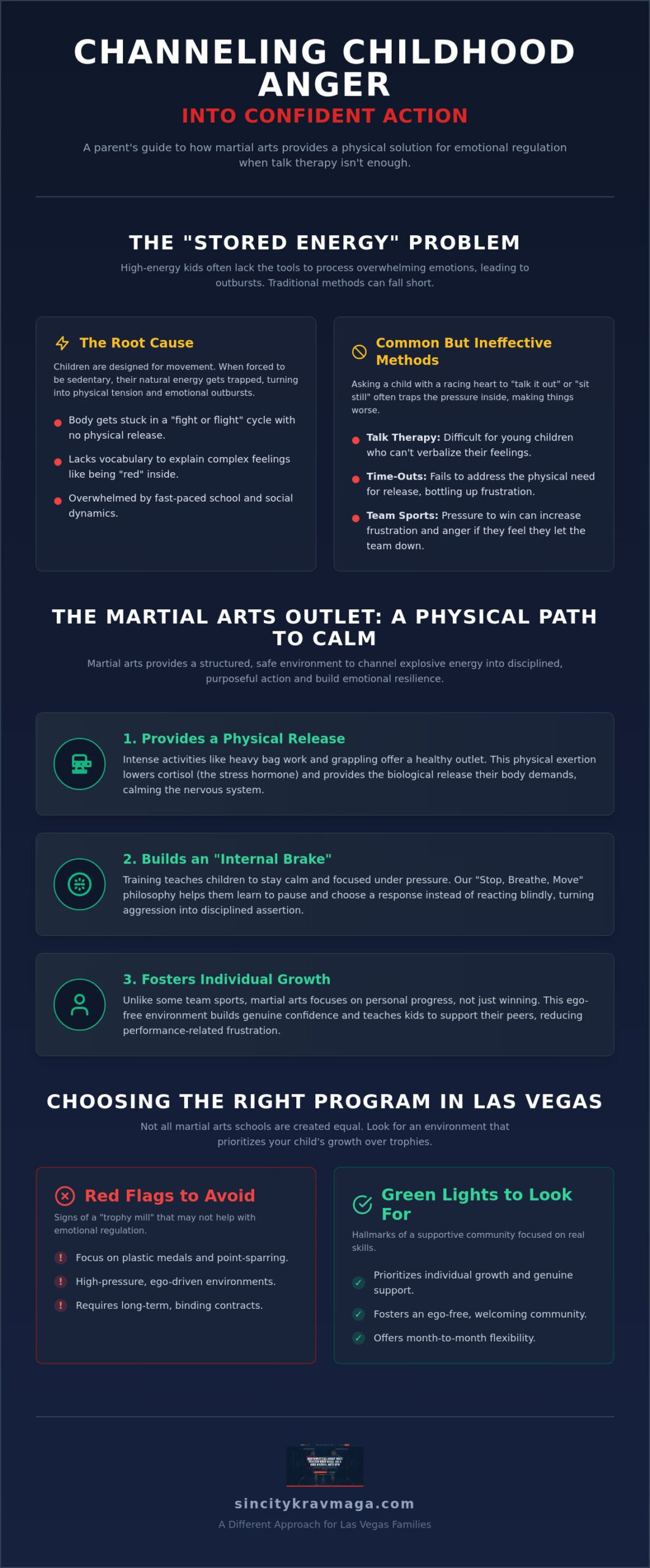
    Anger isn’t a “bad” emotion. It’s a signal. It often means a child lacks the communication tools to express what’s happening inside. For many parents seeking anger management for kids Las Vegas, the struggle is real. Our city presents unique stressors. Large school districts and fast-paced social dynamics can leave a high-energy child feeling overwhelmed and unheard. They don’t need a lecture; they need a way to process what they feel.

    When a child acts out, the standard response is often a “time-out.” For many kids, this fails. You’re asking a child with a racing heart and clenched fists to sit still. It doesn’t solve the problem; it just traps the pressure inside. We need to distinguish between aggressive behavior and assertive self-protection. Aggression is a loss of control. Assertion is a disciplined, confident response. Martial arts teaches the difference by giving kids a safe space to test their limits.

    To better understand how physical disciplines help manage these intense emotions, watch this helpful video:

    The “Stored Energy” Problem

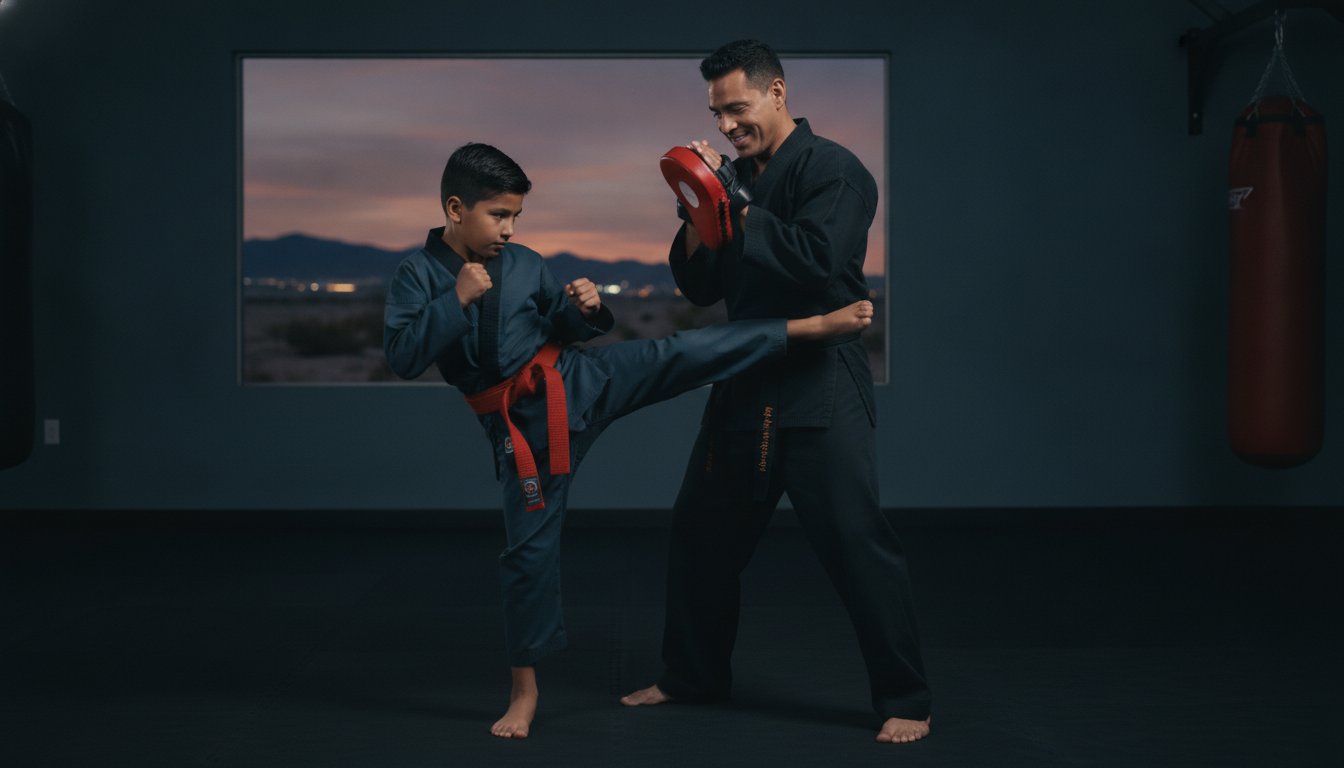
    Kids are biologically designed for movement. When they spend hours sitting at a desk, that energy doesn’t just disappear. It turns into physical tension. This leads to emotional outbursts over small things. Their bodies are stuck in a “fight or flight” cycle with no exit. Martial arts provides that exit. It offers a structured environment to release big feelings through heavy bag work or grappling. It isn’t about teaching them to fight. It’s about giving their body the biological release it demands. This is a vital component of effective anger management for kids Las Vegas.

    When Talk Therapy Isn’t Enough

    Talk therapy is a great tool, but it can be difficult for a young child. A seven-year-old often can’t explain why they feel “red” inside. They lack the complex vocabulary needed for traditional sessions. Movement bridges this gap. By utilizing psychological principles in sports, kids learn to regulate their nervous systems through physical action. Martial arts acts as a moving meditation. It helps them connect their feelings to their actions. They learn to stay calm under pressure and breathe when things get tough. This is the foundation of lasting change.

    The Physical Outlet: Why Martial Arts Works for Anger Management

    Anger is heavy. It sits in the chest and tightens the jaw. For a child, this weight is often too much to carry. They need a place to put it. Martial arts provides a structured environment to release these “big feelings” without judgment. It’s not about aggression. It’s about redirection. We take that destructive energy and transform it into productive, life-saving skills. This physical transition is a cornerstone of anger management for kids Las Vegas.

    When a child hits a heavy bag or engages in grappling, their body undergoes a chemical shift. Intense physical exertion helps lower cortisol levels, the hormone responsible for stress. This isn’t just theory. Research into a martial arts curriculum for emotional regulation shows that structured movement reduces emotional distress. Training creates “controlled chaos.” We use drills that mimic the physical sensation of stress. A child’s heart rate goes up. Their breathing gets shallow. In a typical setting, this leads to a meltdown. In our gym, it leads to a drill. They learn to keep their brain “online” while their body is under pressure. This translates directly to the playground. When a classmate pushes their buttons, their body recognizes the stress, but their brain knows how to stay in charge.

    Krav Maga vs. Traditional Sports

    Team sports are valuable, but they aren’t for everyone. The pressure to win for the team can actually increase a child’s anger. If they miss a goal or let down a teammate, the frustration boils over. Our approach to kids martial arts las vegas is different. We focus on individual progress. There are no benches to sit on and no teammates to disappoint. Validation comes from within. A child sees their own growth, which builds a foundation of confidence that doesn’t rely on a scoreboard. If you’re looking for a supportive environment to help your child grow, consider checking out the programs at Sin City Krav Maga.

    The Science of the “Cool Down”

    Training teaches the brain to stay “online” even when the body is working hard. Most kids with anger issues lose focus when they get mad. Martial arts reverses this. We use physical exertion to strengthen the nervous system’s ability to regulate itself. Proprioception is the body’s ability to perceive its own position and movement in space; developing this physical awareness directly leads to a greater sense of emotional stability and calm. When a child knows where they stand physically, they feel more secure emotionally. They learn to breathe through the heat. This is why martial arts is such a powerful tool for anger management for kids Las Vegas. It gives them the internal brake they’ve been missing.
    Anger Management for Kids in Las Vegas: Why Martial Arts is the Physical Solution

    Building the “Internal Brake”: Discipline Over Aggression

    Discipline is not about following orders. It is about self-command. For parents exploring anger management for kids Las Vegas, this distinction is vital. Anger is a blind reaction; discipline is a conscious choice. We teach kids to identify the exact moment before the explosion. It’s the “internal brake” that allows them to pause, assess, and act with purpose instead of lashing out. This isn’t just about behaving. It’s about taking ownership of their own power.

    Our training centers on the “Stop, Breathe, Move” philosophy. When the heat of frustration rises, the first step is to stop the momentum. Next, a deep breath resets the nervous system. Finally, the child moves with a disciplined response. This repetitive drilling builds muscle memory for calm. On the mat, kids learn to fail. They lose a position in Brazilian Jiu-Jitsu or miss a strike in Krav Maga. These moments are micro-lessons in resilience. They learn that frustration is a part of growth, not a reason to quit. Paradoxically, learning self-defense actually reduces the need for fighting. A child who knows they can protect themselves doesn’t feel the need to prove it through aggression. Confidence is quiet; insecurity is loud.

    The Role of the Instructor

    Kids often view doctors as clinical and parents as the “boss,” but they see a coach as a mentor. In Northwest Las Vegas, having reliable role models is essential for a child’s development. Brock and Camilla lead by example every day. They show our students that true strength isn’t about being the loudest person in the room. It’s about maintaining composure when things get intense. This “Pragmatic Mentor” approach creates a bond of respect. When a coach speaks, kids listen differently because they see the discipline in action.

    From the Mat to the Classroom

    The skills learned in the gym don’t stay in the gym. The benefits of kids in martial arts show up where they matter most: in the classroom and at home. Teachers often report that our students show improved listening and a sharper ability to focus on tasks. The transformation is practical. We have seen students recognize the physical signs of a heart rate spike during a difficult math test. Instead of a meltdown, they use “mat breathing” to clear their heads and stay in the game. They treat the test like a training drill. This is how anger management for kids Las Vegas becomes a life skill that lasts far beyond childhood. They learn to navigate pressure without breaking.

    Choosing a Program in Las Vegas: Red Flags and Green Lights

    Finding the right training environment is a high-stakes decision for your family. Not every martial arts school is equipped for anger management for kids Las Vegas. Some facilities prioritize plastic trophies over personal transformation. These “Trophy Mills” often rely on point-sparring, a style of competition that can actually increase a child’s frustration. When a child is penalized for a technicality they don’t understand, the anger boils over. They don’t need a game; they need a practical outlet for their energy.

    A “No-Ego” rule is the most important green light you can find. A child struggling with intense emotions already feels judged by teachers, peers, and even themselves. They need a supportive community that feels like a second home. This means an environment where instructors lead with approachable authority rather than intimidation. It means a place where every student is recognized personally and supported through their specific challenges. If the gym feels like a factory, it isn’t the right fit for a high-energy child.

    Watch out for long-term binding contracts. Your child’s needs can change, and you shouldn’t be locked into a year-long commitment before you know if the program works. We believe in month-to-month flexibility. This keeps the school accountable to you and your child every single month. Additionally, ensure the instruction is age-appropriate. A five-year-old has different emotional and physical needs than a twelve-year-old. Mixing these groups often leads to chaos and prevents the focused discipline required for anger management for kids Las Vegas.

    The Importance of Real-World Skills

    Practicality builds genuine confidence. Memorizing “kata” or complex, dance-like forms doesn’t help a child feel safer on the playground. In fact, it can lead to more frustration when they realize those skills don’t translate to reality. Our self defense classes las vegas empower kids by teaching them how to handle actual physical threats. When a child knows they can protect themselves, their internal “threat response” lowers. They no longer feel the need to be on high alert. This sense of safety is the ultimate antidote to explosive anger.

    Visiting the Facility

    The best way to vet a school is to walk through the doors. Look at the atmosphere in the Northwest Las Vegas facility. Do the instructors, like Brock and Camilla, know the students by name? Is there a sense of energetic focus or just loud noise? You want to see instructors who genuinely care about student growth and manage intensity with a calm hand. Starting with a krav maga trial class las vegas allows you to see the community in action. It gives your child a chance to experience the “Stop, Breathe, Move” philosophy firsthand before you make any commitment.

    If you’re ready to provide your child with a healthy physical outlet and a supportive community, check out our kids martial arts programs at Sin City Krav Maga today.

    Sin City Krav Maga: A Different Approach for Las Vegas Families

    We aren’t just another martial arts school. Sin City Krav Maga has been a trusted fixture in the Northwest Las Vegas community since 2010. We know the families here. We understand the pressures your kids face every day in our fast-paced city. Our approach to anger management for kids Las Vegas isn’t clinical or theoretical. It’s practical. We provide a second home where kids feel safe to fail, learn, and grow without the fear of being judged.

    Brock and Camilla lead with a simple, powerful philosophy: practical skills, no ego, and a supportive community. We don’t believe in intimidating kids into submission. We believe in building them up from the inside out. Every child is an individual. They have unique needs and different triggers. Our instructors recognize this personally. They focus on the person, not just the technique. This personal investment is what creates life-changing transformations that last far beyond the mat. It’s a partnership between our coaches and your family.

    We also believe in complete transparency. You won’t find long-term contracts or hidden traps here. We offer month-to-month flexibility because we want you to stay because the program works, not because a legal document says you have to. This freedom allows your family to find what truly sticks without the stress of a financial burden. We’re here to solve problems, not create new ones. If you’re looking for effective anger management for kids Las Vegas, you deserve a program that respects your time and your child’s progress.

    The Sin City Kids Program

    Our program serves kids ages 5 to 14. We tailor the training to fit their specific developmental stage. A 6-year-old needs different guidance than a 13-year-old navigating middle school. We integrate jiu jitsu classes las vegas into our curriculum to build ground-based confidence. If a child knows they can handle themselves if a situation goes to the ground, their anxiety drops. Their need for aggressive outbursts fades because they no longer feel powerless. We call this the Pragmatic Mentor approach. We hold high standards for discipline, but we provide even higher levels of support to help them get there.

    Start the Transformation Today

    The first step is often the hardest for a parent. We make it easy. You can sign up for a trial to meet our team and see the energy in our facility firsthand. During your child’s first week, they won’t be thrown into the deep end. They’ll learn the basics of stance, movement, and the “Stop, Breathe, Move” philosophy. They’ll meet other kids who are on the same journey toward self-control. You’ll see them walk off the mat with their head held a little higher and their focus a little sharper. Don’t wait for another frustrating phone call from the school. Join the Sin City Krav Maga community today and give your child the physical tools they need to stay calm under pressure.

    Empower Your Child to Lead with Calm Confidence

    Your child doesn’t need to be “fixed.” They need to be understood. We’ve seen how martial arts transforms explosive energy into quiet strength by building that vital internal brake. It’s about giving them a safe place to fail and the discipline to try again. This physical outlet is the key to lasting anger management for kids Las Vegas. It moves the focus from reacting to situations to commanding themselves.

    You don’t have to navigate this journey alone. Since 2010, we’ve been a local favorite in Northwest Las Vegas for families seeking real change. Brock and Camilla provide expert instruction that focuses on the individual needs of every student. We don’t use long-term contracts because we believe our results speak for themselves. You get the month-to-month flexibility your family needs and the transformation your child deserves.

    Take the first step toward a calmer home life and a more focused student. Book a No-Obligation Trial Class for Your Child today. Let’s help them find their focus and build a future rooted in self-command. Your child already has the power. We just help them channel it correctly.

    Frequently Asked Questions

    Is martial arts too aggressive for a child with anger issues?

    No, it is the exact opposite. Martial arts provides a controlled, safe environment to release physical tension and learn self-regulation. We don’t teach kids to be aggressive; we teach them to be disciplined. By practicing movements that require focus and breathing, they learn to manage their power. This prevents the explosive, “blind” anger often seen in children who lack a healthy physical outlet for their energy.

    How long does it take to see behavioral changes in my child?

    Most parents notice a positive shift in their child’s focus and composure within the first four to six weeks of regular training. While every child is different, the repetitive nature of our “Stop, Breathe, Move” philosophy starts to build muscle memory quickly. You will likely see your child pausing more before reacting to frustrations at home or school. Real transformation is a journey, but the initial “internal brake” often develops during the first month.

    What is the best age for a child to start martial arts in Las Vegas?

    We start training kids as young as five years old. This is the ideal age to begin building the foundations of discipline, respect, and body awareness. At five, children are learning how to navigate social dynamics and handle frustration in group settings. Our programs are specifically tailored for the 5-14 age range to ensure every drill is developmentally appropriate, safe, and engaging for their specific stage of growth.

    Will my child be forced into long-term contracts at Sin City Krav Maga?

    No, we never use long-term binding contracts. We believe in month-to-month flexibility because it keeps us accountable to you and your child’s progress every single class. You stay with us because our program works for your family, not because a legal document requires it. This approach makes starting anger management for kids Las Vegas much easier for parents who want to find the right fit without a trap.

    How does Krav Maga differ from traditional Karate for kids?

    Krav Maga focuses on practical, real-world self-defense instead of point-sparring or memorized forms called “kata.” While some traditional styles can increase frustration, authentic organizations like JKA Shotokan Karate Club Dubai demonstrate how traditional Karate, when taught with a focus on character, can also foster deep self-discipline. We prioritize functional skills that build genuine confidence. When a child feels truly capable of protecting themselves, their overall “threat response” lowers, leading to a much calmer daily life.

    Can martial arts help my child with ADHD and anger?

    Yes, martial arts is highly effective for children with ADHD who struggle with emotional regulation. The structured, high-energy nature of our classes provides the physical release and dopamine they need to stay regulated. By practicing complex movements and following a coach’s direct instructions, they build the “mental muscle” required to stay on task. It turns their high energy from a potential liability into a productive, life-saving skill.

    What should my child wear to their first class at Sin City Krav Maga?

    Comfortable athletic wear like a t-shirt and shorts or leggings is perfect for the first day. Avoid clothing with zippers, buttons, or deep pockets that could catch on the mats or other students during training. We provide a safe, ego-free environment, so there is no need to worry about a specialized uniform right away. Just bring a water bottle, a positive attitude, and a willingness to learn.

    How much do kids martial arts classes in Las Vegas typically cost?

    Martial arts tuition in the valley usually follows a monthly membership model. When researching anger management for kids Las Vegas, you will find that prices often depend on the number of classes per week and the age of the child. We recommend looking for programs that offer a low-cost trial period. This allows you to test the facility and meet instructors like Brock and Camilla before making a financial commitment to your child’s growth.
  • Martial Arts for Hyperactive Children in Las Vegas: Turning High Energy into High Achievement

    Martial Arts for Hyperactive Children in Las Vegas: Turning High Energy into High Achievement

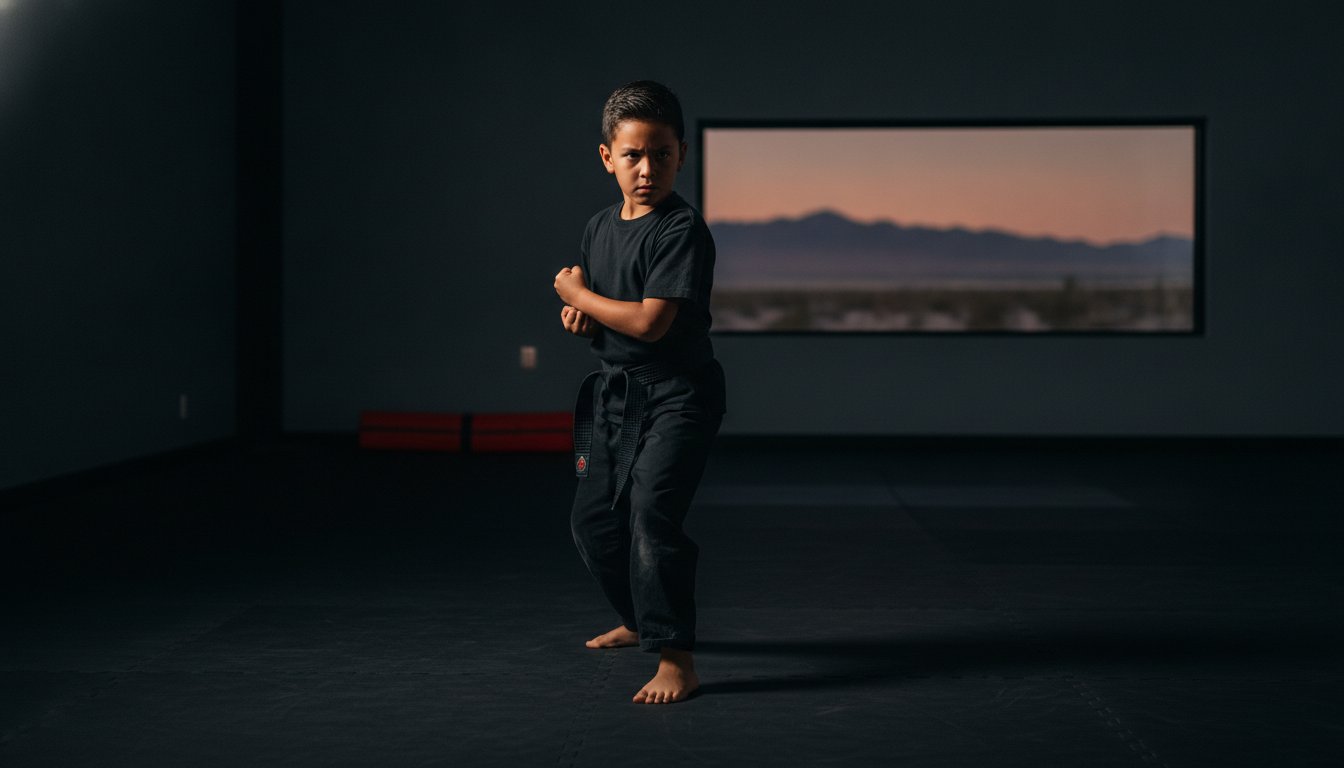
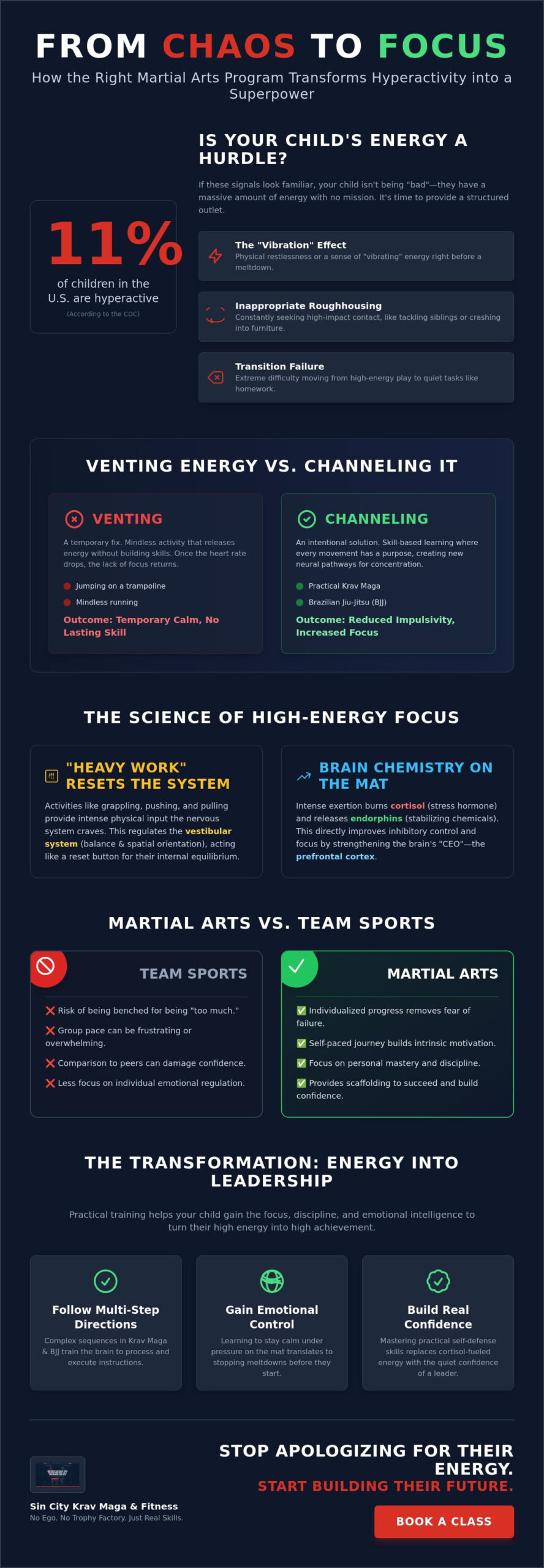
    What if your child’s “explosive” energy wasn’t a behavioral problem to be suppressed, but a high-voltage leadership trait waiting for a grounding wire? You’ve likely felt the sting of judgment from other parents during a public outburst. You might worry your child is falling behind in school because they simply can’t sit still. As many as 11% of children in the U.S. are hyperactive according to the CDC, yet many families still feel isolated. Finding the right martial arts for hyperactive child Las Vegas programs shouldn’t feel like another source of stress. You’re tired of coaches who bench kids for being “too much.” We agree that your child deserves better than being sidelined. They need a place to belong.

    This article shows you how to transform that chaotic energy into lasting discipline and focus through structured, ego-free training. You’ll discover how our approach helps kids follow multi-step directions and gain the emotional control to stop meltdowns before they start. We’ll explore why the individual focus of Kids Martial Arts provides the scaffolding your child needs to succeed. It’s time to stop apologizing for their high energy and start turning it into high achievement. Let’s build their confidence together.

    Key Takeaways

    • Learn how structured environments act as “mental brakes.” Turn misdirected energy into a clear mission.
    • Discover the power of “heavy work.” Physical exertion like grappling helps regulate the vestibular system and stabilize moods.
    • Compare martial arts for hyperactive child Las Vegas training to traditional team sports. Individualized progress removes the fear of being benched.
    • Spot the “Pragmatic Mentor.” Avoid ego-driven trophy factories by choosing instructors who prioritize real skills and community.
    • Foster leadership and emotional intelligence. Practical training helps your child gain focus and follow multi-step directions.

    What is the Best Martial Art for a Hyperactive Child in Las Vegas?

    Las Vegas is loud. It never stops. For a child struggling with hyperactivity, the constant hum of the city can feel like an unending assault on their senses. This often leads to frustration and burnout for both the child and the parent. Hyperactivity isn’t a defect. It’s an engine. Every engine needs a driver. Without one, you just have high-voltage power looking for a mission. Finding a quality program for martial arts for hyperactive child Las Vegas residents shouldn’t be about finding a babysitter. It’s about finding a grounding wire.

    We define a positive outlet as a structured environment that provides both physical exhaustion and mental “brakes.” Many traditional programs focus on “point-sparring,” which is essentially a game of tag. This doesn’t work for high-energy kids. It’s too light. It doesn’t engage the brain. Practical arts like Krav Maga and Brazilian Jiu-Jitsu (BJJ) are different. They require total body awareness and problem-solving. This approach aligns with the principles of Martial arts therapy, where structured movement is used to improve self-regulation and physical control. Your child doesn’t need to be managed. They need to be challenged.

    Venting Energy vs. Channeling Energy

    Mindless running or jumping on a trampoline is venting. It’s a temporary fix. Once the heart rate drops, the lack of focus remains. Channeling energy is different. It’s intentional. Skill-based learning in Kids Martial Arts creates new neural pathways for concentration. Every movement has a purpose. When a child learns a complex BJJ transition or a Krav Maga defense, they aren’t just moving. They’re thinking. This intentional movement is the secret to reducing impulsivity. They learn to process information before they react. They build the stamina to stay focused even when their body wants to quit.

    Common Signs Your Child Needs a Martial Arts Outlet

    Is your child’s energy becoming a hurdle? Look for these specific signals that they need a more structured physical mission:

    • The “Vibration” Effect: You see physical restlessness or a sense of “vibrating” energy right before an outburst or a meltdown.
    • Inappropriate Roughhousing: They constantly seek high-impact contact, like tackling siblings or crashing into furniture, at the wrong times.
    • Transition Failure: They have extreme difficulty moving from high-energy play to quiet tasks like homework or dinner.

    If these signs look familiar, your child isn’t being “bad.” They’re simply uncalibrated. They have a massive amount of energy and no place to put it. In our Northwest Las Vegas community, we focus on real skills. No ego. No “trophy factory” mentality. We provide the practical self-defense training that burns off excess cortisol and replaces it with the quiet confidence of a leader. Your child can learn to follow multi-step directions. They just need the right mission.

    The Science of High-Energy Focus: How Training Grounds the Mind

    Hyperactive children don’t just have “extra” energy. Their bodies are often starving for sensory feedback. This is where “heavy work” comes in. Activities like pushing, pulling, and grappling provide the intense physical input their nervous systems crave. In our programs for martial arts for hyperactive child Las Vegas families, we use these movements to regulate the vestibular system. This is the part of the brain that manages balance and spatial orientation. When a child engages in high-resistance training, it acts like a reset button for their internal equilibrium. It calms the storm inside.

    The biological impact is immediate. Intense physical exertion burns off excess cortisol, the hormone associated with stress and “fight or flight” responses. In its place, the body releases stabilizing endorphins. This chemical shift is vital. Recent research on martial arts and cognitive control shows that these activities significantly improve inhibitory control in children. By providing a controlled environment for aggression on the pads, we actually reduce “uncontrolled” aggression at home. They learn that power requires a purpose. They learn that strength without control is useless.

    This physical discipline directly influences the prefrontal cortex. Think of this area as the brain’s CEO. It handles decision making, focus, and impulse control. Martial arts forces this “CEO” to get to work. Every drill requires the brain to stay present. If you want to see how this transformation starts, visit our training facility and watch a class in action.

    Proprioception and Emotional Grounding

    Proprioception is your body’s ability to sense its position and boundaries in space. Hyperactive kids often have a “noisy” proprioceptive sense, which is why they crash into walls or roughhouse too hard. Brazilian Jiu-Jitsu (BJJ) provides the deep-pressure input they are looking for. The physical resistance of a partner provides a “map” for their nervous system. Feeling the mat beneath them helps a child recognize their own physical and emotional boundaries in real time. They stop guessing where they are and start feeling grounded.

    Building Executive Function on the Mat

    In Krav Maga, we teach a “Pause-Process-Perform” cycle. When a threat or a drill begins, the student must pause their initial panic, process the correct technique, and then perform the move. This isn’t just a self-defense skill. It’s a life skill. Learning complex techniques forces the brain to quiet the background noise and focus entirely on the task at hand. This is exactly why martial arts is a top recommendation for kids with ADHD. We don’t just tire them out. We build their capacity to pay attention.

    Martial Arts for Hyperactive Children in Las Vegas: Turning High Energy into High Achievement

    Martial Arts vs. Team Sports: The Best Environment for High Energy

    Traditional team sports often demand a level of stillness and social compliance that hyperactive kids aren’t ready for. Think about a typical Little League game. A child might stand in the outfield for fifteen minutes without a single ball coming their way. For a child with high energy, that’s an eternity. Inactivity is a massive trigger for frustration. When the brain isn’t engaged, it looks for its own stimulation. Usually, that looks like “acting out.” Finding martial arts for hyperactive child Las Vegas programs solves this by ensuring every second of class is active. There is no bench to sit on. Everyone is moving. Everyone is learning.

    Many parents worry that combat sports will make their child more violent. This is the biggest myth in the industry. The truth is that kids who feel capable are rarely the ones who start fights. Martial arts gives them the confidence to stay calm under pressure. They don’t have to prove anything to anyone because they prove it to themselves on the mat every day. This internal validation is one of the key benefits of martial arts for kids who struggle with self-control. It replaces the need for external attention with a sense of personal mastery.

    Why Team Sports Can Sometimes Trigger Outbursts

    The pressure of “letting the team down” can be crushing. In soccer or baseball, a single mistake can be the focus of the entire sideline. This social comparison creates high stress. For a hyperactive child, this stress often manifests as an emotional meltdown. They “zone out” during the slow parts of the game and then panic when the action starts. A traditional coach is focused on the scoreboard. A pragmatic mentor is focused on the student. We don’t care about the score. We care about the progress. We provide a supportive community where failure is just a data point, not a reason for shame.

    The Individual Journey in a Group Setting

    Martial arts offers the best of both worlds. It’s a group environment, but the journey is entirely individual. This removes the “last pick” anxiety that ruins sports for many kids. Everyone progresses at their own pace. Hyperactive brains crave dopamine, and our belt system provides it in structured, healthy doses. Every stripe on a belt is a visual proof of their hard work. The mat acts as a safe container for big energy. It’s a place where they can be “too much” and still be exactly where they belong. They learn to harness that energy instead of trying to hide it.

    Choosing a Las Vegas Martial Arts School for Your Child

    Selecting a school is a high-stakes decision for your family. You aren’t just looking for a gym. You’re looking for a mentor. We recommend searching for a “Pragmatic Mentor.” These are instructors who are experts in their craft but remain approachable and grounded. Avoid “trophy factories.” If a school focuses more on plastic gold than individual growth, it isn’t the right fit. For a parent seeking martial arts for hyperactive child Las Vegas programs, the environment must prioritize real skills over ego. Your child needs a community, not a corporate hierarchy.

    Transparency is a major factor. Check for “No Contract” options immediately. Most corporate gyms try to lock families into long-term binding agreements. We believe a gym should earn your child’s attendance every single month. This keeps the instructors accountable and the pressure off the parents. If your child has a difficult week, you shouldn’t feel trapped by a legal document. A school that stands by its value won’t need to hide behind a 12-month commitment. It creates a partnership based on results, not fine print.

    Observe a class before you sign up. Pay attention to the small details. Are the instructors identifying kids by name? Are they providing personal encouragement or just barking orders at a group? If the kids are treated like numbers, your child will likely get lost in the shuffle. High-energy children require specific, direct engagement. They need to feel seen. Ready to see how a personal touch changes everything? Visit our training facility to watch our mentors in action.

    What to Look for During Your First Visit

    Watch how the instructors handle a child who loses focus or has an outburst. A great mentor doesn’t shame the child. They redirect the energy. They use the moment as a coaching opportunity. The facility should feel like a boutique local experience. It should be a place where you feel comfortable, not intimidated. If the atmosphere feels exclusionary or overly rigid, it will only increase your child’s anxiety. Look for a supportive vibe where beginners are welcomed with open arms.

    The Importance of Flexibility for Families

    High-energy kids have “off” days. Month-to-month memberships reduce the “pressure to perform” that can trigger meltdowns. We suggest following the “Three-Class Rule.” It usually takes three sessions for a child to adjust to the new sensory input of the mat. Don’t rush the process. This mat discipline eventually bridges the gap to practical self defense classes in Las Vegas. By choosing a flexible, skill-based school, you give your child the space to grow at their own speed. You turn a potential struggle into a lasting success.

    Transforming Energy into Leadership at Sin City Krav Maga & Fitness

    At Sin City Krav Maga & Fitness, we don’t just teach techniques. We build humans. Brock and Camilla have created a supportive, ego-free community right here in Northwest Las Vegas. We understand the unique challenges of raising high-energy kids in this city. Our approach to Kids Martial Arts blends practical self-defense with real-world emotional intelligence. We don’t want your child to just be a good student on the mat. We want them to be a leader everywhere. If you are looking for martial arts for hyperactive child Las Vegas, you need a place that sees their potential. We don’t see a “problem.” We see a future leader.

    We explicitly reject long-term binding contracts. This is a core part of our philosophy. We believe in genuine student success, not legal traps. If we aren’t delivering value, you shouldn’t be forced to stay. This keeps our standards high and our community healthy. It also removes the financial stress from parents who are already managing a lot. Our focus stays on the “Black Belt Mindset.” This is the internal drive to do the right thing even when no one is looking. We help Las Vegas kids take the discipline they learn here and apply it to their homework and their chores. We turn “too much energy” into “unstoppable drive.”

    Our training environment is designed to be a sanctuary from the high-stimulus world outside. We provide a firm handshake and a direct conversation. Every student is recognized personally. We know their names. We know their struggles. We are invested in their growth because we live in this neighborhood too. This isn’t a corporate gym chain. This is a family-oriented dialogue. We act as guides who recognize that every child’s journey is different. We meet them where they are.

    Krav Maga and BJJ: The Ultimate Grounding Tools

    Krav Maga and BJJ are the ultimate grounding tools for a busy mind. We teach “decisive action” to replace “impulsive reaction.” When a child learns to pause before they strike a pad, they are learning to pause before they react in anger at school. The physical resistance in our Brazilian Jiu-Jitsu classes has a profound, calming effect. It provides the deep-pressure input that centers the nervous system. It silences the internal noise. Ready to see the difference for yourself? Sign up for a Krav Maga trial class in Las Vegas and meet our team.

    A Local Community for Northwest Las Vegas Families

    We are a local community for Northwest Las Vegas families. Our “Pragmatic Mentor” philosophy is built on trust. We aren’t here to be drill sergeants. We are here to be partners in your child’s growth. We reinforce parental discipline through mat-side leadership lessons. When we talk about respect, we aren’t just talking about bowing. We are talking about listening to teachers and helping at home. Your child’s high energy is an asset. Let’s sharpen it together. Start your child’s journey to focus and confidence today.

    Build the Leader Your Child is Meant to Be

    Your child’s energy is a superpower waiting for a mission. We’ve explored how skill-based training creates focus where there was once chaos. You’ve learned how the physical resistance of BJJ and Krav Maga provides the sensory grounding hyperactive kids need. This isn’t just about fitness. It’s about building the executive function they need for school and the confidence they need for life. Finding the right martial arts for hyperactive child Las Vegas program means finding a community that values your child’s unique spirit.

    Brock and Camilla are here to guide that journey in our Northwest Las Vegas facility. We offer a supportive, ego-free environment where every student is known by name. We don’t hide behind long-term binding contracts because we believe our results speak for themselves. It’s time to stop managing outbursts and start mentoring a leader. Take the first step toward a more focused home life today.

    Book a No-Ego Trial Class for Your Child

    Let’s build their future together. Your child has the power. We have the plan.

    Frequently Asked Questions

    Will martial arts make my hyperactive child more aggressive?

    Martial arts training actually reduces aggression by building self-control and confidence. Kids who feel capable don’t feel the need to prove themselves through physical outbursts. We focus on “mental brakes” and emotional regulation. This helps them stay calm under pressure rather than reacting impulsively. They learn that true strength is found in discipline, not violence.

    What is the best age for a hyperactive child to start martial arts in Las Vegas?

    Most children find success starting between ages 5 and 6. This is when they typically develop the ability to follow multi-step directions. However, every child is different. We evaluate each student to ensure they are ready for the structure of our Kids Martial Arts classes. The goal is a positive first experience that builds a foundation for leadership.

    How many times a week should my child attend classes to see results?

    Attending classes twice a week is the ideal frequency to see lasting results. Consistency is key for hyperactive brains to build new habits and neural pathways. Research suggests that regular training over several months leads to significant improvements in executive function. This schedule provides enough repetition without causing burnout for the child or the family.

    My child has been kicked out of other activities; how do you handle outbursts?

    We don’t sideline children for having big energy or losing focus. If an outburst occurs, our instructors use redirection and personal engagement to bring the student back to the task. We provide a supportive community where your child is accepted, not just managed. We understand the struggle and offer a safe container for those big emotions to be processed.

    What is the difference between Krav Maga and Karate for a high-energy kid?

    Krav Maga focuses on practical self-defense and high-intensity movement, while traditional Karate often emphasizes stationary forms and point-sparring. For a high-energy kid, the constant engagement of Krav Maga and BJJ is usually more effective. It keeps the brain busy with problem-solving. There is less standing around and more “heavy work” to ground the nervous system and quiet the mind.

    Do I have to sign a long-term contract at Sin City Krav Maga & Fitness?

    You never have to sign a long-term binding contract at our facility. We believe in earning your child’s attendance every single month. Our memberships are month-to-month to keep the pressure off your family. This flexibility is essential for families looking for martial arts for hyperactive child Las Vegas programs that fit their actual lives and changing needs.

    Can martial arts help my child focus better in school?

    Martial arts training directly improves school focus by strengthening the prefrontal cortex, the brain’s “CEO.” The “Pause-Process-Perform” cycle we teach on the mat helps kids manage impulsivity in the classroom. They learn to quiet the background noise and stay on task. Many parents report fewer meltdowns and better grades after just a few months of consistent training.

    What should my child wear to their first trial class?

    Your child should wear comfortable athletic clothing, like a t-shirt and shorts or leggings, for their first session. Avoid clothes with zippers, buttons, or pockets that could catch on the mats or partners. We train barefoot, so no special footwear is required. Just bring a water bottle and a positive attitude. We’ll handle the rest once you arrive.

  • How to Build Self Discipline in a Child: Why Action Beats Lectures

    How to Build Self Discipline in a Child: Why Action Beats Lectures

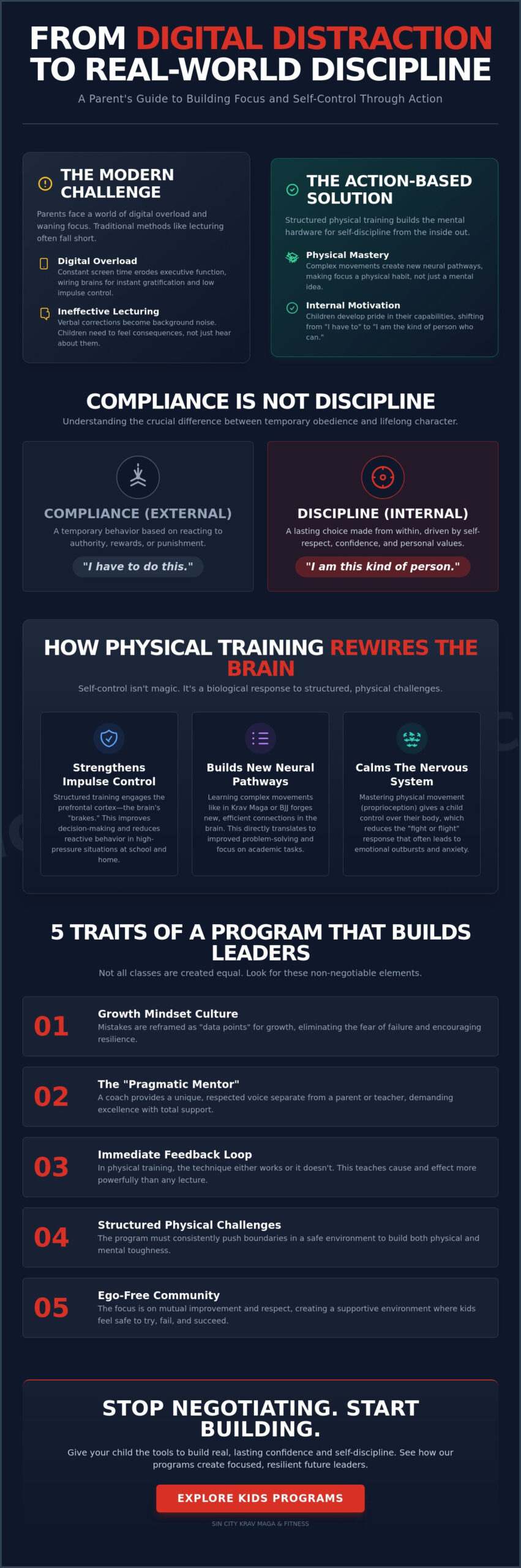
    Your child doesn’t need another lecture. They need a physical challenge that demands their full attention. If you’re tired of constant back-talk and feel like digital screens have destroyed your kid’s ability to focus, you aren’t alone. Many parents are shifting toward a hybrid approach that balances empathy with firm, physical structure. You want to know how to build self discipline in a child without yelling until you’re hoarse. It’s a common struggle, but the solution isn’t found in a longer conversation. It’s found in action.

    Recent scientific reviews from 2026 confirm that regular physical activity is the fastest way to improve emotional control and executive function. We’ve seen how structured movement transforms behavior first-hand. This article will show you how to move from verbal corrections to physical, action-based training. You’ll learn why elite focus starts with the body and how to help your child take initiative at home and school. We’re going to break down why structured programs like Kids Martial Arts succeed where lectures fail. It’s time to stop negotiating and start building a foundation of real confidence.

    Key Takeaways

    • Stop lecturing. Start moving. Discover why physical mastery is the fastest shortcut to mental control and focus.
    • Move beyond simple compliance. Learn how to foster internal discipline so your child makes the right choice even when you aren’t looking.
    • Strengthen the brain. See how to build self discipline in a child by using structured physical challenges to improve impulse control.
    • Reframe the struggle. Understand how to turn behavioral mistakes into “data points” for growth rather than sources of shame.
    • Choose the right environment. Identify the five non-negotiable traits of classes that build future leaders in an ego-free community.

    Understanding the Discipline Gap for Kids in 2026

    Many parents struggle with the same core question: how to build self discipline in a child when the world offers nothing but distractions? Real self-discipline isn’t just about following orders. It’s the internal motor that drives behavior when the teacher or parent leaves the room. Understanding Self-Discipline starts with recognizing that true control comes from within. It isn’t just about sitting still. It’s about regulating impulses, managing frustration, and maintaining focus on a goal. We see this gap every day. Kids are often taught how to be compliant, but they aren’t taught how to be disciplined. Compliance is a reaction to authority. Discipline is a choice made by the child. Our training focuses on bridging that gap through proactive challenge.

    To better understand this concept, watch this helpful video:

    The ‘Compliance vs. Discipline’ Trap

    Raising a “good listener” isn’t the same as raising a disciplined leader. Many traditional settings rely on the compliance trap. This uses shame or the threat of exclusion to get kids to sit down and be quiet. While this might create a peaceful classroom, it doesn’t teach the child how to build self discipline in a child from the inside out. True discipline builds confidence. It replaces “I have to do this” with “I am the kind of person who does this.” When a child takes ownership of their actions, they don’t need a bribe for every chore or a lecture for every mistake. They develop a sense of pride in their own reliability. This internal shift is what separates a child who just follows rules from a child who leads themselves.

    The Impact of Digital Overload on Focus

    The 2026 environment is a dopamine minefield. Constant screen time and instant gratification erode a child’s executive function. Their brains are wired for high stimulation. When they face a “low-stimulation” task like schoolwork or household chores, their focus fails. They aren’t being bad; their brains are just looking for the next hit of digital excitement. To fix this, kids need a physical space where focus is a requirement for success. They need to practice being present in their own bodies. This is a primary reason parents seek out martial arts for kids with adhd. It provides a grounded, analog environment that forces the brain to slow down and engage with the task at hand. By removing the digital noise, we allow the child’s natural ability to focus to resurface and grow stronger.

    How Physical Training Hard-Wires Self-Discipline

    Self-discipline isn’t a gift. It’s a physical habit. When we talk about how to build self discipline in a child, we have to look at the brain. The prefrontal cortex handles decision-making and impulse control. It’s the “brakes” of the mind. Physical training in Krav Maga or Brazilian Jiu-Jitsu acts like a weight room for these mental brakes. Repetitive, complex movements force the brain to communicate across hemispheres. Every punch, every sprawl, and every transition in BJJ requires focus under pressure. This builds neural pathways that translate directly to the classroom. Instead of reacting to every impulse, the child learns to pause. They learn to think before they act. This isn’t a theory. It’s a biological response to consistent, structured challenge.

    Coaches play a unique role in this process. We call it the “Pragmatic Mentor” approach. Kids often test boundaries at home because they feel safe doing so. It’s natural. In the gym, the environment is different. The expectations are clear. The consequences are natural. If you don’t focus on the technique, the technique doesn’t work. This immediate feedback loop is more effective than any verbal lecture. The coach isn’t a parent or a school teacher. They are a guide who demands excellence while providing total support. This shift in dynamic allows kids to listen differently. They start to crave the respect that comes with mastering a difficult skill.

    The Biology of Self-Control

    Proprioception is the body’s ability to sense its own position in space. When a child masters their physical movements, it calms their nervous system. It reduces the “fight or flight” response that leads to outbursts. High-intensity training provides a “just right” challenge that builds grit. Physical discipline is the intentional repetition of difficult tasks under mild stress. This isn’t about punishment. It’s a positive discipline approach that rewards effort and resilience. We don’t use shame. We use progress. Every small win on the mat builds a child’s belief that they can handle hard things. That is the core of self-control.

    Peer Accountability and the Ego-Free Gym

    Training in a group creates a unique sense of social discipline. Kids watch their peers. They learn respect by receiving it. We explicitly reject traditional industry tropes like “master” worship or intimidating atmospheres. We eliminate the ego to ensure every child feels safe making mistakes. In our Northwest Las Vegas facility, we focus on genuine results over traditional point-sparring. You can see the benefits of kids in martial arts when they start helping their teammates instead of competing for attention. This community-centric heart is what makes the training stick. If you want to see this transformation in person, consider checking out our Kids Martial Arts programs to see how we build leaders from the ground up.

    How to Build Self Discipline in a Child: Why Action Beats Lectures

    Discipline vs. Punishment: Skill-Building over Shame

    Punishment looks backward. Discipline looks forward. Many parents struggle with how to build self discipline in a child because they confuse the two. Punishment relies on shame or the removal of privileges to “pay” for a mistake. It often leads to resentment rather than change. Discipline is different. It’s about training the mind and body for future success. In our classes, we reframe every missed technique as a data point. It isn’t a failure. It’s information. This shift removes the fear of making mistakes and replaces it with a drive to improve. We don’t want kids to obey because they’re afraid of trouble. We want them to choose the right path because they value their own progress.

    Some parents worry that learning Kids Martial Arts will make their child aggressive. The reality is the exact opposite. Training provides a safe outlet for energy and teaches the heavy responsibility that comes with strength. When a child knows they can handle themselves, they don’t feel the need to prove it through outbursts or bullying. They move from “Don’t do that” to “Here is how we handle this situation.” The structure of the gym reinforces this. The uniform and the mats create a psychological safe zone. When that belt is tied, it acts as a mental switch. It signals that it’s time to focus and work.

    Confidence: The Ultimate Bully Deterrent

    Disciplined kids aren’t easy targets. Bullies look for signs of emotional volatility or physical uncertainty. Training builds a deep well of emotional resilience that changes how a child carries themselves. If a student can handle a difficult grappling session or a complex Krav Maga drill, a mean comment in the hallway loses its power. They learn to set boundaries on the mat every single day. They practice saying “no” or “stop” with authority during drills. This physical capability translates directly to the playground. They don’t just act tough. They are prepared. This internal certainty is the most effective way to stop bullying before it starts. Parents looking for a structured solution can explore kids krav maga Las Vegas anti-bullying classes that teach de-escalation and bully-proof confidence alongside physical skills.

    Natural Consequences on the Mat

    The mat is the ultimate teacher because it never lies. It provides natural consequences that arbitrary time-outs at home simply can’t match. If you don’t focus on your stance, you lose your balance. If you don’t keep your hands up, you get tagged in a drill. This immediate feedback loop helps kids develop the ability to discipline themselves because they see the direct result of their own effort. It teaches the value of delayed gratification. You don’t earn a new belt because you waited a certain amount of time. You earn it because you put in the work to master the skill. This lesson stays with them long after they leave the gym.

    5 Traits of Effective Discipline Classes for Kids

    Finding the right school is the next step in learning how to build self discipline in a child. You don’t want a trophy mill. You want a training ground. Not all environments foster growth. Some just sell belts. To get real results, you need a program built on five core pillars: practicality, expert mentorship, inclusivity, consistency, and flexibility. Practicality is the foundation. Kids can spot fake progress from a mile away. They need to learn real-world skills they can actually be proud of. Mentorship is about having instructors who act as guides rather than dictators. They must understand how to push a child without breaking their spirit. Inclusivity ensures the program works for everyone, providing a solid entry point for martial arts for 5-year-olds. Consistency keeps the momentum going with a curriculum that builds incrementally. Finally, flexibility respects your family’s life. If a gym tries to lock you into a three-year deal, walk away.

    What to Look for in a Trial Class

    The trial class is your best window into a gym’s culture. Watch the “Ego Meter” carefully. Are the older kids helping the beginners, or are they just showing off? A healthy gym is a community, not a competition. Pay close attention to how instructors handle a child who loses focus or gets frustrated. The response should be calm redirection, not shouting. You want to see a facility that is clean, professional, and family-oriented. If the environment feels intimidating or disorganized, it won’t be a productive space for your child to learn self-control. A great class should feel like a firm handshake. It’s welcoming but disciplined.

    The ‘No-Contract’ Advantage

    We explicitly reject the high-pressure sales tactics common in traditional martial arts. You’ve probably heard of the “Black Belt Club” or long-term binding contracts. These are designed to protect the gym’s bottom line, not your child’s growth. Flexibility prevents resentment. If a child feels trapped in a three-year commitment, the training becomes a chore. They stop engaging. They stop learning. We believe the quality of instruction should be the only thing that keeps students coming back. By offering a no-contract approach, we stay accountable to you. We have to earn your trust every single month. This keeps the standards high and the focus on the student’s transformation. If you’re ready to see how a no-ego environment changes behavior, come experience our Kids Martial Arts classes for yourself.

    Building Future Leaders at Sin City Krav Maga & Fitness

    Brock and Camilla founded Sin City Krav Maga & Fitness with a specific goal: turning potential into performance. We’ve moved beyond the traditional karate model to offer something more substantial. By combining Krav Maga’s practical awareness with the technical control of Brazilian Jiu-Jitsu, we provide a complete framework for growth. This is how to build self discipline in a child who needs more than just a hobby. They need a path. Our “Real Skills, No Ego” philosophy ensures every student focuses on their own progress rather than a trophy shelf. We aren’t just teaching kicks; we’re teaching the mental toughness required to navigate life’s challenges. It is about preparing them for the world outside the gym.

    Our Northwest Las Vegas facility serves as a hub for families who value authentic results. We’ve moved from the theory of discipline to the practice of it. Students learn that their effort on the mat dictates their success. This immediate feedback loop is essential. It’s the difference between hearing about focus and actually experiencing it. We invite you to step into our community and see the transformation for yourself. Our instructors act as pragmatic mentors, guiding each student through the highs and lows of physical training with sincerity and high standards.

    The Northwest Las Vegas Difference

    Since 2010, Sin City Krav Maga & Fitness has been a reliable fixture in the local neighborhood. We focus on practical self-defense because it demands a higher level of presence and responsibility. Traditional point-sparring often lacks the real-world application that keeps kids engaged. Our curriculum is designed to be a “home away from home” for students aged 5 to 14. They find a tribe that values hard work, humility, and mutual support. When a child feels they belong to a high-standard community, they naturally rise to meet those expectations. We take pride in being a trusted part of this neighborhood, helping parents raise the next generation of resilient leaders.

    Start the Journey Today

    Getting started is straightforward and low-pressure. You don’t need a background in sports or any specialized gear to walk through our doors. A simple t-shirt and shorts are all that’s required for the first session. During the trial, your child will meet our mentors and experience the rhythm of a professional class. They’ll start to see that discipline isn’t a burden; it’s a superpower. Don’t wait for the next school report or behavioral issue to take action. Join the premier kids martial arts program in Las Vegas and give your child the tools they need to lead themselves. This is the most effective way to understand how to build self discipline in a child through consistent, ego-free training.

    Build the Leader Within Your Child

    Stop the cycle of endless lectures. You’ve seen why talk isn’t enough. Real change happens on the mat. By focusing on physical mastery, you’re giving your child the biological tools they need to regulate themselves. They’ll trade digital distractions for real-world focus. They’ll replace external compliance with internal pride. This is how to build self discipline in a child that lasts. Every drill and every transition builds a brain that’s ready for the challenges of 2026.

    At Sin City Krav Maga & Fitness, Brock and Camilla provide expert instruction in Northwest Las Vegas’s premier ego-free gym. We don’t hide behind fine print. There are no long-term contracts ever. We stay because the results are real. Your child deserves a community that pushes them to be their best while keeping them safe. It’s time to move beyond the “listen to me” phase and into the “watch me” phase. Book a Trial Class at Sin City Krav Maga & Fitness and Watch Your Child’s Discipline Grow. Your child is capable of incredible focus. They just need the right place to build it. Let’s get to work.

    Frequently Asked Questions

    What age is best to start discipline classes for kids?

    Five years old is generally the ideal age to begin. By this time, children have developed the coordination and listening skills necessary to participate in a group setting. Starting early is a proactive way to learn how to build self discipline in a child before they face the social and academic pressures of middle school. It sets a foundation of focus that carries through their entire education.

    Will martial arts classes make my child more aggressive at school?

    No, the opposite is true. Training provides a controlled environment to release energy and teaches that physical force is a last resort. When kids feel capable and confident, they don’t feel the need to prove themselves through posturing or fighting. They learn to de-escalate situations and use their words first, knowing they have the skills to protect themselves if necessary.

    How long does it take to see changes in a child’s self-discipline?

    Most parents report noticeable improvements in focus and follow-through within the first four to six weeks. While every child is different, the consistent structure of the mat creates fast results. You’ll likely see them start to handle chores or homework with less resistance. Understanding how to build self discipline in a child is about consistent repetition, and those habits start forming from the very first session.

    Are these classes suitable for kids with ADHD or sensory processing issues?

    Yes, the high-structure environment is often exactly what these children need. We focus on clear, physical tasks that help ground the nervous system and improve executive function. The classes provide a predictable routine that helps kids with ADHD manage their impulses and stay present. It’s a low-stimulation, high-engagement setting that rewards focus and effort in real-time.

    What is the difference between Krav Maga and traditional Karate for building discipline?

    We prioritize practical self-defense and functional movement over the rigid forms and point-sparring found in traditional Karate. Krav Maga is based on real-world situations, which keeps kids more engaged because they see the immediate utility of what they’re learning. This practicality fosters a different kind of discipline, one rooted in awareness and problem-solving rather than just memorizing choreographed patterns.

    Do I need to sign a long-term contract for kids’ classes in Las Vegas?

    No, we explicitly reject the industry standard of long-term binding contracts. We believe in the quality of our instruction and the results our students achieve. If the training isn’t the right fit for your family, you shouldn’t be locked in. This no-contract approach keeps us accountable to you and ensures we’re earning your trust every single month through genuine transformation.

    What should my child wear to their first discipline-focused martial arts class?

    Your child just needs comfortable athletic clothing like a t-shirt and shorts or leggings. There’s no need to buy a special uniform or any gear before you know if the program is a fit. We want the focus to be on the training and the environment. If they decide to continue their journey, we’ll help you get set up with the right equipment for their specific program.

    Can parents watch the classes at Sin City Krav Maga & Fitness?

    Yes, we encourage parents to stay and observe the sessions from our viewing area. We want you to see the “Real Skills, No Ego” philosophy in action. Transparency is vital to our community-centric heart, and it helps you reinforce the lessons at home. Watching your child overcome a physical challenge at Sin City Krav Maga & Fitness is the best way to understand the power of action-based training.

  • Martial Arts for Kids with ADHD: Why Practical Training Beats Traditional Sports

    Martial Arts for Kids with ADHD: Why Practical Training Beats Traditional Sports

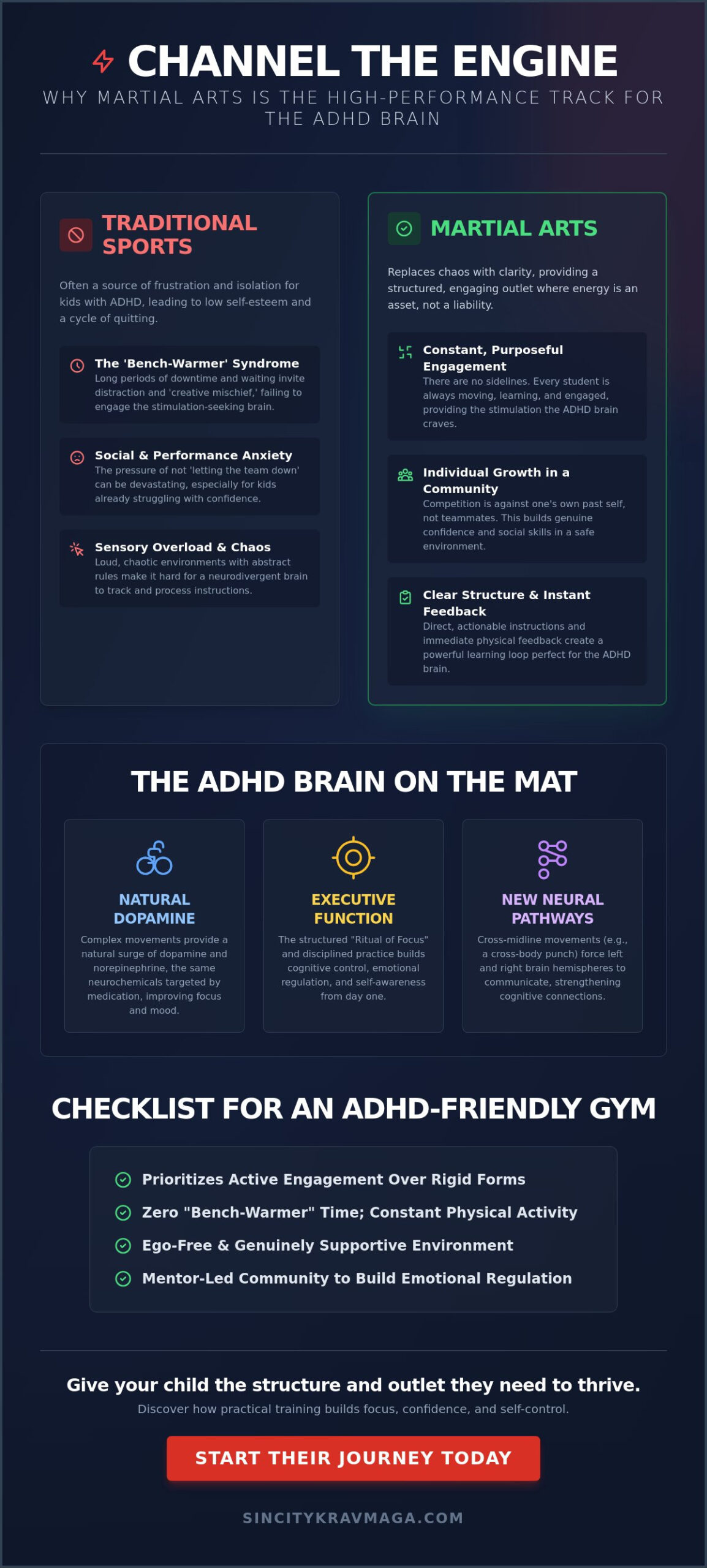
    ADHD isn’t a deficit of energy that needs to be suppressed. It’s a high-octane engine. It just needs a high-performance track. If you’ve spent seasons on the sidelines of soccer games feeling judged by other parents, you know the struggle. Traditional team sports often leave children with ADHD feeling isolated or misunderstood. You need a place where their energy is an asset. Not a liability. Finding the right martial arts for kids with adhd is the turning point where your child stops struggling and starts leading.

    We understand the frustration of seeing your child’s self-esteem dip because of school struggles. You want results that show up on the report card and at the dinner table. You’re looking for better emotional regulation and a community that actually accepts your kid. This article shows you how practical training provides the structure and physical outlet your child needs to thrive. We’ll break down why styles like Brazilian Jiu-Jitsu and Krav Maga build focus better than traditional sports. Discover how to give your child the tools to succeed everywhere.

    Key Takeaways

    • Understand how complex, practical movements trigger natural dopamine regulation to help your child find focus without the boredom of traditional sports.
    • Learn why choosing the right martial arts for kids with adhd means prioritizing active engagement over rigid, repetitive forms.
    • Identify the “bench-warmer syndrome” and why constant physical activity is the best way to keep high-energy children motivated and focused.
    • Get a practical checklist for your first “vibe check” at a gym to ensure the environment is ego-free and truly supportive.
    • Discover how a mentor-led community builds the emotional regulation skills your child needs to succeed in the classroom and at home.

    Why Traditional Sports Often Fail Kids with ADHD

    Team sports are loud. They’re often chaotic. For many parents, Saturday morning soccer is a source of stress rather than pride. You watch your child wander off during a play. You see them get distracted by a blade of grass while the ball zooms past. This happens because Attention Deficit Hyperactivity Disorder (ADHD) affects how a child processes complex instructions and sensory input. In a crowded gymnasium or a sprawling field, the noise is overwhelming. The rules are often abstract. Your child feels lost in the crowd.

    Finding the right martial arts for kids with adhd solves this by replacing chaos with clarity. Team sports rely on moving parts that a neurodivergent brain might struggle to track all at once. Martial arts simplifies the equation. It’s about the student and the instructor. It’s about direct, actionable feedback. There’s no hiding in the back of the pack. Every movement has a purpose. Every second counts. We focus on the individual’s progress within a community, ensuring no one gets left behind on the bench.

    To better understand this concept, watch this helpful video:

    The Problem with ‘Downtime’ in Youth Sports

    ADHD brains crave stimulation. They need a constant stream of engagement to stay locked in. Baseball is the ultimate test of patience; for these kids, it’s a failing grade. Standing in the outfield for twenty minutes waiting for a fly ball is an invitation for distraction. We call this ‘creative mischief.’ When there’s nothing to do, the brain finds something to do. Usually, it’s something that gets them in trouble with the coach. Martial arts for kids with adhd eliminates this ‘bench-warmer’ syndrome. There are no sidelines. You’re always moving, always learning, and always engaged. The consequences are immediate. If you drop your guard during a drill, you feel the shift in balance right away. That instant feedback loop is exactly what the ADHD brain needs to thrive.

    Social Anxiety and the Team Dynamic

    The pressure of a team can be paralyzing. Nobody wants to be the kid who missed the game-winning shot. For a child already struggling with self-esteem due to school, this public failure is devastating. It leads to a cycle of quitting and low confidence. Martial arts offers a different path. It’s a structured individual pursuit within a supportive community. You’re training with peers, but you’re only competing against your own previous best. This removes the fear of ‘letting the team down.’ It allows for genuine social growth in a controlled environment. Social skills are built through partner drills and mutual respect. It’s safe. It’s predictable. It’s effective.

    The ADHD Brain on the Mat: How Martial Arts Builds Executive Function

    The ADHD brain works differently. It’s often a dopamine-seeking machine. When a child trains, their body releases the very chemicals their brain is searching for. This isn’t just theory. A recent scientific study on martial arts and ADHD confirms that structured physical activity directly improves cognitive control. Training provides a natural surge of dopamine and norepinephrine. These are the same chemicals targeted by many medications. By using martial arts for kids with adhd, you’re giving your child a healthy, physical way to regulate their own brain chemistry.

    Movement is medicine. We use complex techniques that require crossing the ‘midline’ of the body. Think about reaching across your chest to grab a lapel or throwing a cross-body punch. These movements force the left and right hemispheres of the brain to communicate. It builds new neural pathways. It’s like upgrading the wiring in a house. Every class starts with a ‘Ritual of Focus.’ We bow in. We stand tall. We leave the outside world at the door. This routine acts as a nervous system reset. It tells the brain that the chaos is over. The work starts now. Finding the right martial arts for kids with adhd is about more than just kicks and punches; it’s about brain development.

    Proprioception and Self-Regulation

    Proprioception is knowing where your body is in space without looking. Kids with ADHD often lack this awareness. They bump into furniture. They play too rough without meaning to. In Brazilian Jiu-Jitsu, they get the ‘heavy work’ their sensory system craves. Grappling and wrestling provide deep pressure. It’s calming. It turns physical impulsivity into controlled, purposeful movement. They learn to master their own strength.

    The Science of ‘Focus Training’

    Think of executive function as the brain’s ‘air traffic control system’ for kids. It manages everything from following directions to finishing homework. Martial arts acts as moving meditation. We don’t just teach a kick. We break it down into four distinct steps. Look. Chamber. Strike. Reset. By mastering these small increments, a child builds the confidence to tackle larger tasks. This discipline doesn’t stay on the mat. It follows them home. It shows up in better school grades and a cleaner bedroom. If you’re ready to see this transformation, consider checking out the classes at Sin City Krav Maga & Fitness to find the right fit for your family.

    Martial Arts for Kids with ADHD: Why Practical Training Beats Traditional Sports

    Choosing the Right Style: Practical Movement vs. Rigid Tradition

    Traditional martial arts like Karate or Tae Kwon Do are the standard recommendation. You have likely heard it a thousand times. But here is the reality. Memorizing long, static sequences called katas or forms can be a disaster for a child who struggles with focus. It is repetitive. It is theoretical. For many, it is just plain boring. When an ADHD brain gets bored, it checks out. That is when the fidgeting starts. That is when they want to quit. You don’t need more “drills” that feel like schoolwork. You need engagement.

    Practical styles offer a better alternative. We focus on movement that makes sense. In Krav Maga, we use natural instincts. In Brazilian Jiu-Jitsu, we solve physical puzzles. This “live” training keeps the brain engaged because the problem is changing in real-time. You can’t daydream when someone is trying to control your movement on the mats. This constant stimulation is why these styles are the premier choice for martial arts for kids with adhd. It turns training into a game of high-stakes problem solving. It keeps them locked in.

    The benefits of kids in martial arts are most visible when the training is functional. We don’t care about aesthetic performance or high-kicking for a trophy. We care about results. We want your child to be safe, confident, and focused. Practical training provides a direct link between effort and outcome. There is no ambiguity. This clarity is exactly what a neurodivergent child needs to build a sense of mastery.

    Why Krav Maga and BJJ Work for ADHD

    Krav Maga is built on what your body already wants to do. There are no rigid, 45-degree-angle stances that feel like a chore. It is fast. It is direct. It is practical. Brazilian Jiu-Jitsu is often called “human chess.” It requires intense mental engagement. You have to plan your next move while reacting to your partner. This level of focus is exactly what builds executive function. It teaches them to stay calm under pressure. It prioritizes real-world safety over point-sparring rules that don’t apply outside the gym.

    The ‘Ego-Free’ Environment Factor

    The style on the sign is important, but the culture inside the gym is everything. You need to avoid “Belt Factories.” These are places that hand out ranks just for showing up and paying a fee. They prioritize profit over progress. For a child with ADHD, this lack of genuine challenge leads to disengagement. Look for these signs of a healthy gym:

    • Individualized Attention: Instructors who know your child’s specific triggers and strengths.
    • Realistic Goals: Progress based on skill mastery, not a calendar date.
    • Positive Reinforcement: Discipline delivered with respect, not through shame or shouting.

    Brock and Camilla built this gym to be a sanctuary. It’s an ego-free zone. We don’t use intimidating tropes or military-style shouting. We use encouragement and high standards. We recognize that every child learns differently. When you choose martial arts for kids with adhd, look for a place where your child is a name, not a number. A supportive community is the foundation of every life-changing transformation.

    What Parents Should Look for in an ADHD-Friendly Martial Arts Gym

    Choosing a gym is a major decision. It isn’t just about the location or the price. It’s about the environment. You need to perform a ‘Vibe Check.’ Walk into the facility. Don’t just look at the trophies on the wall. Look at the students on the mat. Are they engaged? Is the instructor’s voice encouraging or just loud? Martial arts for kids with adhd requires a specific balance of firm boundaries and genuine empathy. If the atmosphere feels cold or overly rigid, your child will likely shut down before the first water break.

    The instructor-to-student ratio is your next priority. A child with ADHD can easily get lost in a crowd of thirty students. When they lose the thread of the lesson, they find ‘creative mischief’ to fill the void. You want a gym that keeps classes manageable or ensures multiple coaches are on the floor. This ensures your child gets the direct feedback they need to stay locked in. It prevents them from becoming a face in the back of the room who isn’t actually learning the skills.

    Flexibility is the final piece of the puzzle. Life with a neurodivergent child is unpredictable. You don’t want the added stress of a 12-month binding commitment. This is why finding no contract martial arts las vegas is vital. It allows you to focus on your child’s progress rather than a monthly bill you’re forced to pay. Use a trial class strategy. It lets you gauge the fit in real-time. If the gym is confident in their product, they won’t need to trap you with a long-term contract.

    Questions to Ask the Lead Instructor

    Be direct with your questions. Ask how they handle a child who is having a sensory meltdown or losing focus. A seasoned instructor won’t be offended. They’ll have a clear, compassionate protocol. Inquire about age-specific groupings. If you are looking for martial arts for 5 year olds, the curriculum should focus on foundational movement and listening skills, not just high-intensity combat. Finally, ask if they offer private training. Sometimes a few one-on-one sessions can bridge the gap for a child who feels overwhelmed by a group setting.

    Red Flags to Avoid

    Watch out for gyms that use shame as a coaching tool. Public punishment for a lack of focus is a massive red flag. It destroys self-esteem and creates a negative association with physical activity. Be wary of high-pressure sales tactics. If the staff is more interested in your credit card than your child’s needs, keep looking. Avoid overly ‘militaristic’ environments. While discipline is key, constant shouting can trigger anxiety in neurodivergent kids. You want a mentor, not a drill sergeant. Understanding how to build self discipline in a child through action rather than lectures is the key distinction between a gym that produces real results and one that simply goes through the motions.

    If you’re ready to find a community that truly understands your child, sign up for a trial at Sin City Krav Maga & Fitness today and experience our ego-free approach.

    Sin City Krav Maga & Fitness: A Supportive Community for Every Child in Las Vegas

    Sin City Krav Maga & Fitness isn’t just another gym. It’s a sanctuary for families in Northwest Las Vegas. We understand the specific hurdles you face at school and on the sports field. Our mats are a place where your child’s high energy is an asset, not a problem to be solved. Brock and Camilla founded this school on a strictly ego-free philosophy. We don’t care about being the toughest people in the room. We care about being the most supportive guides for your child’s transformation. This is martial arts for kids with adhd that focuses on the individual student. We act as pragmatic mentors. We provide firm discipline, but we always lead with a heart.

    We believe in the power of our training. That’s why we explicitly reject long-term binding contracts. You shouldn’t feel trapped by a membership while you’re navigating your child’s needs. Life with a neurodivergent child requires flexibility. We make it easy to start. If our program isn’t the right fit, you won’t be penalized. This removes the financial stress. It lets you focus on what actually matters: your child’s progress. We want your family here because our community is making a difference. Not because of a legal document.

    Real Skills for the Real World

    We move beyond the theoretical “forms” found in other schools. We don’t teach point-sparring that only works in a controlled tournament. We teach actual self-defense and functional movement. This practical focus is what helps our students become local leaders. They learn that respect is earned through consistent action. They see that discipline leads to tangible growth. Our family-oriented culture at Sin City Krav Maga & Fitness ensures every child feels safe. They aren’t just another face in a class. They are part of a localized, boutique experience where instructors know their names and their stories. Beyond building focus and confidence, our kids Krav Maga Las Vegas program also equips children with the de-escalation skills and bully-proof confidence they need to stay safe at school.

    • No Ego: A culture of humility where students help each other grow.
    • No Contracts: Freedom to choose what’s best for your family month-to-month.
    • Real Skills: Training that works in the real world, not just a gym.
    • Community: Expert instruction from leaders who care about your child’s success.

    Start Your Child’s Journey Today

    The best way to understand our approach is to see it in person. We invite you to bring your child to the mat. Every child is welcome here. We don’t care about labels. We care about potential. When you choose martial arts for kids with adhd, the connection between the student and the coach is the most important factor. Your child deserves a place where they can be themselves while learning the skills to become their best version. We are ready to partner with you.

    Ready to see the difference for yourself? Book a trial class at Sin City Krav Maga & Fitness and join our community today.

    Take the Next Step Toward Your Child’s Success

    Your child doesn’t need another activity where they feel misunderstood or sidelined. They need an environment that transforms their high-octane energy into a distinct advantage. Throughout this article, we’ve explored why practical movement and immediate feedback succeed where traditional team sports often fail. Finding the right martial arts for kids with adhd is the first step toward building the focus and emotional regulation they need to thrive in the classroom and at home.

    At Sin City Krav Maga & Fitness, we do things differently. Brock and Camilla provide expert instruction in a setting that is strictly ego-free and community-focused. We serve Northwest Las Vegas families with a commitment to real results and genuine safety. You won’t find any long-term binding contracts here. We believe in the life-changing results of our training; we want you to feel confident in your child’s progress every single month. It’s time to stop managing energy and start mastering it.

    Start your child’s journey with a trial class at Sin City Krav Maga & Fitness. Give them the tools to succeed on and off the mat. We are ready to help your child lead.

    Frequently Asked Questions

    Is martial arts safe for a child with ADHD who is prone to impulsivity?

    Martial arts is safe because it provides a highly structured environment with clear, immediate consequences for impulsive actions. We don’t just let kids go wild. We teach them the stop and start mechanics of their own bodies. This helps them recognize the urge to act before they follow through. It builds a mental brake system that they can use in the classroom or on the playground. Safety is our non-negotiable priority.

    Will martial arts make my ADHD child more aggressive?

    Training does not make children more aggressive; it actually teaches them to regulate their emotions. By providing a safe, physical outlet for frustration, children learn how to process big feelings without lashing out. They realize that true strength is shown through self-control and respect for their training partners. Most parents find that their children are significantly calmer and more cooperative at home after a hard session on the mats.

    How many times a week should a child with ADHD attend martial arts classes?

    Attending classes two to three times per week is the ideal frequency for martial arts for kids with adhd. This schedule provides enough repetition to build muscle memory and focus without causing sensory burnout. Consistency is the foundation of success here. It creates a predictable routine that helps the child feel secure and prepared. We find that kids who attend at this rate stay motivated longer and see better results.

    What is the best age for an ADHD child to start martial arts?

    Most children are ready to start their journey at age five. This is the stage where they begin to grasp multi-step instructions and can participate in group social dynamics. Starting early allows us to build foundational listening skills before the pressures of school become overwhelming. If your child is younger, we recommend a trial class to see how they handle the structure and the noise of a busy training environment.

    How long does it take to see focus improvements in an ADHD child?

    You will often see an immediate improvement in physical energy levels after the first few classes. However, lasting improvements in school focus and emotional regulation typically take three to six months of consistent effort. We are building new neural pathways and better executive function. This isn’t a quick fix; it’s a long-term investment in your child’s ability to manage their own mind. Stay the course and the results will follow.

    Can martial arts replace therapy or medication for ADHD?

    Martial arts is a powerful support system, but it should not be used as a replacement for professional medical therapy or prescribed medication. It acts as a physical laboratory where kids can practice the skills they learn in therapy. It provides a natural dopamine boost that complements clinical treatments. Always discuss any major changes to your child’s ADHD management plan with your pediatrician or mental health professional to ensure a balanced approach.

    What if my child wants to quit after three weeks?

    It’s common for kids with ADHD to want to quit once the initial novelty wears off and the work gets challenging. This is the moment where the most growth happens. We encourage parents to commit to a specific period to get past that first hurdle. Our no-contract policy gives you peace of mind, but we find that children who push through the novelty dip end up gaining the most confidence and resilience.

    What is the difference between Krav Maga and Karate for a child with ADHD?

    The main difference is the level of mental engagement required by each style. Karate often relies on memorizing static forms which can lead to boredom and disengagement for a neurodivergent brain. martial arts for kids with adhd like Krav Maga or Brazilian Jiu-Jitsu focus on instinctive, practical movements. These styles require live problem-solving and constant adaptation. This keeps the brain stimulated and prevents the child from checking out during the lesson. If you are concerned about bullying as well as focus, our anti-bullying classes for kids in Las Vegas teach children how to use their words before their hands while building the real-world confidence to stand tall in any situation.