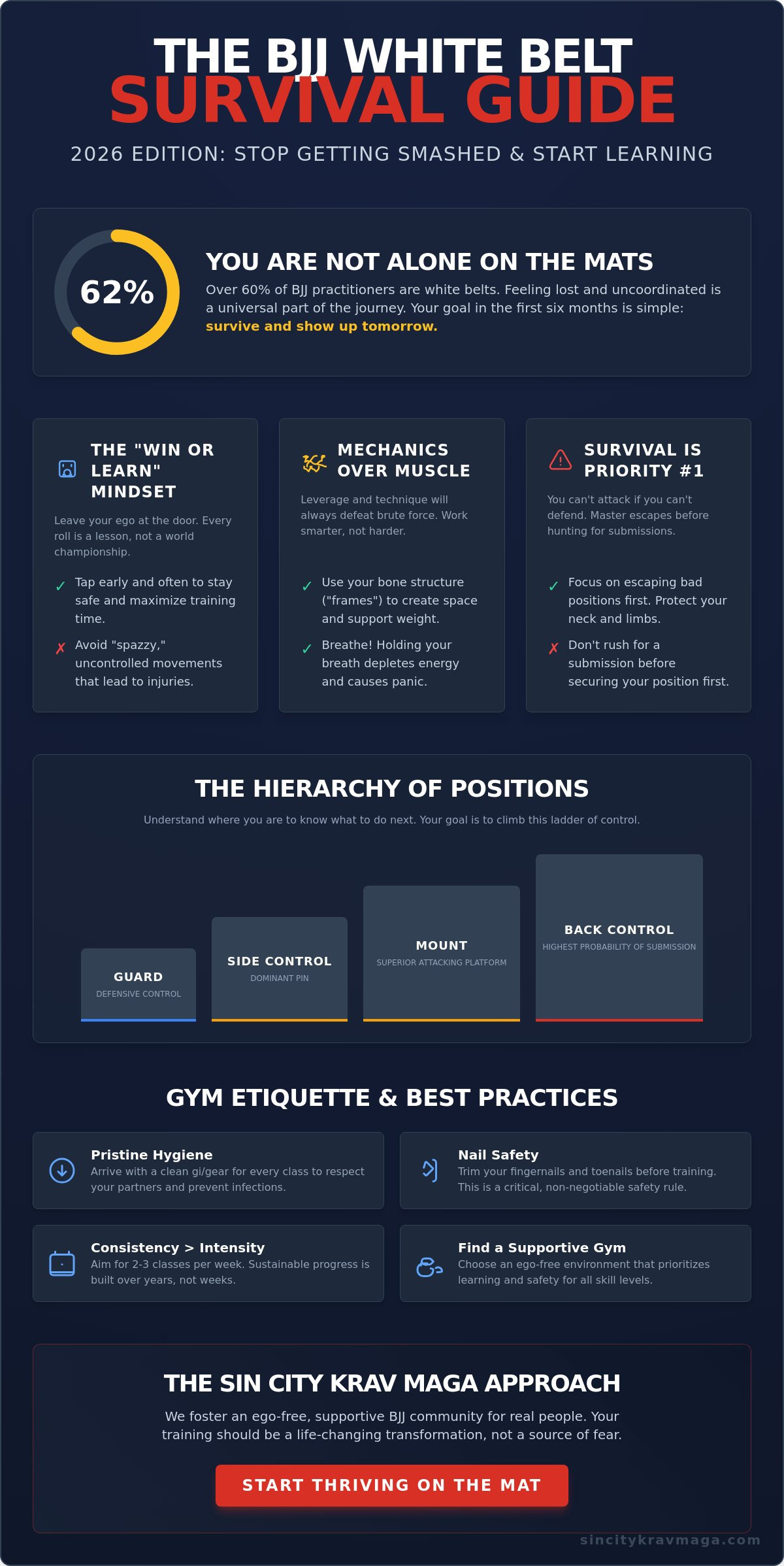
Did you know that 62% of all BJJ practitioners are currently wearing a white belt? You aren’t the only one feeling lost on the mats. It’s normal to feel uncoordinated during drills or “spazzy” during your first rolls. You’re physically exhausted, your body is sore, and you’re tired of feeling like you don’t know what to do with your limbs. We understand that frustration. Our goal is to turn that confusion into confidence. This guide shares the essential bjj white belt tips you need to stop getting smashed and start actually learning the art.
Jiu-Jitsu is not a race. It is a game of survival. The person who stays on the mat the longest is the one who wins. You don’t need a hundred flashy moves to succeed. You need a solid foundation. In this 2026 guide, we’ll show you how to survive your first six months and understand the basic positions. You will learn how to build a sustainable training habit without burning out or getting injured. It’s time to stop surviving and start thriving. Let’s get to work.
Key Takeaways
- Adopt the “win or learn” mentality. The first six months are about survival, not winning.
- Prioritize breathing and positioning. Strength fails, but leverage and calm mechanics keep you in the game.
- Use these essential bjj white belt tips to master gym etiquette. Clean gear and trimmed nails are non-negotiable for safety.
- Focus on escapes first. Don’t hunt for submissions until you can protect your neck and limbs effectively.
- Find a supportive, ego-free environment. Training should be a life-changing transformation, not a source of fear.
The White Belt Mindset: Checking Your Ego at the Door
You just walked into the gym. You’re sweaty, tired, and probably a little confused. Welcome to the Survival Phase. This is the period where your only job is to not quit. Many beginners fail because they treat every roll like a world championship final. They want to win. They want to prove they are tough. This is the fastest way to burn out. If you’re looking for the most effective bjj white belt tips, start with your head. You have to leave your ego in the locker room. What is Brazilian Jiu-Jitsu? It’s a system of leverage and control, but you can’t learn control if you’re panicking. BJJ mindset is the ability to stay calm under pressure.
Adopting a “win or learn” mentality is the only way to stay sane during your first year. You’re going to get tapped. You’re going to feel “dumb” during drills. That’s okay. If you get caught in a submission, you didn’t lose. You just found a hole in your defense that needs fixing. The real danger on the mats isn’t losing; it’s being a “spazzy white belt.” This happens when you use 100% explosive energy to compensate for a lack of technique. It leads to injuries for you and your partners. Slow down. Focus on the movement, not the result.
To better understand how to fix these common beginner mistakes, watch this helpful video:
Embrace the Art of Tapping Out
Tapping is your best friend. It’s a reset button, not a sign of weakness. Don’t wait until your joint hurts or your vision starts to fade to signal your partner. Tap before it hurts. By tapping early, you protect your body and keep yourself on the mats for the next round. Use these “early taps” as a way to maximize your learning time. The more rounds you can safely complete, the faster your skills will develop. Remember, the goal is to train tomorrow, not just win today.
Focus on Consistency Over Intensity
Consistency is the secret sauce of martial arts. Training six days a week for a month before quitting is a waste of time. Aim for 2-3 days a week for a full year. This sustainable pace helps you manage physical soreness and mental fatigue. You’ll likely face “imposter syndrome” after your first few rolls when you realize how much you don’t know. Fight that feeling by setting micro-goals. Instead of trying to get a submission, make your goal to “keep my elbows tight” or “escape one side control.” These small wins build the foundation for long-term success and keep you coming back to the mats.
Mastering the Mechanics: Breathing and Positioning Over Power
Stop holding your breath. It sounds simple, but it’s the biggest mistake beginners make during a scramble. When you hold your breath, your muscles tense up. You burn through your gas tank in seconds. This leads to the “spazzy” behavior we discussed earlier. Oxygen is the most important fuel for a grappler; without it, your technique evaporates. Learning to breathe while someone is trying to pin you is a core skill. It also taps into the mental benefits of martial arts, helping you stay calm under extreme physical stress.
Success in BJJ comes from the physics of leverage, not the size of your biceps. If you try to bench press a 200-pound opponent off you, you will lose. Instead, use “frames.” A frame uses your bones to create space. Think of it like a kickstand on a bike. It doesn’t require muscle to hold up the weight. These bjj white belt tips focus on working smarter. When you stop pushing and start framing, you save energy for the movements that actually matter. If you want to see how these mechanics apply in a real-world setting, visiting a professional training center can provide the hands-on feedback you need.
The Hierarchy of BJJ Positions
You need a roadmap. In BJJ, there is a clear hierarchy: Guard, Side Control, Mount, and the Back. Your first goal is to understand where you are at all times. You must learn to hold a position before you can ever hope to attack from it. If you rush for a submission before securing the position, you’ll likely lose both. One vital rule: Don’t be flat. If your back is glued to the mat, you are a stationary target. Stay on your side to keep your hips mobile and your defenses active.
Essential Solo Drills for Beginners
You don’t always need a partner to improve. Mastering these solo movements will accelerate your progress on the mats:
- Shrimping (Hip Escapes): This is the most important move you will ever learn. It creates the space needed to escape almost any bad position.
- Technical Stand-ups: This move is a bridge between sport grappling and self defense classes Las Vegas. It allows you to get to your feet safely while protecting your face.
- Bridging and Granby Rolls: These drills build the core grappling mobility required to recover your guard and prevent passes.
Prioritizing Survival: Why Escapes Are Your First Priority
Forget the highlight reels. In your first six months, hunting for submissions is a trap. Most beginners see an opening and lunge for a choke, only to find themselves countered and pinned. This happens because you haven’t mastered the “Safety First” rule yet. You must protect your neck and limbs at all costs. One of the most vital bjj white belt tips is to spend your first year becoming un-tap-able. If your training partners can’t finish you, they will get frustrated. They will make mistakes. That is when you win.
Staying safe requires a specific posture. We call this “T-Rex Arms.” Imagine your elbows are glued to your ribs. Never reach. Never leave an arm dangling in space. By keeping your elbows tight, you deny your opponent the inside position they need to control you. This “inside position” is the secret to all defense. When you master the art of staying compact, you build the confidence to take risks later. You aren’t afraid to try a new sweep because you know exactly how to get out if it fails.
Escaping the Worst Positions
You will spend a lot of time on the bottom. Accept it. To get back to your feet or recover your guard, you need the “Shrimp and Bridge” combo. This is the gold standard for escaping mount. When you are stuck in side control, stop pushing with your hands. Use your forearms to create frames. These frames act like structural pillars, holding your opponent’s weight so you can move your hips. If someone takes your back, remember the “Three-Point Rule.” Protect your neck first. Clear the hooks second. Get your back to the mat third. Follow this sequence every time. It’s a simple, repeatable process for survival.
The Role of the Guard
The guard is the “Great Equalizer” in Brazilian Jiu-Jitsu. It allows a smaller person to defend against a larger, stronger attacker by using their legs as shields. As a white belt, you should prioritize the Closed Guard. It is the safest place to be. It limits your opponent’s options and gives you more control over their posture. While Open Guard is flashy, it requires more advanced movement and timing. Master the basics of maintaining distance and preventing the pass first. If they can’t get past your legs, they can’t hurt you. Focus on being a wall before you try to be a spear.
The 2026 Beginner Checklist: Hygiene, Gear, and Etiquette
Hygiene is non-negotiable. It is the foundation of respect in any martial arts community. The Golden Rule is simple: wash your gi and yourself after every single class. Skin infections like staph or ringworm thrive in moist, warm environments. Don’t be the person who brings them onto the mats. These bjj white belt tips are about protecting your team as much as yourself. Trim your nails. Remove all jewelry. A jagged fingernail or a stray earring can cause unnecessary injuries during a scramble. Cleanliness is a sign of a professional mindset.
Understanding your gear is the next step. Gi training involves the traditional uniform, allowing for grips on the collar and sleeves. No-Gi uses rash guards and grappling shorts, focusing on overhooks and underhooks. Both are essential for a well-rounded game. If you want to explore how these two styles differ and which is right for you, our complete guide to brazilian jiu jitsu las vegas training in both Gi and No-Gi formats breaks down everything you need to know. To stay organized, build a definitive 2026 gym bag. You need a clean gi or rash guard, a mouthguard, athletic tape, a large water bottle, and flip-flops for off-mat use. Never walk into the restroom barefoot and then step back onto the mats. This is a major safety violation that puts everyone at risk.
BJJ Etiquette: The Unwritten Rules
Respect the training space. Bowing on and off the mat is a standard tradition that acknowledges the discipline required inside. When it comes to rolling, follow the protocol. In many traditional gyms, lower belts should wait for higher belts to invite them to roll. It’s a gesture of humility and awareness. Be a good “Uke” during drills. This means providing the right amount of resistance. Don’t be a wet noodle, but don’t fight the move while your partner is still learning the mechanics. Help them get better. Following these bjj white belt tips regarding etiquette ensures you are welcomed back to the mats every day.
Recovery and Longevity
Training in the Las Vegas desert presents unique challenges. Hydration is a full-time job. Don’t just drink water; maintain your electrolyte balance to prevent cramping during high-intensity sessions. Sleep and nutrition are your primary recovery tools. If you aren’t sleeping seven to eight hours, you aren’t recovering. You will burn out. Minor “finger and toe” injuries are part of the journey. Learn to tape them properly and keep training. Consistency is the only way to see results. If you want to build a foundation that lasts, join a community that prioritizes your long-term growth.
The Sin City Approach: Ego-Free BJJ for Real People
Training should empower you. It shouldn’t be a source of anxiety. At our Northwest Las Vegas facility, owners Brock and Camilla have built a culture that explicitly rejects the “meathead” stereotype. We prioritize a no-ego environment. This means you can focus on these bjj white belt tips without the fear of being judged or intimidated. We are a family. Our coaching staff is here to guide you, not crush you. We don’t believe in long-term binding contracts. You train on your terms with our month-to-month memberships. We want you here because you love the progress, not because a piece of paper forces you to stay.
Jiu-Jitsu is only one piece of the puzzle. While many sport-focused gyms ignore the street, we integrate our grappling with krav maga las vegas for complete, real-world self-defense. If a fight goes to the ground, you need to know how to survive. If you are on your feet, you need to know how to strike and escape. Combining these disciplines creates a truly versatile defender. This is the ultimate “Pragmatic Mentor” approach. We teach you what works when it matters most. It is about tangible reality and genuine results.
Real Skills for Real People
Our curriculum focuses on practical application. We don’t chase sport points or flashy tournament medals. We chase life-changing transformations. The benefits of brazilian jiu jitsu extend far beyond the mat. You will see a massive boost in your mental health and daily confidence. You’ll carry yourself differently. You’ll handle stress better. Ready to start? We offer a trial class so you can experience our bjj white belt tips in person today. No pressure. Just progress.
Your First Class at Sin City
What happens when you walk through the door? You’ll be greeted by name. You’ll meet your instructors and a group of fellow white belts who were in your shoes just weeks ago. There is no mystery. We lay out exactly what to expect. This is the “Pragmatic Mentor” philosophy in action. We are your partners in this journey. We are invested in your growth. We don’t hide behind vague marketing speak. If you’re still researching your options, our complete guide to jiu jitsu classes las vegas walks you through exactly what to look for in an ego-free academy. Grab your gear and step onto the mat. Your transformation starts now.
Take the First Step Toward Mastery
Survival is only the starting line. You now have a clear roadmap to navigate your first year on the mats with confidence. Focus on your breathing. Prioritize your positioning over power. Remember that every tap is a valuable lesson rather than a failure. These bjj white belt tips are your guide to staying safe while building a foundation for a life-changing transformation. You don’t have to navigate this journey alone.
At Sin City Krav Maga & Fitness, we’ve eliminated the intimidating stereotypes common in the industry. Brock and Camilla have cultivated a supportive, no-ego community in Northwest Las Vegas where your personal growth is our primary mission. We offer month-to-month memberships because we believe in the value of our training. No long-term binding contracts. You train because you are genuinely invested in your progress.
It’s time to stop observing and start participating. The mat is waiting for you. Start your ego-free BJJ journey with a trial class at Sin City Krav Maga & Fitness! We look forward to being part of your success story.
Frequently Asked Questions
How long does it take to get a blue belt in BJJ?
Most practitioners take one to two years to earn their blue belt. This timeline depends on your consistency and how quickly you grasp the fundamental movements. Don’t rush the process. The white belt phase is about survival and building a defensive foundation. Focus on showing up regularly. Your progress will naturally follow your commitment to the mat. It is a marathon, not a sprint.
Do I need to be in shape before I start BJJ classes?
Brock and Camilla often see students wait to begin because they feel unconditioned. You don’t need to be in fighting shape to start your journey. Jiu-Jitsu is what builds that specific grappling cardio. The best way to get in shape for the mats is to be on the mats. Start exactly where you are today. Our instructors will help you scale the intensity as your fitness and confidence improve.
What is the difference between Gi and No-Gi Jiu-Jitsu?
Gi training involves the traditional heavy cotton uniform, which allows for complex grips on the collar and sleeves. It is often slower and more technical. No-Gi uses rash guards and shorts. It relies on overhooks and underhooks because there are no clothes to grab. Both styles are essential for a complete self-defense game. We recommend trying both to see what fits your personal style and goals. For a deeper breakdown of how each format works in a Las Vegas training environment, our guide to No-Gi Jiu Jitsu Las Vegas covers everything from gear to competition.
How many times a week should a white belt train?
A schedule of two to three sessions per week is ideal for most beginners. This frequency allows your body to recover from the physical soreness while keeping the techniques fresh in your mind. One of the best bjj white belt tips for longevity is to avoid the “every day” trap. Consistency over the long haul always beats high intensity for a single month. Build a sustainable habit.
Is BJJ dangerous for beginners?
Jiu-Jitsu is remarkably safe when you prioritize control over chaos. Over 95% of modern gyms in 2026 follow strict hygiene and safety protocols to protect their students. Most injuries occur when practitioners refuse to tap or use explosive, spazzy movements. By training in a supportive environment and communicating with your partners, you can enjoy the art without unnecessary risk. Your safety and health come first.
Can I learn BJJ at home using YouTube videos?
You cannot learn BJJ effectively at home through YouTube alone. While videos are great for reviewing specific bjj white belt tips, they lack the live resistance and expert feedback required for real skill development. You need a partner to feel the weight and leverage. You also need a coach to correct your posture in real time. Use online videos as a supplement, not a replacement for your time on the mat.
What should I eat before a BJJ class?
Eat a light, easily digestible meal about two hours before you step onto the mat. Focus on a mix of simple carbohydrates and lean protein, like a banana with almond butter. Avoid heavy, greasy foods or large meals immediately before training. Proper hydration is even more critical. Drink plenty of water throughout the day to ensure you don’t cramp during high intensity rolling. Fueling your body correctly ensures you have the energy to finish class.
How do I stop my fingers from hurting after training?
Finger soreness is a normal part of the adaptation process. Start by using athletic tape to support your knuckles and prevent hyperextension. More importantly, learn to relax your hands. Beginners often use a death grip on their partner’s collar, which drains energy and strains tendons. Focus on using your frames and hooks instead of relying entirely on grip strength. This small change will protect your joints and improve your endurance.