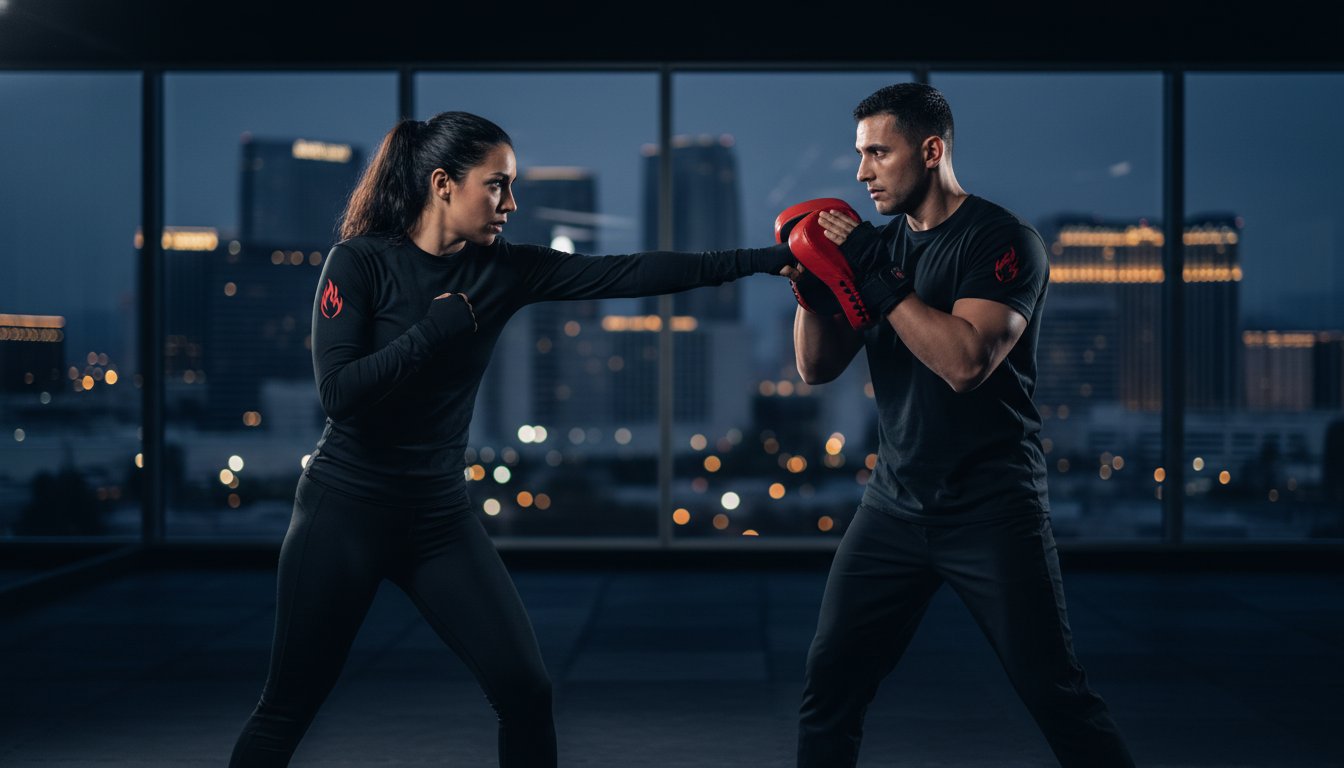
The toughest thing about finding self defense classes in Las Vegas isn’t the training itself. It’s walking through the door for the first time. Too many gyms feel like they were built for people who already know what they’re doing, leaving beginners to figure it out alone while egos fill the room. If that fear has kept you on the sidelines, you’re not alone.
Here’s the truth most gyms won’t tell you: real self-defense has nothing to do with being the toughest person in the room. It’s about practical skills that work under pressure, built inside a community that actually wants you to succeed.
That’s exactly what this guide is for. Whether you’re a complete beginner trying to sort out Krav Maga from Brazilian Jiu-Jitsu, or you’re tired of being burned by long-term contracts that don’t deliver, we’re cutting through the noise. You’ll learn how to identify the right style for your goals, what to look for in a gym, and why the ego-free approach is the one that produces real, lasting confidence. Let’s get into it.
Key Takeaways
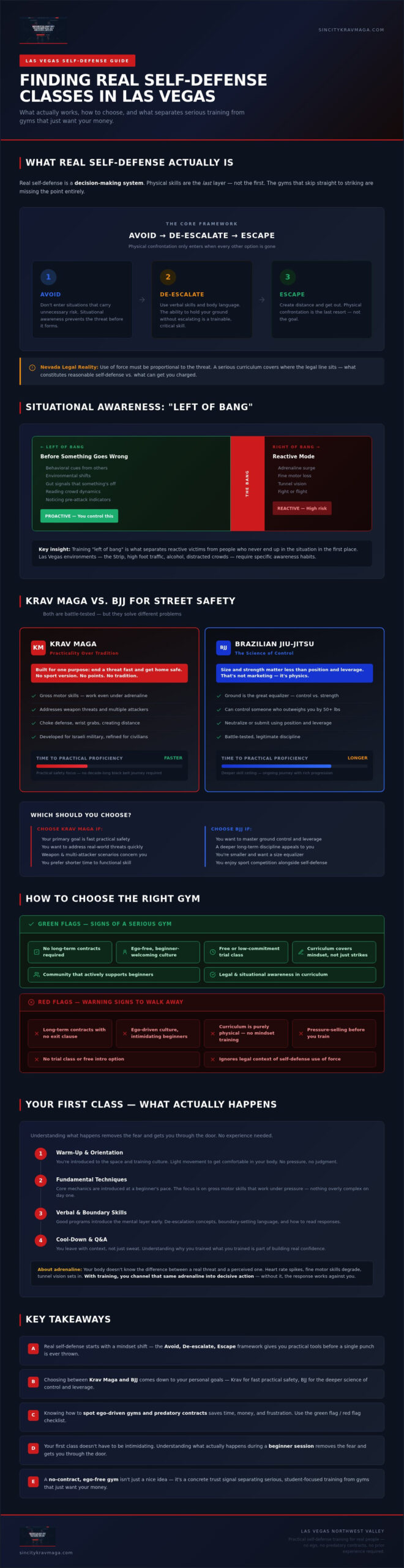
- Real self-defense starts with a mindset shift — the “Avoid, De-escalate, Escape” framework gives you practical tools that work before a single punch is ever thrown.
- Choosing between Krav Maga and BJJ comes down to your personal goals, and this guide breaks down exactly how each style performs under real-world pressure.
- Knowing how to evaluate self defense classes in Las Vegas — including spotting ego-driven gyms and predatory contracts — can save you time, money, and frustration.
- Your first class doesn’t have to be intimidating; understanding what actually happens during a beginner session removes the fear and gets you through the door.
- A no-contract, ego-free gym isn’t just a nice idea — it’s a concrete trust signal that separates serious, student-focused training from gyms that just want your money.
What Real Self-Defense Looks Like in 2026
Most people picture self-defense as a highlight reel of strikes and takedowns. That’s not what it actually is. Real self-defense is a decision-making system, and the physical skills are the last layer, not the first. The gyms that skip straight to “how to hurt someone” are missing the point entirely — and potentially setting their students up to fail when it counts.
The framework that holds everything together is simple: Avoid, De-escalate, Escape. You avoid situations that carry unnecessary risk. When avoidance fails, you use verbal skills and body language to de-escalate. When de-escalation isn’t working, you create distance and get out. Physical confrontation only enters the equation when every other option is gone. That’s not weakness. That’s intelligence.
There’s also a legal reality to consider. In Nevada, the use of force must be proportional to the threat. Understanding where the legal line sits — what constitutes reasonable self-defense versus what can get you charged — is part of any honest self-defense curriculum. A class that ignores this isn’t preparing you for the real world.
Situational Awareness in Las Vegas
Las Vegas isn’t one environment. It’s several layered on top of each other. The Strip operates at a completely different threat level than a quiet street in the Northwest Valley, and your awareness strategy needs to reflect that. High foot traffic, alcohol, distracted tourists, and unpredictable crowd dynamics create specific risks that require specific habits.
The concept of “left of bang” thinking is critical here. “Bang” is the moment something goes wrong. Left of bang is everything before it — the behavioral cues, environmental shifts, and gut signals that tell you something’s off before it escalates. Training this skill is what separates reactive victims from people who never end up in the situation in the first place. If you want to go deeper on this, situational awareness training in Las Vegas is covered in detail here.
The Mental Game of Personal Safety
Your body doesn’t know the difference between a real threat and a perceived one. Adrenaline hits fast — heart rate spikes, fine motor skills degrade, tunnel vision sets in. Without training, that response works against you. With it, you can channel that same adrenaline into decisive action.
Building verbal boundary-setting skills is equally important. The ability to say “back off” with conviction, hold your ground without escalating, and read how someone responds to that boundary is a trainable skill. When you search for self defense classes Las Vegas, look for programs that train this mental layer, not just the physical one. The best curricula treat your mindset as the foundation everything else is built on.
Comparing Krav Maga vs. BJJ for Street Safety
Krav Maga: Practicality Over Tradition
Krav Maga was built for one purpose: end a threat fast and get home safe. There’s no sport version. No points. No bowing to tradition. The system was developed for Israeli military and security forces, then refined for civilian use, which means every technique is filtered through a single question: does this actually work when you’re terrified and your hands are shaking?
The answer is yes, because Krav Maga leans heavily on gross motor skills. These are the large-muscle movements your body can still execute when adrenaline has wrecked your fine motor control. Defending a choke, breaking a wrist grab, creating distance from a strike — these are the bread and butter of the curriculum. It also addresses weapon threats and multiple-attacker scenarios that most martial arts quietly ignore. Time-to-proficiency is relatively fast for beginners, which matters if your goal is practical safety rather than a decade-long black belt journey. The Krav Maga Las Vegas buyer’s guide breaks this down in much greater detail for anyone ready to go deeper.
BJJ: The Science of Control
Brazilian Jiu-Jitsu operates on a different principle: size and strength matter less than position and leverage. That’s not marketing language. It’s physics. A trained BJJ practitioner can control, neutralize, or submit an attacker who outweighs them by fifty pounds, because the ground is the great equalizer.
This matters in real-world scenarios more than people realize. A significant percentage of physical altercations end up on the ground. If you’ve never trained there, you’re improvising in the most dangerous position possible. BJJ builds the ability to stay calm, manage distance, and work systematically even when someone larger is on top of you. It’s a skill set that complements striking arts rather than competing with them. Explore the full picture at our Jiu Jitsu classes in Las Vegas guide.
The honest answer for most civilians? Neither style alone is the complete picture. Krav Maga covers the stand-up, high-intensity, get-away-fast scenario. BJJ covers what happens if that fails and you hit the ground. A hybrid approach, training both, gives you responses across the full range of how real confrontations actually unfold. That’s the approach worth looking for when evaluating your options. If you’re ready to experience both under one roof, explore what Sin City Krav Maga offers and see how the programs work together.
How to Choose the Best Self Defense Gym in Las Vegas
Start with what we call the Ego Test. Walk in during an open class or a busy training hour. Watch how experienced students treat the newer ones. Is there patience? Instruction? Or is there a hierarchy where beginners are left to sink? A gym built for fighters will make that obvious within ten minutes. A gym built for people will feel different from the moment you walk through the door.
The contract question matters just as much. No-contract, month-to-month memberships aren’t just a convenience feature; they’re a trust signal. When a gym doesn’t need to lock you in to keep you, it means they’re confident the training speaks for itself. That’s the model Sin City Krav Maga operates on, and it’s the model worth holding every other gym accountable to.
Instructor quality is the third filter. A credential on the wall doesn’t tell you whether someone can actually teach. Watch how an instructor handles a student who’s struggling. Do they adapt? Do they encourage? Or do they run the class like a drill sergeant who’s more interested in their own performance than yours? The best instructors function as mentors. They meet you where you are and build from there.
If you’re in Northwest Las Vegas, the facility itself is worth evaluating. Clean mats, organized equipment, and a well-maintained space signal that the ownership takes the environment seriously. It’s a small detail that reflects a larger attitude toward student safety and professionalism.
Red Flags in Martial Arts Schools
Some gyms have mastered the art of looking legitimate while delivering very little. Watch for these warning signs:
- Belt testing fees that never end. “McDojos” monetize rank rather than skill. If the curriculum seems designed around getting you to the next belt rather than making you capable, walk away.
- Exclusionary culture. Gyms that celebrate toughness over growth push out the people who need training the most. A room full of unchecked egos isn’t a training environment; it’s a liability.
- High-pressure sales on day one. If your trial class ends with a hard sell for a 12-month contract, that’s the gym’s priorities revealing themselves. Confidence doesn’t need pressure tactics.
Questions to Ask During Your Trial Class
Don’t leave a trial class without getting real answers. Ask directly: “How do you handle beginner safety and injury prevention?” A vague answer is a red flag. Ask about the balance between fitness conditioning and actual technical self-defense, because some gyms lean so heavily on the workout that the self-defense becomes secondary. For a full breakdown of what to look for, use our checklist for choosing a martial arts school before you commit to anything.
What to Expect in Your First Self Defense Class
Walking into your first class is the hardest part. Once you’re there, the uncertainty disappears fast. A well-structured beginner session follows a clear progression, and knowing that progression in advance turns a nerve-wracking unknown into something you can actually look forward to.
Class typically opens with a dynamic warm-up. Not the static stretching you remember from gym class. This is movement-based conditioning: footwork patterns, shadow work, bodyweight exercises that build the functional fitness you’ll actually use. Your cardiovascular system and your coordination are being trained simultaneously. By the time the warm-up ends, you’re warm, focused, and ready to absorb technique.
From there, the session moves into drilling the basics. Stance. Movement. Fundamental strikes. These aren’t glamorous, but they’re the foundation everything else is built on. Good instructors slow this down for beginners, breaking each movement into its components so your body can build the right muscle memory from day one. This is where the “Pragmatic Mentor” approach that Brock and Camilla bring to Sin City Krav Maga makes a real difference: technique is taught, not assumed.
Stress drills come next in more advanced classes, and they’re introduced gradually for beginners. The goal is to safely simulate the pressure of a real encounter. Think controlled scenarios where you practice a technique while a partner provides light resistance, or timed drills that introduce mild fatigue. This is how your nervous system learns to access skills under pressure, not just in a calm, static environment. It’s the gap between knowing a technique and actually owning it.
Class ends with a cooldown and, just as importantly, community. This is where you meet your training partners. Ask questions. Laugh about what went wrong. That social layer isn’t a bonus feature; it’s a core part of why people stay and keep improving. When searching for self defense classes Las Vegas, the community you’re joining matters as much as the curriculum.
Gear and Preparation
Show up in comfortable athletic gear. Nothing restrictive, nothing with zippers or hardware that can scratch a training partner. Remove all jewelry before class. Bring water, because you’ll need it. The one thing that matters more than any of it is your attitude. Leave the ego at the door and bring curiosity instead. For a full breakdown of what to expect, the Krav Maga trial class guide walks you through everything before you arrive.
The First 30 Days
Expect muscle soreness. Your body is learning to move in new ways, and that adaptation takes time. Set realistic goals: in your first month, the win isn’t mastering a technique, it’s showing up consistently. Consistency beats intensity every time when it comes to long-term skill retention. Two or three sessions a week, done regularly, will outperform a punishing week followed by two weeks off. Trust the process and let the progress accumulate.
Ready to see what day one actually feels like? Book your first class at Sin City Krav Maga and find out for yourself.
Why Sin City Krav Maga & Fitness is the Northwest Standard
Every gym makes promises. Sin City Krav Maga & Fitness backs them up with something more valuable: a philosophy that actually holds up in practice. Owned and operated by Brock and Camilla, this isn’t a franchise location managed by a distant corporate office. It’s a neighborhood gym run by people who live in the same community as their students, know them by name, and genuinely care about what happens to them outside the mats.
That personal investment shows up in every class. Brock and Camilla bring the “Pragmatic Mentor” approach that serious self-defense training demands. High standards for technique. Zero tolerance for ego. Consistent encouragement for students at every level. Whether you’re a complete beginner or someone returning to training after years away, you’re met where you are, not where the curriculum expects you to be.
The program lineup covers the full spectrum of what families in Northwest Las Vegas actually need:
- Krav Maga for practical, real-world self-defense skills that work under pressure
- Brazilian Jiu-Jitsu for ground control, leverage-based defense, and competition-ready grappling
- Kids Martial Arts for building confidence, discipline, and physical literacy from an early age
- Women’s Self Defense for targeted, scenario-based training built around real threats women face
- Private Training for accelerated, one-on-one development at your own pace
One roof. One community. No gaps in your training.
A Boutique Training Experience
Corporate gyms optimize for volume. More members, more revenue, less accountability per student. Sin City Krav Maga runs the opposite model. As a locally owned, owner-operated facility, the student-to-instructor ratio stays manageable, which means your form gets corrected, your questions get answered, and your progress gets noticed. The environment is clean, professionally maintained, and built around safety. That’s not a small detail. It’s the foundation of consistent, injury-free training.
Start Your Journey Today
The barrier to entry is intentionally low. No long-term commitment required. No hard sell waiting for you after your first class. The no-contract martial arts approach means your membership earns your loyalty every single month, not the other way around. That’s the standard every gym offering self defense classes Las Vegas should be held to, and it’s the one Sin City Krav Maga was built on.
You don’t need experience. You don’t need to be in shape. You just need to show up. Join the Sin City Krav Maga community today and find out what training in a genuinely ego-free environment actually feels like.
Your Next Step Toward Real Confidence Starts Now
You now have everything you need to make a smart decision. Real self-defense isn’t about being the toughest person in the room. It’s about practical skills, sharp awareness, and a community that builds you up instead of tearing you down. Whether Krav Maga, BJJ, or both make sense for your goals, the right gym makes all the difference in whether you actually stick with it.
For Northwest Las Vegas residents, that gym exists. No long-term contracts. No ego. Just Brock, Camilla, and a community that genuinely wants to see you succeed. When you’re evaluating self defense classes Las Vegas, hold every option to that standard.
You don’t need to be ready. You just need to show up. Claim your trial class at Sin City Krav Maga and take the first step toward building confidence that actually holds up when it matters.
The hardest part is walking through the door. Everything after that gets easier.
Frequently Asked Questions About Self Defense Classes in Las Vegas
Are self-defense classes in Las Vegas safe for beginners?
Yes, and a well-run gym prioritizes beginner safety above everything else. Reputable programs introduce techniques gradually, pair newer students with patient training partners, and teach controlled drilling before any live resistance is introduced. At Sin City Krav Maga, Brock and Camilla build safety into the structure of every class, not as an afterthought, but as the foundation the curriculum is built on.
The biggest safety risk isn’t the training itself. It’s choosing a gym with an ego-driven culture that throws beginners into the deep end unprepared. Ask any gym you’re evaluating how they specifically handle beginner injury prevention. A vague answer tells you everything you need to know.
How long does it take to learn basic self-defense?
Most people develop functional, usable self-defense skills within the first few months of consistent training. Krav Maga is specifically designed for fast skill acquisition, focusing on gross motor techniques your body can execute under stress. You won’t be a complete practitioner in three months, but you’ll have real tools that work.
Consistency matters more than intensity here. Two to three sessions per week, maintained over time, will build genuine capability faster than sporadic bursts of heavy training. The first month is about showing up. The skills accumulate from there.
Do I need to be in good shape to start Krav Maga or BJJ?
No. You don’t need to get fit before you start training. That logic gets more people hurt than anything else, because they wait indefinitely. Both Krav Maga and BJJ are scalable to your current fitness level. The training itself builds the conditioning you need, at a pace your body can actually adapt to.
Show up as you are. Instructors who know what they’re doing will meet you where you are, not where they wish you were. The only thing you need to bring is the willingness to try.
What is the best martial art for women’s self-defense in Las Vegas?
There’s no single best answer, but Krav Maga consistently performs well for women’s self-defense because it addresses the specific scenarios women are statistically more likely to face: wrist grabs, chokes, bear hugs, and attacks from larger opponents. The techniques rely on leverage and decisive action, not size or strength. Sin City Krav Maga offers a dedicated Women’s Self Defense program built around exactly these scenarios.
BJJ is a strong complement, particularly for ground defense. A combination of both disciplines gives you the most complete toolkit. For a deeper breakdown of women-specific training, the Women’s Self Defense guide on the Sin City Krav Maga blog covers this in detail.
How much do self-defense classes cost in Las Vegas?
Pricing varies across gyms depending on program type, class frequency, and whether you’re locked into a contract. We won’t quote specific numbers here because pricing changes and you deserve accurate information directly from the source. What we can tell you is that Sin City Krav Maga operates on a no-contract, month-to-month model, which means you’re never paying for something you’re not actively using.
Contact Sin City Krav Maga directly for current membership rates. While you’re at it, ask any gym you’re comparing whether their pricing includes hidden testing fees or mandatory equipment purchases. The total cost of training matters, not just the headline number.
Can kids take self-defense classes at Sin City Krav Maga?
Yes. Sin City Krav Maga offers a Kids Martial Arts program designed specifically for younger students. The curriculum builds confidence, discipline, and physical coordination in an age-appropriate environment. It’s structured differently from adult classes, with an emphasis on personal safety awareness, respect, and the kind of mental habits that carry well beyond the gym.
For families in Northwest Las Vegas looking for a program that takes kids seriously without an intimidating atmosphere, this is a strong option. Brock and Camilla’s community-first approach extends directly into how the kids program is run.
What should I wear to my first self-defense class?
Comfortable athletic wear works perfectly for a first class. Think fitted workout pants or shorts and a breathable top. Avoid anything with zippers, belt loops, or hard hardware that could scratch a training partner. Remove all jewelry before you step on the mat. Most beginners train barefoot or in wrestling-style shoes during Krav Maga; BJJ is typically barefoot.
Don’t overthink the gear. Bring water, leave the ego at the door, and wear something you can move freely in. Specialized equipment like gloves or a mouthguard becomes relevant as you progress, but none of that is required on day one.
Is there a difference between martial arts and self-defense?
Yes, and it’s an important distinction. Traditional martial arts are often rooted in sport, competition, or cultural tradition. They can build discipline and fitness, but they aren’t always designed with real-world threat scenarios in mind. Self-defense training, particularly Krav Maga, is built around a single question: does this work when you’re scared, outnumbered, or caught off guard?
That said, the line isn’t absolute. BJJ is a martial art that also translates directly to real-world self defense classes Las Vegas residents can use practically. The key is evaluating any program by whether it trains you for reality, not just performance in a controlled setting.